
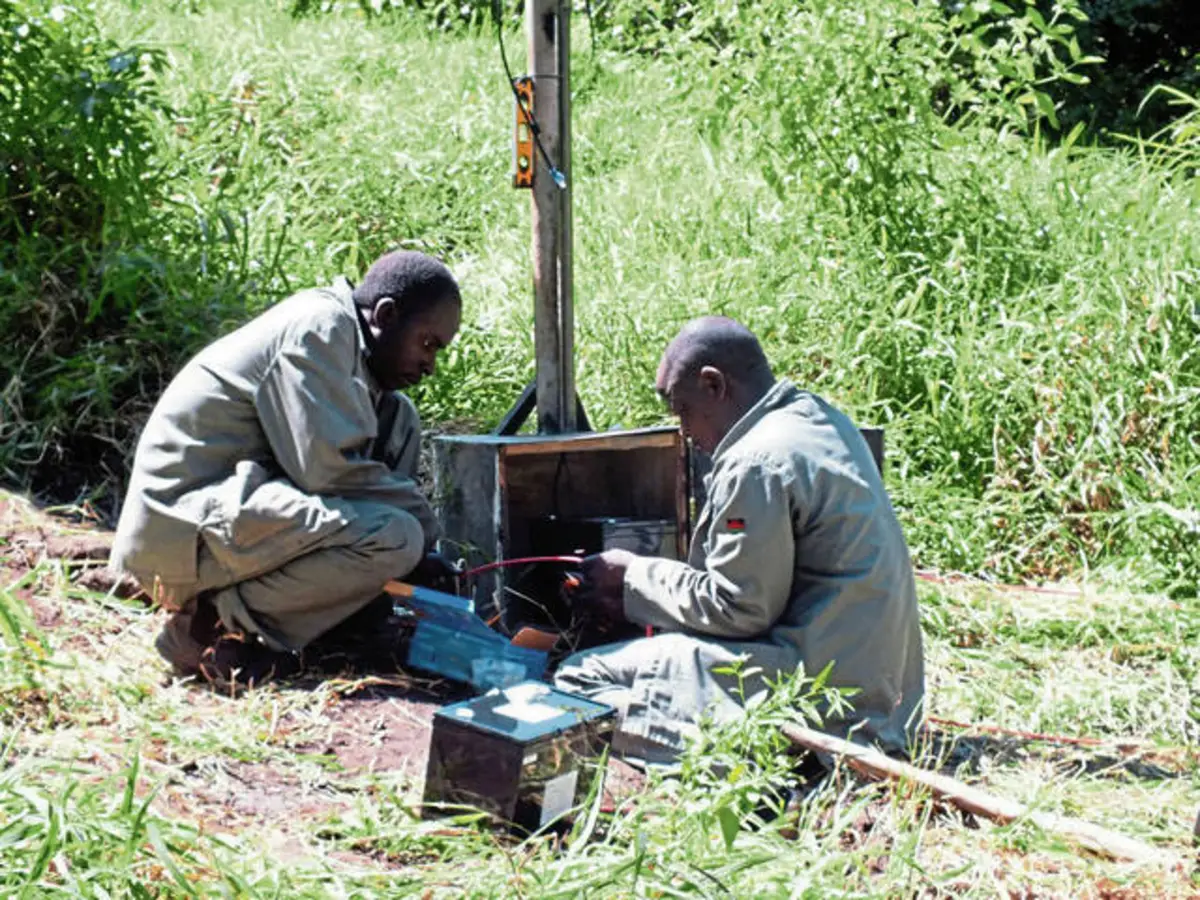
From tracking bald eagles in Southwestern Pennsylvania to deterring poachers in southeastern Africa, technology developed by a Murrysville business is expanding its global reach.
Visitors to the PixCams website can now watch a livestream of several watering holes at the Majete Wildlife Reserve in Malawi.
The new international feeds are the latest venture for PixCams founder Bill Powers, whose cameras already monitor bald eagles nesting along the Monongahela River in Pittsburgh’s Hays neighborhood and at the U.S. Steel Mon Valley Works Irvin Plant in West Mifflin.
Every day, more than 50 of the company’s cameras stream wildlife from across the region.
“Last year, I developed a system that works on the Starlink satellite system, and we developed an encoder that can take a standard security camera, convert it into something we can send out to YouTube, then ship it out through Starlink,” Powers said.
Powers initially built a couple of cameras that were shipped to Colombia, where they were installed in the jungle to capture video of birds. A scientist who had traveled with Powers to Africa on several occasions suggested using the cameras there next.
“He was in contact with the Majete Wildlife Reserve, and he’d talked with them about finding a donor to help us install five camera systems that would help bring some publicity and exposure to Majete, which is really a special place in Africa,” Powers said.
Powers said he was surprised to find there’s been substantial deforestation in Malawi over the past dozen years.
“You have just these few spots left, like the reserve, that are fenced in and electrified, with rangers that walk the park and try to preserve the nature that’s left,” Powers said. “The cameras also have an anti-poacher effect as well. We were fortunate to capture some amazing video of a lion whose rear paw was missing from being caught in a poacher’s snare, and they discovered there are other lions within the pride that are helping to keep it alive.”
To best capture wildlife — and deter poachers — Powers and park rangers worked to set up cameras near water sources.
“The reserve has a number of watering holes, where they’ve set up pumps that run all year long because Majete and a lot of Africa goes through a very dry spell that’s actually coming up pretty soon,” Powers said. “Everything needs to drink at some point, so with those cameras we end up getting all your predator species, elephants, small birds — it’s a really great place to watch wildlife.”
The cameras are small enough to be installed in inconspicuous locations where a poacher would not necessarily look.
“In addition, the camera’s angle is pretty wide, so you walk into view and get caught on camera before you would see it,” Powers said.
The audio from the livestreaming cameras is shared with BirdNET, an artificial intelligence algorithm that can isolate and identify birds based on their calls. Powers also developed his own AI tool to create Majete Watch, which snaps a photo and sends a notification to users when an animal crosses in front of the camera, allowing them to watch it live.
“The AI is also good at recognizing people and vehicles, so we can notify the park rangers when it captures something like that,” Powers said. “It’s really a whole wildlife survey system.”
Majete Wildlife Reserve is part of the African Parks network, a nonprofit conservation group with more than 6,000 employees working across the continent.
“Malawi has really been one of their success stories,” Powers said. “This was an area that was largely depleted of wildlife about 25 years ago, and since then it’s become one of their premier parks. It’s the only park in Malawi that has what they call the Big Five — lions, leopards, rhinos, elephants and buffalo.”
Through the technology PixCams has deployed, anyone with internet access can take a virtual safari from home, while park staff gains an invaluable resource to track and deter poachers.
To watch a livestream from the Majete Wildlife Reserve, see Pixcams.com/majete-wildlife-reserve.