
John Frasca’s eighth-grade history students listen intently when he teaches about the Sept. 11, 2001, terrorist attacks.
“Kids are curious. Every year, I share my 9/11 story and kids always ask questions,” said Frasca, a teacher at Marshall Middle School in the North Allegheny School District. “There’s an inherent curiosity because they know something big happened, but they don’t know the human side.”
Now, they will.
Frasca was one of 40 teachers statewide who took part in the Flight 93 National Memorial Educator Symposium, held Monday through Wednesday at the memorial in Somerset County.
It’s intended to help educators present the story of the Sept. 11 attacks to children, and it’s coordinated by the Friends of Flight 93 National Memorial, the National Park Service and the University of Pittsburgh.
Forty teachers were selected statewide to participate in the conference. The number is symbolic to honor the lives of the 40 passengers and crew members who died on the flight.
“This went beyond history,” said Jennifer Wachs, a media specialist for middle school students in the South Allegheny School District. “What I really learned and gleaned from the experience is the power of being together and the power of ordinary people. The passengers and crew were all somebody on Sept. 10; character didn’t just develop on Sept. 11.
“Each of those people are more than names in a history book.”
Some family members of Flight 93 victims were able to share their stories with the teachers. They emphasized how the 40 passengers and crew members united in their act of heroism.
“They were gracious, answered questions and helped us understand who the passengers were as people,” Frasca said.
Teachers also got closer looks at artifacts recovered from the crash site — including flight attendant Lorraine Bay’s earrings and a debit card from a hijacker that assisted the FBI in identifying the terrorists.
Those experiences will shape this fall’s teachings of Sept. 11 — the 25th observance of the attacks.
“I can still give that coverage of what’s happening, but ‘Let’s get to know a hero,’ ” Frasca said. “My approach to teaching will have kids learn about the people of Flight 93 and why their stories matter.”
‘We want our students to know this history’
Although today’s students weren’t alive in 2001, they remain interested in learning about the day.
Emily Frasca, John’s wife, is a history teacher at North Allegheny Senior High School and helps chaperone an annual trip to the Flight 93 Memorial.
Last year, more than 200 students attended.
“We want our students to know this history,” Emily Frasca said. “We spend time talking to them about local and state history with 9/11 and the impact Flight 93 had.”
North Allegheny’s 11th grade history curriculum includes a 2000s unit. Emily Frasca walks students through the people, timeline and investigation of the attacks, as well as the impact it had locally.
How the attacks can be best taught varies by grade level and age appropriateness. High school students might better handle information like Flight 93 audio recordings and call logs than younger students would.
At the middle school level, John Frasca talks about the democracy behind the Flight 93 passengers’ decision — they gathered information, discussed and voted before charging the cockpit.
Kindergarten teachers can teach students about characteristics of bravery, courage and heroism, and connect those qualities to the Flight 93 passengers.
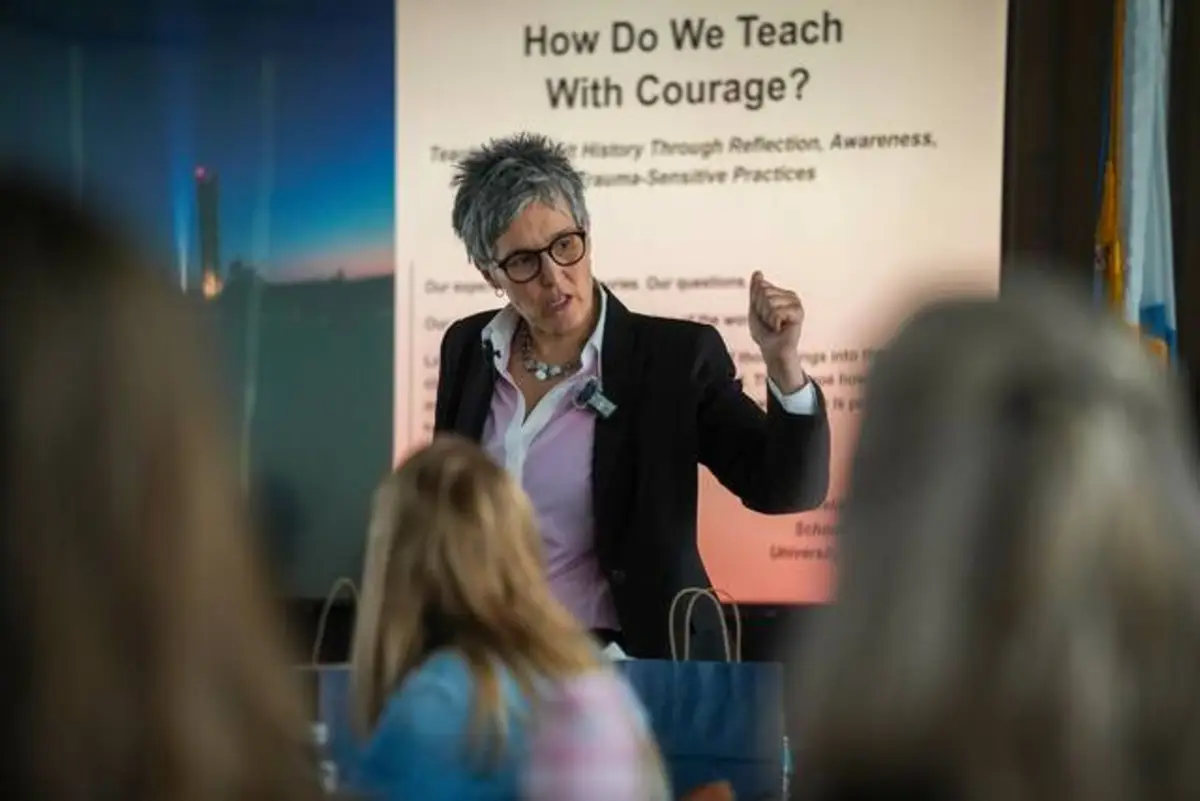
“It’s not just facts, but engaging them in a way that helps bring students into places they can be safe in their curiosity,” said Melissa Nelson, an education professor at Pitt.
‘Curiosity is how students learn’
Middle school students “know the nuts and bolts” of Sept. 11, said South Allegheny’s Wachs, but some things like Flight 93 are lesser known. She tries to make her classroom a place where students feel comfortable being curious, asking questions and learning more.
“For a lot of students, they are curious and they’ve heard things that are false about 9/11,” Wachs said. “I’m honest with them, and I give them what they want and meet them where they are.”
Students can benefit when teachers lean in to their personal and lived experiences teaching 9/11, Nelson said.
“Children come to the classroom understanding the events of 9/11 and Flight 93 through the lens they have — either oral history, what they read in textbooks or on social media, for better or for worse,” Nelson said. “The one thing all children have in common is that none of them have a lived experience.”
Frasca’s students pay close attention when he shares his experience on 9/11. His family had visited New York City and walked around the South Tower that July.
On Sept. 11, Frasca remembered being picked up early from school and in disbelief over the news.
“We’re the last group of people with vivid memories of it,” said Frasca, who was 8 at the time. “There’s some teachers hired this year that very well could not have been born.”
It’s important for those young teachers to think about where and what they’ve learned about the attacks, Nelson said.
“It’s nearly imperative that we allow ourselves as educators to be vulnerable about our personal experiences in this space,” she said. “Children look to us to navigate difficult topics.”