
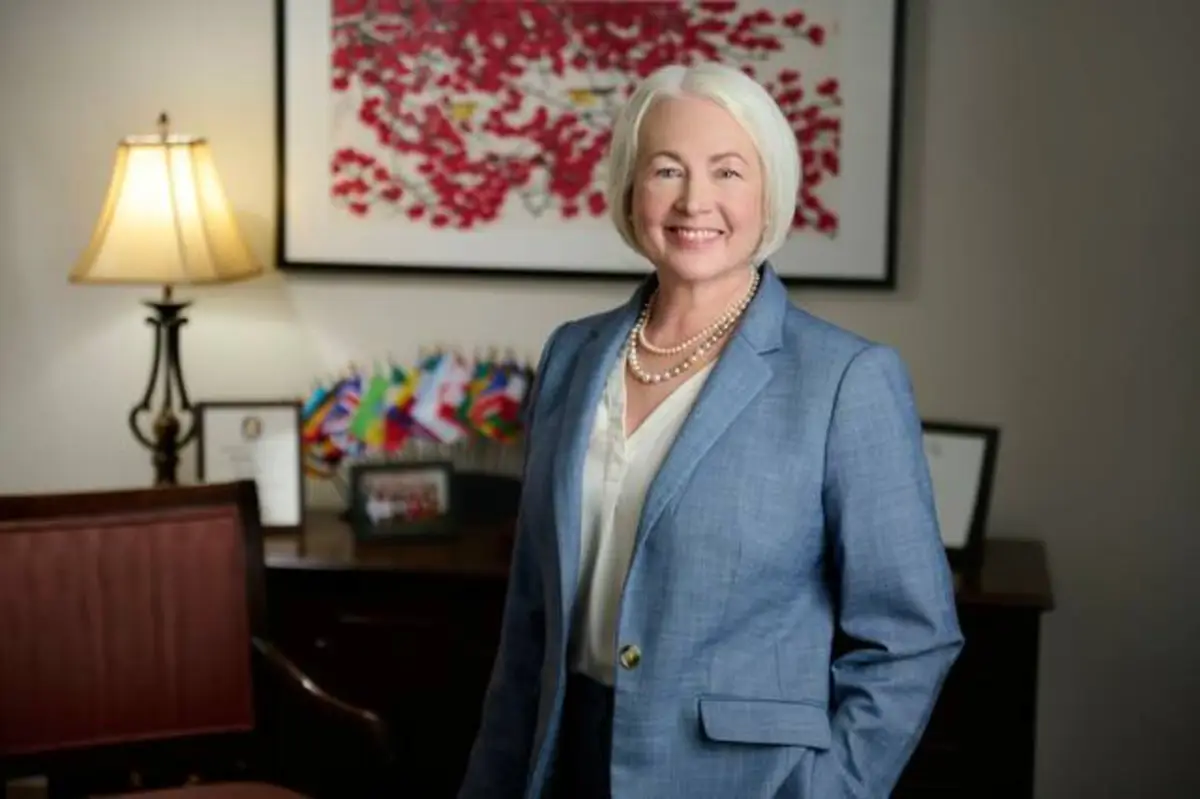
La Roche University President Christina A. Clark believes an appointment to the state’s independent colleges board can bring issues facing private higher education institutions in Western Pennsylvania to the forefront.
Clark was elected to the Board of Directors of the Association of Independent Colleges and Universities of Pennsylvania. Her term began Wednesday.
“It’s important for our leaders and community to know the contribution we make to the economy as well as empowering students with the power of a transformative education,” said Clark, president since 2024 of La Roche, a Catholic school in McCandless.
The association represents more than 80 independent nonprofit colleges and universities across the state. It aims to advocate for policies that improve students’ access to college, affordability and educational opportunities.
Clark was one of nine higher education leaders elected to the board, and the only one from Southwestern Pennsylvania.
The association reports its colleges contribute $29 billion annually to the state. Independent colleges represent 53% of all four-year degree-seeking students in Pennsylvania, and 46% of all Pell Grant recipients seeking four-year degrees.
“We really perform an important function in the state, and we work collaboratively with public schools,” Clark said. “We don’t see ourselves as competition, but we’re an important part of the higher education landscape in Pittsburgh and Pennsylvania.”
Pennsylvania ranks fourth statewide in the number of higher education institutions. Its universities aren’t immune to the challenges facing the sector nationwide.
“The challenges to higher education are pretty national for synchronized compression hitting all of us,” Clark said. “The demographic shifts will impact the state differently, and Pennsylvania is pretty hard hit with the decrease of high school graduates.”
Pennsylvania is projected to see more than a 17%, or 24,000-student, decline, in high school graduates from 2023 to 2041, reports the Western Interstate Commission for Higher Education.
Clark is also concerned with what she called a “federal disinvestment in higher education.” She referred to the Grad PLUS loan programs being eliminated for new borrowers, and new federal borrowing caps for graduate and professional students, both effective July 1.
That’s coupled with Pennsylvania being one of the least affordable states to pursue higher education and its students carrying an increasing debt load.
“We try, like many institutions, to keep our tuition as low as possible,” Clark said. “It’s more difficult now with economic pressures outside of our control.”
Top of Clark’s mind is ensuring students have equitable access to a college education, given increasing costs, inflation and outside factors impacting college revenues. She also is concerned about a rising rate of “non-consumers” of higher education or workforce training beyond high school. Non-consumers are defined as students who could attend college but choose not to. They’ve caused a 6.5% drop in the national-college going rate since 2012, reports EAB, an education consulting firm.
“That percentage is rapidly rising, and that’s a huge problem not just for colleges and universities but society at large,” Clark said.
Clark is La Roche’s second lay president since the Catholic college’s founding in 1963. A scholar of classical literature, she has made her career in higher education at Catholic institutions. She came to La Roche two years ago from Marywood University in Scranton, where she was provost. Previously, she was an administrator at Marymount University (Arlington, Va.) and at Creighton University (Omaha, Neb.).