
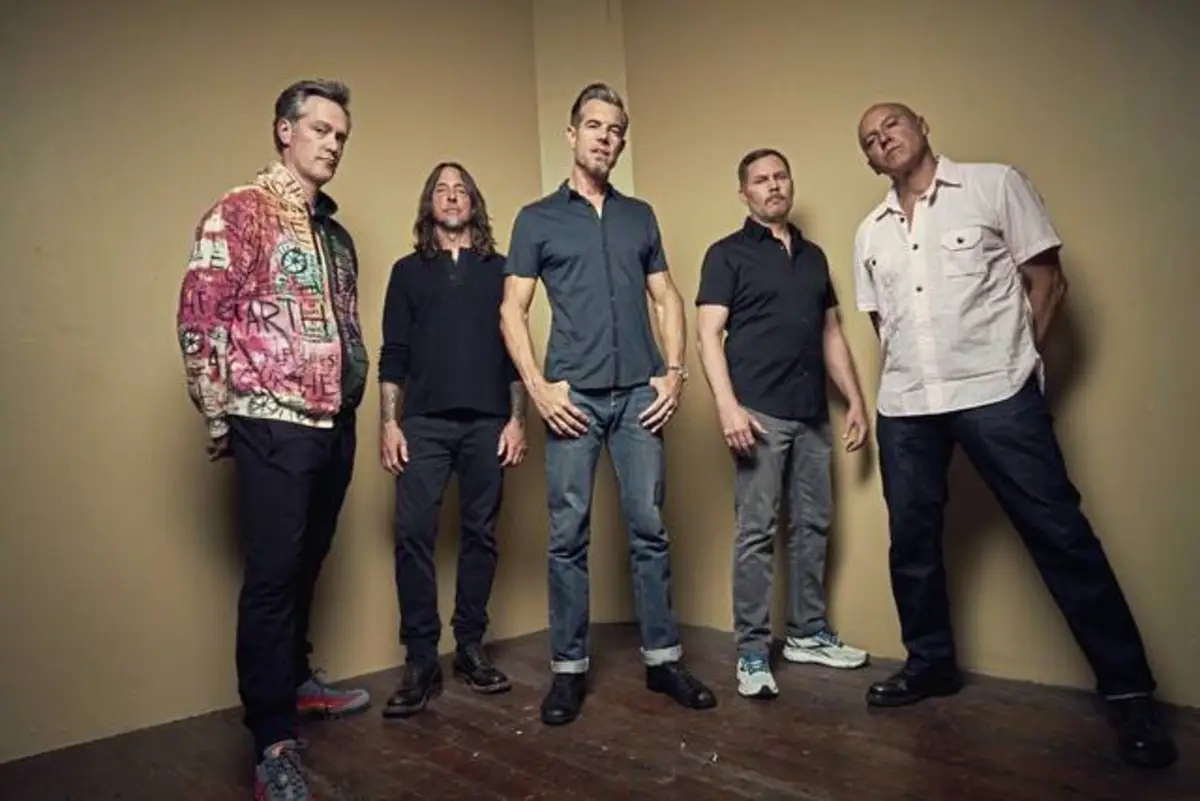
The So Glad You Made It summer tour, featuring co-headliners 311 and Dirty Heads, couldn’t come at a more-appreciated time for 311 vocalist/guitarist Nick Hexum.
“It’s just our favorite time of year,” Hexum said, “when it’s July and the sun is setting and 311 is getting ready to rock a show, as commemorated in our song ‘Sunset in July.’”
The veteran alt rockers, blending rap, rock, funk and more, formed in 1988 in Omaha, Nebraska, and last year celebrated the 30th anniversary of their biggest album, 1995’s self-titled record (aka their blue album.) They’ve been radio staples ever since, with No. 1 hits (on the modern rock charts) like “Down” and their cover of the Cure’s “Lovesong.”
Playing under that sunset in July might be in the cards when the tour stops on July 25 at Stage AE on Pittsburgh’s North Shore. Besides Dirty Heads, the tour also includes Australian psychedelic rockers Ocean Alley and Rome, the former singer of Sublime with Rome.
“Killer shows there, great crowds, somewhat like Omaha, because it’s not the jadedness that you get in the biggest cities,” Hexum said. “So Pittsburgh crowds go off, and they have a great, perfect-sized amphitheater for us so just really looking forward to that show.”
In a recent call from his studio near Malibu, California, Hexum spoke with TribLive about the setlist, unity, the secret to a long-lasting band and more. Find a transcript of the conversation, edited for clarity and length, below.
There are certain songs that you have to play, but how do you balance the newer songs and the deeper cuts? How do you fit those in?
We make a fresh setlist every night or right after soundcheck. We have soundcheck and then we have a band meeting because the setlist is so important so we all make it together. We take turns being the scribe because I used to do all the writing and I was like, OK, it’s time that we pass it around. So we rotate who’s going to write the setlist. We kind of have a vibe of each city of whether it’s going to be more hardcore fans and we drop in more deeper cuts or is it a festival show? But this summer, we’ll be co-headlining so it’ll be more of our show. Then we like to keep track of stats where we’ll look at, OK, last time we played Pittsburgh, we dropped in these rarities, so let’s put some different ones in. We also keep track of stats to make sure that over the course of the summer, we played a lot of different songs. We’ll blast through a hundred different songs that we’ll have played by the end of the tour.
That keeps everybody in the band on their toes then, if you have to do all those songs.
Yeah, you got to review songs because the older albums, they’re just always there at the drop of a hat, but the newer songs haven’t had as much time in our neurotransmitters to really get deeply set in. So, you do have to, OK, let me get out of the guitar, let me make sure I’m ready.
So you couldn’t see yourself going on tour and playing the same 20 songs every night for two months like some bands do?
No, that wouldn’t work for us, and our fan base would be a little bummed. But at the same time, when I go to see Paul McCartney, I really want to see classics, but he’ll also sprinkle in some of his newer solo work, which I really enjoy, too. So we’re going to play “Amber” every night. We’re going to play “Down” every night. But then there’s plenty of room for rotations.
You’re going on tour with Dirty Heads and you’ve toured with them in the past. How do you sum up that whole experience of that summer together with you two bands?
We’ve done it before. We’ve been friends with them for a long time, and it’s just a cool summer camp vibe, a lot of hanging out, Southern California vibes. I did a collaborative song with them called “So Glad You Made It” a few albums ago for them, and that’s the name of the tour that we took from the collab song so that’s pretty cool.
What are you hoping that people take away from the tour? How do you want them feeling whenever the show’s over?
Synchronized movement is something that humans have done to bond for at least 50,000 years. Tribal dance, there’s a connection and the oxytocin that you get from when you are moving your body to music along with other people. You also can get it in boot camp when you’re marching. It’s not just to get your stamina up, it’s to connect. And you get a feeling of a high from synchronous movement. Music and tribal dance is just such a great way to bond. So I know we’re doing a good job when people feel that high. And then you also, besides just moving your body, the message of love and unity and inclusion and tolerance is very important, values that we’ve based our band on. I would like to hope they walk away feeling spent in a good way, sweaty, and then also just that the high you get from bonding.
There’s definitely a lot of division in this country, so it’s nice to see some unity.
Yeah. It’s a very important calling for us to be something that takes all comers. It’s important as a human to not go around looking for the differences. We can look for the similarities and that’s what unity is about. And yes, it has been a very divided time, and we’d like to be somewhat of an antidote for that.
The 30th anniversary edition of the self-titled album came out last year so what was it like revisiting that album? Did it unlock any memories going through all those old tracks?
Yeah, I got to give a shoutout to our drummer Chad (Sexton). He’s kind of the resident archivist, so he spends a lot of time keeping all the files together and going through it and overseeing the remastering and the bonus tracks. But listening to it all together just really reminds we have a time when we found our groove in a way that we hadn’t before because this is when we had blasted through our 10,000 hours as a band, between the years of living on the road that we did during “Music” and “Grassroots.” We just toured constantly at one point. We didn’t even have a home. We just literally lived on the road and would do 20 shows in a row without a day off. So we were road warriors. We were road-hardened. And then the blue album (1995’s self-titled album) is the product of that hard work of learning what kicks ass live, of having our chops get at a higher level and we just went in there and ripped those songs as a band. Because on “Music” and “Grassroots,” we hadn’t really captured our live energy. So that was our focus on the blue album – to have killer live songs and capture that live energy by playing them all together and just ripping them. I’d go back and overdub the vocals so I could take a little bit more time with it, but it really was the culmination of years of growth. That energy that was captured really helped us break through to a much bigger audience in ‘95, ‘96.
That album went triple platinum – do you have that displayed somewhere in the house?
I have a bathroom completely full of platinum discs. (laughs) I don’t have them here in my studio because honestly reflective surfaces aren’t as good for acoustics. I like to have windows, but everything opposite the window needs to be soft and absorbent. Otherwise you have frequencies that resonate too much.
The band’s been together for more than 35 years, so what would you say is the secret to that longevity? It’s basically been almost the same guys.
Same guys. At very early days, SA (Doug Martinez), we’d call him up as a guest vocalist. But then in ‘92, we moved to L.A. together and he became an official member. We’re one of the longest-running original lineup bands that there are today. The way you can keep a band together is A., don’t break up, you know what I mean? It’s just like, that’s off the table. We know we have something really special. We keep an attitude of gratitude that we know we’re super lucky to do this. Sometimes ego struggles can get in and ruin a band. But if you realize that we have a very special lineup and that everybody contributes and we keep it democratic and individuals need to be ready to speak their truth, but then also be willing to not get their way because sometimes you’re going to get outvoted and you just have to keep what’s best for the collective in mind. That’s a group conscience where we decide things. And honestly, it doesn’t usually come to a vote. We just talk things out. It’s very rare that things are so split that we’d actually need to put it to a vote. We learn to be flexible and just talk things out.
I don’t know if Wikipedia is to be believed, but it said the band’s first show as 311 was opening for Fugazi. Is that right?
It’s true. That was just such a random occurrence because we love Fugazi so much. They were such a grassroots organization that they would just call some local punk rocker in a city and say, hey, we need four or five local bands to open our show, which is super cool because they didn’t need help selling tickets, but they wanted to support the local scene. Somehow P-Nut (Aaron Wills), our bass player, got the call and I was in Germany at the time, just kind of exploring. Chad told me about the opportunity and that he had been playing with this new young, whiz kid bass player. I was like, I want to sing for that band and he was like, come on. I went back to Omaha and we linked up and did some rehearsals. It was such a great way to have a first show because that crowd was ready to rock out and mosh. We got the entire crowd jumping in unison. It was just such a great launching pad for us.
Related
• Blues musician Ruthie Foster on saying yes, Grammy win and more ahead of free Pittsburgh show
• Q&A: Mike Campbell on the Dirty Knobs’ ‘soul healing’ shows and more
• 2026 Pittsburgh area concert calendar
Speaking of a launching pad, you recently played at the Moon 2 Mars Festival. There’s a space shuttle in the background, right?
Yes, that was dope. I really always have had such a fascination with aeronautics in general. So to get a private tour of the inner workings where they are training for the International Space Center and they have three different lunar modules that they’re trying to decide — one’s Blue Origin — and to just to be get a private tour and ask so many questions really connected with the love that I had when I was in fourth grade and we went to the Smithsonian Air and Space Museum and you could see like the the Wright Brothers’ plane and touch some lunar rock and all this stuff. I love that stuff, and I’m hoping that space travel will be available in my lifetime so I can go up and feel weightlessness and maybe go to the moon. Maybe make an album on the moon.
Is that one of the most unusual places that you’ve played, with a space shuttle in the background, in the band’s career?
It’s up there on the list of really cool and special settings. It was really nice that they have concerts there. We love playing on the beach, but mostly just being in a nice sounding amphitheater, like the one in Pittsburgh, where the acoustics are good and when the weather is cooperating, a warm summer night, that’s just our favorite.