
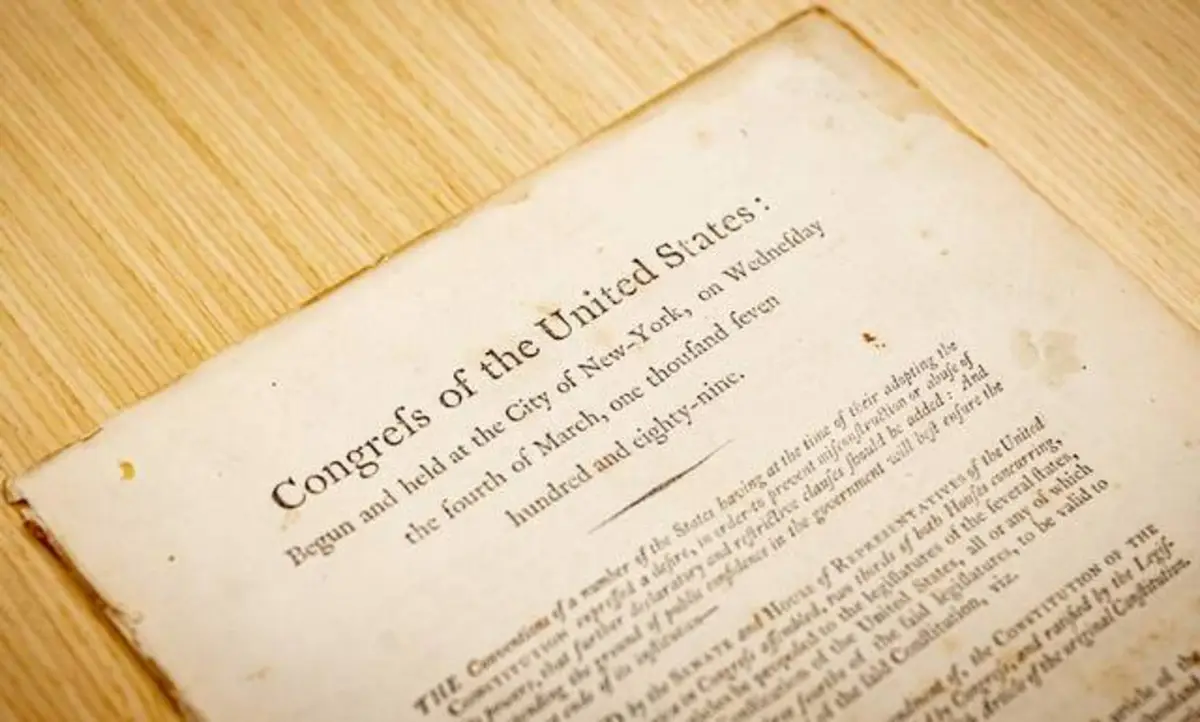
A printing of one of America’s oldest, most influential and rarest documents is held at Carnegie Mellon University.
At the Posner Memorial Collection, CMU is displaying its rare 1792 printing of the U.S. Bill of Rights — one of only five known copies — this year as the country marks its 250th birthday.
“This is a foundational text of U.S. history, and it’s still ink on paper,” said Sam Lemley, director of the Posner Center for Special Collections and curator of special collections. “It’s a huge privilege to be the caretaker for this.”
The Bill of Rights was printed in Philadelphia by Francis Childs and John Swain immediately after ratification in December 1791. The first, “official” printing is undated, but believed to be around January or February 1792, Lemley said.
The 13-by-8 inch 12-page document is perhaps the rarest item in CMU’s Special Collections.
The other complete copies are at the Maryland State Archives, the Library of Congress and the American Antiquarian Society near Boston. CMU’s is one of two privately held copies; the other sold at auction in December 2002.
A sixth copy, surviving only as a single-sheet fragment, reappeared at an auction in 2024.
The CMU copy landed in Pittsburgh through Henry Posner Sr., the late Pittsburgh entrepreneur and collector for whom the Posner Memorial Collection is named.

Posner acquired the document in 1963 from antiquarian bookseller H. P. Kraus. It was later deposited with CMU Libraries in 1978 in Posner’s memory.
The Posner Memorial Collection includes 1,000-odd volumes of important works in the history of science, including first editions by Isaac Newton, Galileo, Marie Curie, Charles Darwin and Albert Einstein.
The entire collection is held in a vault at the Posner Center, Lemley said. The Bill of Rights copy is fragile, and the vault is kept at an environmentally controlled, 64-degree temperature with 45% relative humidity.
“That’s the range paper and books are happiest,” Lemley said.
Observers will note the first two amendments listed on the printed copy aren’t actually the first two amendments, because they were unable to be ratified by the states at that time.
Rather, the ratified articles — articles 3-12 — constitute the first 10 amendments of the Constitution.
Instead of the first amendment guaranteeing freedom of religion, speech, press and assembly, and the right to petition, the listed copy’s first amendment deals with congressional apportionment and representation.
The second printed amendment — rather than the right to bear arms — prohibits law that changes Congress members’ salaries from taking effect until the next election. That article was later ratified in 1992 as the 27th amendment.
The first leaf of CMU’s copy outlines the amendments. The following pages document the state’s responses.
“You have a record of the debate around the Bill of Rights, along with the text,” Lemley said.

There are also slight printing differences among the remaining copies.
The version held at the Maryland State Archive is on bigger paper. Lemley believes the bigger copy represents the one Thomas Jefferson sent to governors of the 13 states at the time. The smaller copies could have been distributed to congressmen or people interested in buying them.
Two damaged letters in the document — a fractured B in the attestation of John Beckley, clerk of the Senate, and a fractured O for Sam A. Otis, secretary of the Senate — also signaled that the larger copy now in Maryland was printed before the smaller copies, Lemley said.
People can view the display by appointment this summer. Open public hours for the Posner Center, 4964 Margaret Morrison St., resume during CMU’s fall term. The exhibit runs until December.
CMU also plans to showcase the document for events around Constitution Day, Sept. 17.
“Having this allows us to do things like that, and tell the story of American history in an embodied and exciting way,” Lemley said.