
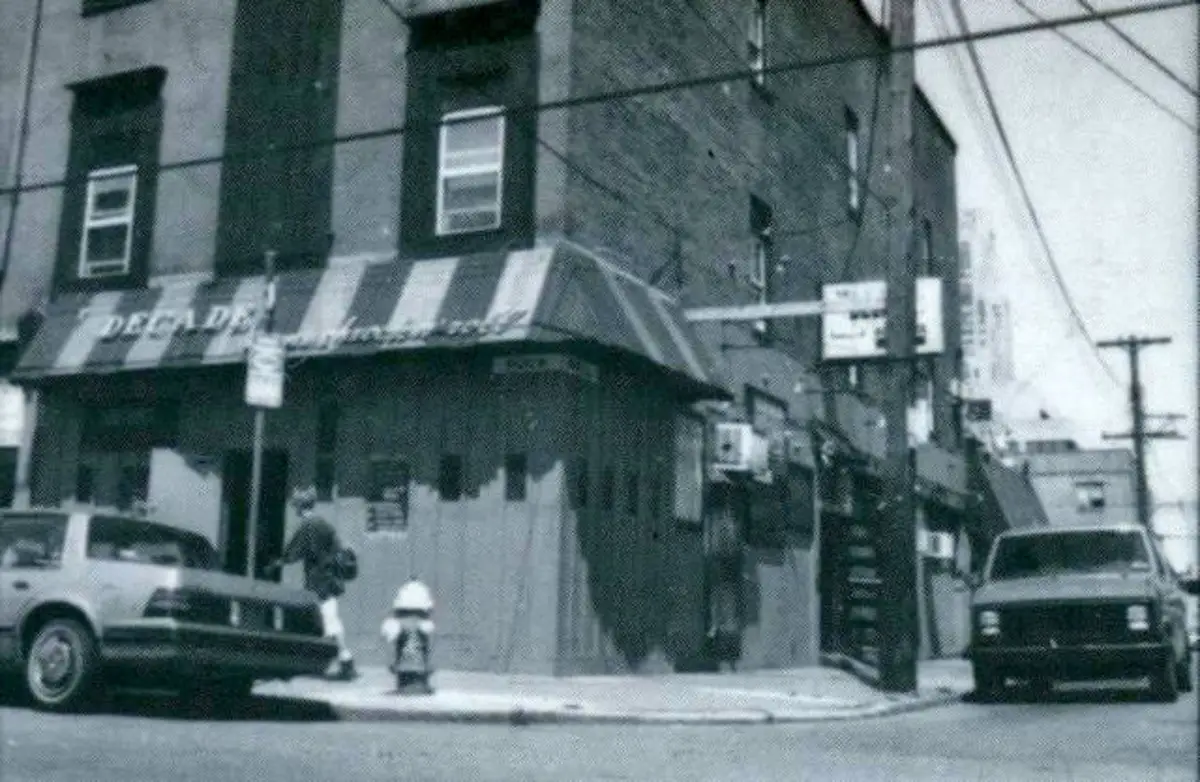
Editor’s note: This is the first in an occasional series about bygone music venues in Pittsburgh.
If you stood at the corner of Atwood and Sennott streets in Oakland today, looking at the building that stands at 223 Atwood St., you’d never know that it was once the center of Pittsburgh’s musical universe.
The Decade may have closed in 1995, but the bar, restaurant and music venue was so well-loved and mythically remembered that patrons far and wide still talk about it in reverent tones.
That’s especially true now, after the passing of its founder, Dom DiSilvio, earlier this year at age 86.
“I think that it is a really important institution. It was something that was so important to my grandfather,” said Gabby Means, DiSilvio’s granddaughter, in an interview.
In 2016, Means and DiSilvio teamed up to write a book enshrining the venue in history: “The Decade” is still available at all major booksellers.
The Oakland hot spot opened in 1973, and was owned by DiSilvio and his wife at the time, Janet Chepes. They modeled it with the music of the 1950s in mind — hence its name — and while it was originally intended as a restaurant, DiSilvio’s mind quickly turned to live music.
Eventually, The Decade was home to live music seven nights a week. And DiSilvio didn’t discriminate; while many of the artists — both local and national — were rock, the venue covered lots of bases.
“He had a good variety of stuff,” said Billy Price, singer of the Keystone Rhythm Band who regularly played on Sunday nights at The Decade for several years. “It became kind of a place where people from out of town could go and sit in, and it just became a scene over there.”
Through the first few years, DiSilvio and Chepes ramped up the number of musicians they took on. It was Chepes who hired the Iron City Houserockers in 1977, and they were ready to play seriously in their new home.
“There were a lot of places to play, but The Decade, it was just a magic-in-a-bottle type thing,” said Joe Grushecky, frontman of the Houserockers.
The band would often work out songs on Tuesday or Wednesday and then play at the club on Thursdays. On their days off, they hung out there. Grushecky said that it’s the last bar where he was a regular.
Bill Pascale served as bar manager for The Decade for about 15 years until its closure.
“I was about 21, 22 years old and the manager of the best rock and roll bar in the city,” he said.
It took until California promoter Danny Kresky approached the owners about booking national acts for them to look beyond the region, and even then, DiSilvio was hesitant. But after watching Kresky build his business in the region, DiSilvio agreed. Soon, now-legends The Ramones were playing back-to-back nights at The Decade in March 1979, and the whole scene opened up.
Huge stars and well-known artists, including The Police, the Red Hot Chili Peppers, 10,000 Maniacs, They Might Be Giants, Bon Jovi, Cyndi Lauper, the Pretenders, Stevie Ray Vaughan and so many more, performed there. It was also a proving ground for Pittsburgh scene staples, including The Clarks, Room to Move, The Silencers and — most notably, the Iron City Houserockers.
Price recalled one particularly memorable night.
“Around that time, I was working with a great soul singer named Otis Clay. Sometimes we would perform. He would sing with my band and sometimes I’d sing with his band. … They were playing The Decade and I was on the show; I sang with him. At that time, Danny DeVito and Jack Nicholson were in town filming the movie ‘Hoffa.’ I guess they were looking around for something to do and they saw that listed and they came over.”
Price got to meet the two legendary actors, and he even said that they were “pretty excited to see the show.”
Pascale also remembers that night fondly.
“I got to stand in the back room and talk to Jack Nicholson for about 10 minutes,” he said.
Grushecky recalls the infamous night that he brought friend and longtime musical collaborator Bruce Springsteen to the tiny club.
“He was on the ‘Born in the USA’ tour,” Grushecky said. “His fame was just exploding at that point.”
They were drinking together at a hotel when the topic of hot dogs came up, so Grushecky naturally decided to take Bruce to The O in Oakland — parking in the lot behind The Decade to walk over.
On their way back from their culinary adventure, “He said, ‘Oh, let’s stop in the bar.’”
Local band Bon Ton Roulet was playing The Decade that night, including the Houserockers’ keyboardist Gil Snyder, so Grushecky and Springsteen hopped on the club’s tiny stage to play a few songs.
Pascale recalls getting Cyndi Lauper in the club just before her big break in late 1983; she would come back to town on her next tour and fill the Civic Arena.
“It was such a unique experience. She was really cool. She hung out with Dom’s daughters and talked to them, you know, just like teenage girls.”
For musicians, it wasn’t just a place to play, it was a home away from home — and DiSilvio felt the same way about them.
“My grandpa had a large family, but he also considered the bands and the people who played at The Decade and the people who visited and frequented The Decade; they were part of his extended family, too,” Means said.
Local band The Imprints also played gigs there, starting in August 1980. The “new wave” band would go on to create their own material, but initially they played covers by The Pretenders, The Cars and other giants of the scene.
“I remember the stage and the main room was fairly small compared to some other venues we played,” said Bob Russ, the band’s drummer. “It felt packed with maybe 50-100 people.”
“It was a dark, smelly bar,” said Valerie Barnes, their bass guitarist. “You walked by the bar and into a middle room that was long and narrow.”
“We didn’t get a large enough crowd to beat the Pretenders and have the fire department stop by, but we did fill the club with close to 200 friends, family members and strangers who saw our DIY advertising,” said Bill Poznanski, who provided keyboards, guitar and vocals.
DiSilvio had eight children with two wives, many of whom grew up and eventually worked at the venue.
“It was our home,” Grushecky said. “It meant so much to us, musically and socially.”
Means was born the same year that The Decade closed, in 1995; she said that there is one photograph of her as a baby at The Decade before its closure. Naturally, the Iron City Houserockers were the final act to stand on the too-small stage.
DiSilvio reportedly said that he “wouldn’t have had anyone else do it.”
“I probably went home and cried,” Grushecky said. “It was like friends on steroids and full of rock ‘n’ roll, you know? Everybody knew everybody. It was home when you walked in The Decade.”
DiSilvio and Chepes didn’t decide to close the bar because of anything but their own changing times, according to Means’ book. Their kids had grown up and had no interest in taking over the business, so they decided that it had run its course.
Over the past 31 years, the building has been many things since its time as a rock venue, most recently the Garage Door Saloon. The bar closed down in 2021 after the building was partially condemned and closed permanently in 2025. Neal Scoratow, president of National Builders and the owner of the property, said that the condemnation notice was lifted in 2024 and that the building is for sale. According to the property listing, the sales price is undisclosed.
But The Decade lives on, in so many photographs, documents and memories.
“Just the other day, my dad and my mom and my siblings and I were in Alexandria, Va., and — I kid you not — a man was walking towards us in a The Decade T-shirt.”
With both The Decade and DiSilvio now gone, this is a difficult time for Means and her family, but she takes great comfort in knowing that Dom’s legacy continues.
“He’ll live on in all of us for that reason,” she said.