
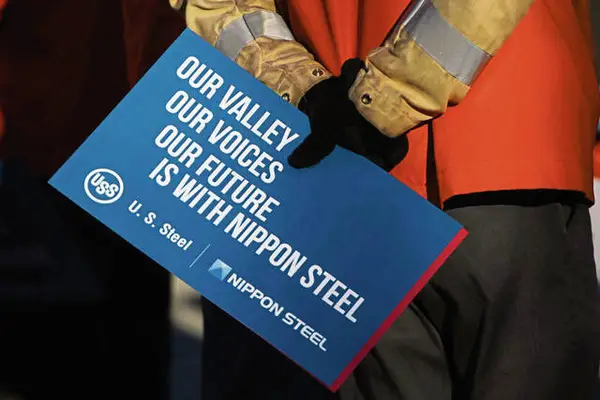
With its future murky at best, U.S. Steel’s stock plunged 6% by early Friday afternoon after President Joe Biden officially blocked the Pittsburgh-based steelmaker’s proposed sale to Japan’s Nippon Steel.
The stock kept falling and was at $30.60 at 1:30 p.m.
Observers were hesitant to predict what might happen as both companies decried Biden’s decision.
“I don’t think there is any way of knowing right now what the future holds for legacy steel production in the Mon Valley,” said Chris Briem, a regional economist with the University of Pittsburgh’s Center for Social and Urban Research. “The steel plants in the Mon Valley are among the oldest such facilities in the nation, and their future is dependent on new investment to keep them operating. What firms are willing to make that investment is a large unknown.”
To Allegheny Conference CEO Stefani Pashman, the Biden administration is wrong in opposing the deal, which leaves an uncertain future for steelmaking in Southwestern Pennsylvania.
There was a viable and highly beneficial deal on the table and the Biden administration rejected it, Pashman said.
“Nippon made specific commitments that should have been embraced — maintaining a regional headquarters, investing in upgrading facilities and growing jobs in the Mon Valley,” said the head of the regional economic development organization.
Nippon Steel had promised to make an investment of about $2.7 billion in U.S. Steel, without which the Pittsburgh-based steelmaker said it may have to close some of its mills.
Earlier in the week, Pashman pointed out in a statement that they were hard pressed to understand how elected officials in Washington, D.C., could abandon this region and threaten the deal when they aren’t going to modernize the steel factories or replace the lost jobs. The region’s steel industry has shed some 75,000 job in the past 45 years — from about 90,000 to just 16,000, Pashman stated.
“Simply put, we are concerned there is no Plan B that proposes similar or greater value to our region,” Pashman said.
Related:
• U.S. Steel, Nippon say Biden's decision to block sale was 'political'
• What they're saying about it: U.S. Steel-Nippon deal blocked
• Read Biden's statement about decision to block sale of U.S. Steel
• Read Nippon Steel's statement about Biden's decision to block sale of U.S. Steel
Even with the new investment that Nippon Steel had promised if it merged with U.S. Steel, there is no real prospect that the region can expect to expand steel production or jobs, Briem said.
U.S. Steel opted to invest $412 million four years ago in a new electric arc furnace at its Fairfield, Ala., plant, shifting its focus to newer technologies for steel production, Briem said. The electric arc furnace produces steel using scrap metal, thus avoiding the need to burn coal into coke for carbon-based steel production.
With the government blocking Nippon Steel’s bid, Briem is not optimistic another buyer will step up and purchase U.S. Steel’s operations.
“It is possible the assets get broken up and sold off to different firms. If that is the case, what happens to the plants of the Mon Valley is the most uncertain,” Briem said.
U.S. Steel in August 2023 had rejected an unsolicited bid valued at $7.3 billion from Cleveland-Cliffs Inc., a Cleveland-based steelmaker whose operations include plants at Steelton and Butler, as well as the coke-producing plant in Monessen, formerly owned by Wheeling-Pittsburgh Steel Corp. Nippon countered with a bid valued at $14 billion in late 2023.
After the company’s bid was rejected and before the Biden decision, Cleveland-Cliffs CEO CEO Lourenco Goncalves had said his company still was interested in acquiring U.S. Steel and keeping it under domestic control.
Patricia Persico, a Cleveland-Cliffs spokeswoman, could not be reached for comment Friday about whether Cleveland-Cliffs will revive its offer to buy U.S. Steel.