
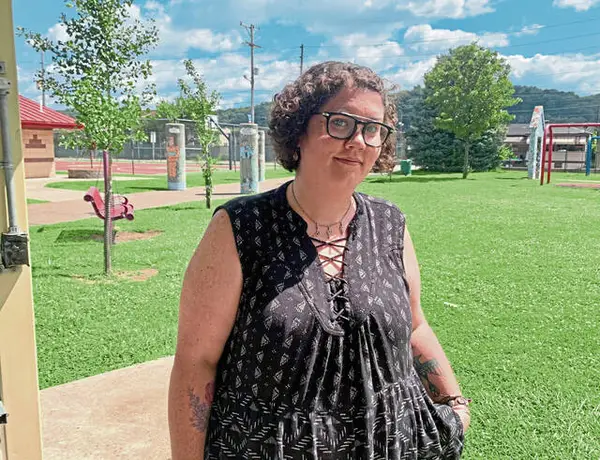
Brackenridge was without a mayoral candidate on the primary ballot, but that doesn’t mean the current mayor wouldn’t like to keep her job.
Incumbent Lindsay Fraser announced on primary election day that she is running for a second, four-year term.
A registered independent, Fraser was not able to be on the primary ballot. She said in recent weeks she was unsure whether she wanted to remain in politics.
She planned to announce her decision this summer to align with the independent electoral process, but “there was so much concern that it shifted my approach.”
Pennsylvania runs a closed primary system, meaning only candidates and voters registered as Democrat or Republican can participate except in the case of referendum votes.
“I think that, no matter who you vote for, most Americans agree that the two-party system is broken,” Fraser said.
“I’m happy to be an independent so my focus can be on the needs of Brackenridge and not on the narrative of our larger, national parties.”
Fraser may have company on the fall ballot.
According to the Allegheny County Elections Department, borough Democrats had 101 write-in votes for mayor on Tuesday and Republican had 38. A candidate needs 10 to get on the ballot.
County results are expected to be certified in coming weeks, when it will be known whether another candidate will challenge Fraser in November.
Fraser said she was intentionally delaying an announcement on her decision to run for mayor because she is unhappy with the state’s primary process.
“It hinders us from any kind of progress when we get caught up in who is on what team,” Fraser said.
“Most of it is not relevant to the day-to-day governing of a small town like Brackenridge.”
If reelected, Fraser said, she hopes to continue working to better her relationships with council, improve zoning enforcement and recruit new people to become involved in borough activities.
Working with local and state agencies to upgrade public works facilities also would be a priority, she said.
She cited a previous power outage that demanded the diesel generator at the water treatment plant to cycle 11 gallons of fuel per hour.
“There have been several energy-efficiency upgrades in recent years, and during the outage following the April 29 storm, we were able to keep the plant running on three gallons of diesel per hour,” she said.
“I think it’s time to modernize our systems. Even if it’s small things like online bill pay options and having an answering machine for calls that come in after-hours,” Fraser said.
“There will be big changes to the administrative staff in the next 18 months, and I’d like to be an active participant to make sure we bring in new staff members that steer the borough in the direction we want to go.”