
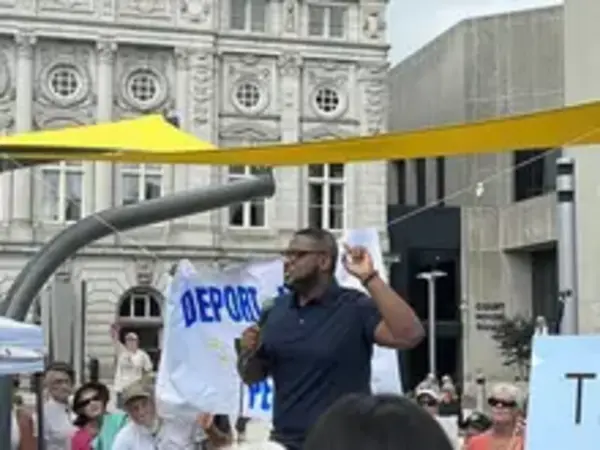
Those who came out to No Kings protests Saturday in downtown Greensburg and Pittsburgh cited a multitude of reasons for joining the national movement to voice opposition to President Donald Trump and his administration’s policies.
“We are pro-democracy and we’re tired of resources being taken from everyday people to enrich billionaires,” Amanda Parks of Forest Hills said as she participated in the event on Grant Street outside the City County building in Downtown Pittsburgh.
Andrew Arsenault, 47, of North Huntington, said he traveled to the Pittsburgh protest because he’s worriesd how Trump’s policies affect his daughters.
“I’m afraid they’re gonna die,” he said. “I’m afraid they won’t get the health care they need, or they won’t have the choice to take care of their own selves.”
Saturday was billed as nationwide day of defiance to protest the Trump administration and events were held in Pittsburgh, Greensburg and Cranberry that were among the locations across Western Pennsylvania, that were using the No Kings name.
Several hundred people came out for the protest at Cranberry’s main intersection of Route 19 and 228.
Another gathering was planned in Mt. Lebanon later in the afternoon.
Husband and wife Michael Solano-Mullings and Amanda Parks, of Forest Hills, have their arms around each other at the No Kings rally in Pittsburgh. “We are pro-democracy and we’re tired of resources being taken from everyday people to enrich billionaires,” Amanda said. @TribLIVE pic.twitter.com/DEWNONOBBP
— Brian Rittmeyer (@BCRittmeyer) June 14, 2025
Andrew Arsenault, 47, of North Huntington, said he worries how Trump’s policy affects his daughters.
“I'm afraid they're gonna die,” he said. “I'm afraid they won't get the health care they need, or they won't have the choice to take care of their own selves.” @TribLIVE pic.twitter.com/q1UgPE1xke
— Megan Trotter (@meganktrotter) June 14, 2025
Jaime Martinez, 23, from Casa San Jose is protesting for “liberty, respect and divinity for all”
“I didn't spend my entire childhood pledging allegiance to the flag of the United States of America, only for us to not be living up to those values today,” Martinez said. @TribLIVE pic.twitter.com/ppiseGCByc
— Megan Trotter (@meganktrotter) June 14, 2025
Linda Kelley, of Crescent, is thinking of her late grandfather, Robert Welch, who served in the Army in WW II. “They went and they fought and they took care of it for us. Now we have to do it again.” @TribLIVE pic.twitter.com/NtsVzadrv6
— Brian Rittmeyer (@BCRittmeyer) June 14, 2025
A demonstrator said, “They promised to block the main road by 11:30—but they didn’t!” pic.twitter.com/wFRNuMwmnw
— Massoud Hossaini (@Massoud151) June 14, 2025
No Kings has listed on its website more than 1,800 cities nationwide where demonstrators are scheduled.
Pa. Lt. Gov. Austin Davis of McKeesport was among the speakers in Greensburg.
“We’re going to stand up to Donald Trump,” Davis told the crowd.
Pa. Lt. Gov. Austin Davis takes the mic in Greensburg. “”We’re not going to stand for this. We are going to stand up to Donald Trump.” pic.twitter.com/QjFNti5Xm1
— Rich Cholodofsky (@RichCholodofsky) June 14, 2025
“I recognize that many in our city feel passionate about the issues facing our country, and I respect and support your right to make your voices heard,” Pittsburgh Mayor Ed Gainey said in a statement on Saturday. “Peaceful protest is a powerful tool for change, and throughout our nation’s history it has led to some of our greatest progress. I encourage all those attending planned protests to engage peacefully and responsibly.”
Saturday was also Trump’s 79th birthday and Flag Day. It will be capped by a 6:30 p.m. parade in Washington to celebrate the 250th anniversary of the formation of what became the U.S. Army.
Military equipment, including tanks, are supposed to be in the parade, as are 6,600 uniformed soldiers and veterans, according to the Army.
Pittsburgh
Jaime Martinez, 23, of Casa San Jose said he was protesting for “liberty, respect and divinity for all” at the event in Downtown Pittsburgh.
“I didn’t spend my entire childhood pledging allegiance to the flag of the United States of America, only for us to not be living up to those values today,” Martinez said.
Linda Kelley, of Crescent, said she was thinking of her late grandfather, Robert Welch, who served in the Army in World War II.
“They went and they fought and they took care of it for us. Now we have to do it again,” Kelley said. “We just want some Democrat leaders to stand up to this guy and start doing their jobs. We need Democratic leadership and we need it now. We don’t need a king, just leaders who want to take care of our country.”
People are gathering on both sides of Grant Street at the city-county building in downtown Pittsburgh for the No Kings rally. @TribLIVE pic.twitter.com/cE57EYFmjx
— Brian Rittmeyer (@BCRittmeyer) June 14, 2025
A vibrant clash of generations united in color, energy, and purpose; chanting boldly for rights and freedom: 'This is what democracy looks like!' pic.twitter.com/6cVmEVym7Y
— Massoud Hossaini (@Massoud151) June 14, 2025
As at the Hands Off rally, some anticipate the common attack that protesters are paid. @TribLIVE pic.twitter.com/XGuZZkLVdM
— Brian Rittmeyer (@BCRittmeyer) June 14, 2025
#NoKingsProtest pic.twitter.com/YYO0esJ3XZ
— Massoud Hossaini (@Massoud151) June 14, 2025
People were also expected to gather at Freedom Corner on Crawford Avenue in the Hill District.
Pittsburgh officials worked with protesters in maintaining peace.
#NoKingsProtest safety message: pic.twitter.com/o8XLtdLYl5
— Massoud Hossaini (@Massoud151) June 14, 2025
Director of Public Safety Lee Schmidt on said officers talked with organizers to coordinate the best way to “protect their First Amendment rights and ensure safety of anyone who is participating in demonstrations.”
Pittsburgh No Kings protest organizers filed special event permits and registered the demonstrations with the city, Schmidt said. Police will maintain a barrier between the No Kings movement and any potential counter protests.
Greensburg
“The mad king doesn’t think we exist,” Westmoreland Commissioner Ted Kopas said, referring to Trump. “He doesn’t want to hear us.”
Abby Graham-Pardus of Murrysville, chairperson of WTF Can I Do Westmoreland, said she expected more than 1,000 people at the Westmoreland County Courthouse courtyard.
Kopas, Davis and former county commissioner Tom Balya were among those who attended.
Retired Rev. Ronald Wanless of Ligonier was among the rally goers.
“I’m here because of the mistreatment of immigrants and the use of military in our cities,” Wanless said.
Former state Sen. Allen Kukovich calls out the “ tyranny of Trumpism.” pic.twitter.com/32CFfn8SoM
— Rich Cholodofsky (@RichCholodofsky) June 14, 2025
A large crowd has gathered at the Westmoreland County Courthouse in Greensburg for the No Kings protest on June 14, 2025. @TribLIVE pic.twitter.com/EbXT9MirTC
— Sean Stipp (@SeanStipp) June 14, 2025
Former westmoreland County Commissioner Tom Balya to Donald Trump. “Your administration stinks and apparently you do too.” pic.twitter.com/GrvMjBfN5q
— Rich Cholodofsky (@RichCholodofsky) June 14, 2025
Chants ring out calling for impeachment of president Donald Trump. pic.twitter.com/TKn1IhdaD3
— Rich Cholodofsky (@RichCholodofsky) June 14, 2025
Protestors chant eighty six 47 at the Westmoreland County Courthouse for the No Kings protest. @TribLIVE pic.twitter.com/Ji8HuKz2tE
— Sean Stipp (@SeanStipp) June 14, 2025
Retired Rev. Ronald Wanless of Ligonier among No Kings rally goers in Greensburg. “I’m here because of the mistreatment of immigrants and the use of military in our cities.” pic.twitter.com/BioEEaq24s
— Rich Cholodofsky (@RichCholodofsky) June 14, 2025