
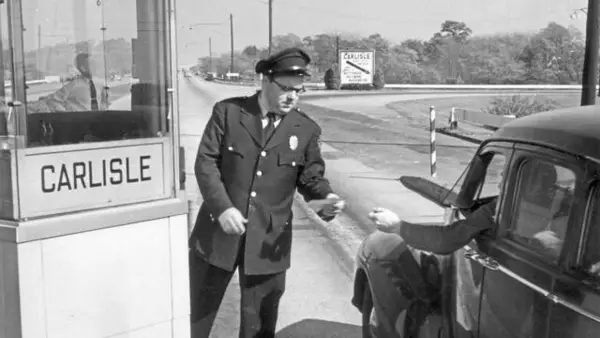
On Aug. 14, 1940, the Pennsylvania Turnpike officially opened, a 160-mile road running between Carlisle and Irwin. It marked the first long-distance, limited-access highway in the U.S.
Today is the Turnpike’s 85th anniversary. It is 200 miles longer than when it began, and the tolls are certainly much higher than the original toll one-penny toll.
To mark the anniversary, TribLive takes a look at the history behind “the grandfather of American highways.”

Origins
The road was designed in the 1930s to hasten automobile transportation across the Pennsylvania mountains by way of seven tunnels that were originally built to serve the South Pennsylvania Railroad. By 1950, it was extended east to Valley Forge, and west to the Ohio state line in 1951, where it now becomes the Ohio Turnpike.
The Turnpike was extended to the Delaware River in 1954 and its main line was completed in 1956 with the construction of the Delaware River Bridge.
It served as a model for the eventual Interstate Highway System, a network of limited-access roads connecting major American cities.
The documentary newsreel above, originally produced by the Portland Cement Association, describes the construction of the original stretch of the Turnpike.

Tolls
While the original toll was a penny, today it costs a passenger vehicle between $53 and $104 to travel the length of the main line, depending on what method of payment drivers use.
The original method of payment was a ticket and cash up until March 2020 and electronic tolling was being rolled out on a small scale starting in 2016.
Today in addition to the E-Z Pass system, Turnpike users are billed through the Toll-By-Plate system. Once all of the overhead toll gantries have gone into operation — estimated at late 2026 — the Pennsylvania Turnpike Commission says it plans to demolish all of their toll plazas.

Scandal
In 2013, former Turnpike officials were charged by the state Attorney General and state police in an influence-peddling and bid-rigging scheme.
Prosecutors alleged it was a “pay-to-play” scheme of campaign contributions to favored officials in return for contracts.
Vendors doled out gifts such as travel, meals, sports tickets and limo rides, prosecutors said.
Former turnpike CEO Joe Brimmeier of Ross pleaded guilty to felony conflict of interest and was sentenced to 60 months of probation. George Hatalowich of Harrisburg, the turnpike’s former chief operating officer, pleaded guilty to conflict of interest.
But it wasn’t the first time Turnpike officials found themselves being investigated for corruption: In 1956, a $9.5 million scheme was exposed with a contractor, and 22 people were indicted, including two former turnpike commissioners.
A company had been hired to fill mine “voids” on the Northeast Extension; the state alleged 95 percent of the work was fraudulent, adding millions of dollars to the cost. Former Gov. George Leader called the Manu-Mine Scandal, as it was known, “literally highway robbery.”
The ‘abandoned’ Turnpike
In 1968, a 13-mile stretch of the Turnpike, including two tunnels at Sideling Hill and Rays Hill, was abandoned in favor of a new section.
Much of the property containing that road was sold to the Southern Alleghenies Conservancy in 2001, and it was eventually converted into a bicycling trail.
In the video above, YouTube channel Dark Exploration Films walks the former section of road. It was also used during the filming of the 2009 film adaptation of Cormac McCarthy’s post-apocalyptic novel, “The Road.”

The future
For the western Pennsylvania portion of the Turnpike, the future may be in a new interchange in Penn Township.
Late last year, Turnpike officials unveiled preliminary designs for a new interchange near the intersection of Route 130, Nike Site, Sandy Hill and Pleasant Valley roads.
Some of the proposed changes include making room for interchange exits and entryways by shifting portions of Pleasant Valley, Sandy Hill and Nike Site roads, which are closest to Route 130.
The project is expected to cost between $60 and $90 million. Construction would not begin until the mid-2030s.