
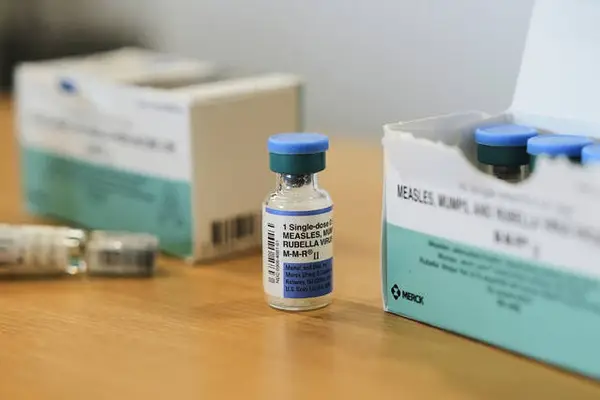
A federal vaccine panel’s recommendation to withhold from the youngest children a single shot that protects against measles, mumps, rubella and chickenpox mostly falls in line with existing practice, medical experts told TribLive on Friday, even as it reflects the empowerment of vaccine skeptics.
The vaccine, abbreviated as MMRV, should no longer be given to children under 4 years old, the Advisory Committee on Immunization Practices said Thursday. The panel, which is also meeting Friday to set vaccine recommendations, focused on rare feverish seizures linked to the first dose.
Panelists left unchanged recommendations for separate immunizations against the diseases — a combined one for measles, mumps and rubella, and a different one for chickenpox.
Joseph Aracri, chair of pediatrics at Allegheny Health Network, said the change in guidance — which is not yet final — is clinically sound.
“Because of the higher risk of fevers and side effects, it’s actually safer to give it separately than together,” Aracri said.
Nonetheless, he said the decision reflects “mistrust in the medical community” that doctors should work to earn back.
A distinct measles, mumps and rubella vaccine can be given in the same visit with the chickenpox shot. The only advantage of the combination shot, in Aracri’s view, is the child gets one jab instead of two.
Only 15% of families are opting for the four-in-one shot, according to Amesh Adalja, a Pittsburgh-based infectious disease expert. That means the panel’s guidance won’t have much impact on vaccination practices for these diseases.
But he’s troubled that the panel, stuffed with vaccine skeptics by Health and Human Services Secretary Robert F. Kennedy Jr., would concern itself with what he called a “nonissue.” Doctors have known about these side effects for years and incorporate them into the advice they give parents.
“The anti-vaccine movement has always railed against combination vaccines,” he said. “You just have to look at this as if you watched an anti-vax conference that’s going on in some hotel.”
What are these shots?
The first dose of these vaccines — whether the combination or separate shots — are usually given to children between 12 and 15 months old, according to the Mayo Clinic. That’s followed by another dose between the ages of 4 and 6.
Mumps, rubella and chickenpox are usually mild viruses but can lead to serious complications. Measles can be more severe.
Because of their highly contagious nature, it’s important that an overwhelming majority of people are vaccinated against them to achieve herd immunity, according to Aracri.
The combination shot has been linked to a higher risk of fever as a child’s body provides an immune response, which can lead to seizures. These seizures are common in children with any type of infection, and are considered harmless by medical experts.
They are not tied to any developmental issues or long-term seizure disorders.
“Febrile seizures are usually worse for the parent than they are the kid,” Aracri said.
What could change at the doctor’s office?
The panel’s recommendations do not become official Centers for Disease Control and Prevention policy until approved by the agency’s director. Even then, they’re nonbinding.
Physicians have historically given weight to advice from the agency. But as it continues to veer away from scientific consensus on vaccines under Kennedy’s Department of Health and Human Services, states and medical associations have started issuing guidance of their own.
That could leave parents with conflicting information on how and when their children should get certain vaccines, according to Adalja.
Even just seeing vaccine changes in the news can be disorienting, said Leslie Francis, 45, of Beechview as she watched her 2-year-old daughter, Isabella, play at Brookline’s Moore Park on Friday.
She said her husband had just read a news story about federal advisors altering guidelines for some childhood immunizations.
“He didn’t like that,” she said.
So far, insurers say they’ll continue to cover the combination shot and other vaccines possibly impacted by the panel’s meeting.
America’s Health Insurance Plans, a trade association representing insurers, said Tuesday its members will continue to cover all vaccines recommended by the panel as of Sept. 1.
Highmark spokesman Aaron Billger said his organization has not changed its coverage or medical policies on vaccines.
“Members should be always consulting with their physician about personal health care needs, including vaccines for themselves or their children,” Billger added.
UPMC did not immediately return a request for comment.
The panel voted Thursday the Vaccines for Children program, a federal initiative that provides no-cost vaccines for eligible children, could cover the combined shot if parents want it. On Friday, it reversed the decision.
Could other vaccines be impacted?
Panelists had planned to weigh whether to stop recommending the hepatitis B vaccine for newborns.
It delayed that vote indefinitely Friday morning.
The panel is expected to vote later Friday on who should get the season’s covid-19 shots.
Last month, the federal Food and Drug Administration limited the new boosters to adults 65 and older as well as younger people with risk factors for severe infection.
Staff writer Julia Burdelski contributed to this report.