
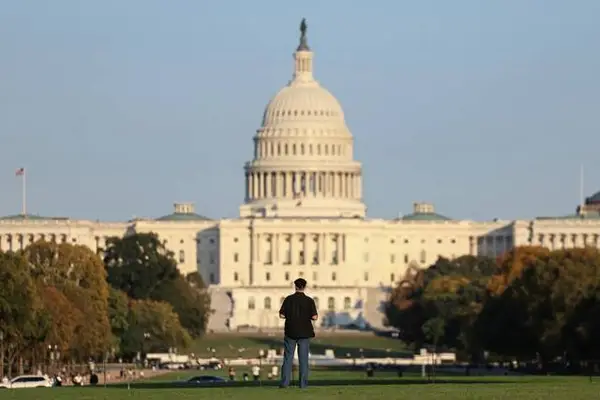
WASHINGTON – The government shutdown entered its third week and is now the second longest in history at 22 days, with no signs of a breakthrough as Democrats and Republicans trade blame and President Donald Trump prepares to leave the country for a multi-day trip to Asia.
Trump gathered Senate Republicans at the White House on Tuesday, bashing Democrats and declaring “We will not be extorted on this crazy plot of theirs.” Senate Minority Leader Chuck Schumer called on Trump to meet with Democrats before he leaves.
“Things get worse every day for the American people,” Schumer said the same day. “He should sit down with us (and) negotiate in a serious way before he goes away.”
Trump is scheduled to leave Friday for a trip that will end at the Asia-Pacific Economic Cooperation Forum in South Korea, where he will meet with Chinese President Xi Jinping.
Democrats continue to insist on greater health care spending – an extension of Affordable Care Act subsidies and the restoration of Medicaid benefits – as a condition of reopening the government. But Republicans contend the government should reopen before health care talks begin.
The Senate failed for the 11th time Oct. 20 to approve a House-passed bill to fund the government through Nov. 21. Three Democrats have joined Republicans but the GOP needs another five Democrats to overcome a 60-vote threshold to send the legislation to Trump.
Meanwhile, the shutdown grinds on with workers missing paychecks, flights increasingly delayed and lower-income families could lose food assistance.
Here are the latest updates about the shutdown:
Key dates to watch in the shutdown
As the shutdown grinds on with no end in sight, here are some key dates ahead:
On Wednesday, the shutdown becomes the second longest at 22 days, eclipsing the shutdown in 1995 to 1996 which lasted 21 days during the Clinton administration. The longest funding lapse was 35 days in 2018 to 2019.
On Friday, federal workers will begin missing their first full paychecks. Workers received partial checks on Oct. 10, and the administration shifted funding to pay the military on Oct. 15. But more than 1.8 million paychecks – scheduled for payment on Oct. 24, 28 or 30 depending on the agency – will be withheld from civilian workers, according to the Bipartisan Policy Center.
On Nov. 1, open enrollment begins under the Affordable Care Act, nicknamed Obamacare. Premiums are projected to more than double without an extension of subsidies that expire Dec. 31. Most Senate Democrats are voting against reopening the government unless the tax credits are extended but Republicans contend the government should reopen before health care negotiations.
Senate to vote for 12th time on funding bill
The Senate is set to vote again for the 12th time on Wednesday on a short-term funding bill to reopen the government.
The measure is expected to fail once more.
The timing of the vote will be affected by how long Sen. Jeff Merkley, D-Oregon, continues to speak on the Senate floor in protest of the Trump administration. The nearly 69-year-old lawmaker had held the floor for 15 hours as of 9:15 a.m.
Fetterman supports blowing up Senate filibuster to end shutdown
As Americans begin to bite their nails over the looming ramifications of the shutdown, at least one Democratic lawmaker says it is time to blow up the Senate’s 60-vote filibuster rule.
“We ran on killing the filibuster, and now we love it,” Sen. John Fetterman, D-Penn., said this week. “Carve it out so we can move on. I support it because it makes it more difficult to shut the government down in the future, and that’s where it’s entirely appropriate.”
Senate Majority Leader John Thune has stiff-armed calls to reopen the government by passing the spending measure with a simple-majority vote, which Sen. Bernie Moreno, R-Ohio, has called to do.
But Fetterman, known as a party maverick, has been one of the few Democrats voting with the Senate Republicans in OK’ing the spending bill that is at the center of Washington’s logjam.
He told reporters during a Tuesday gaggle the shutdown is getting worse by the day, citing how America’s food stamps are close to running out of money.
“I don’t want to hear any Democrat clutching their pearls about the filibuster,” Fetterman said. “We all ran on it.”
The GOP has a shutdown scheduling headache
For weeks, the Senate has repeatedly voted down a bill to reopen the government on a short-term basis until Nov. 21. That date is now just a month away, putting Republicans in a tough spot.
With the shutdown dragging on, GOP leaders in Congress will have to decide soon whether to extend that date, and by how much.
Exactly how far out to schedule the new deadline will be a tricky question. Moderates would rather see a shorter funding patch to work out regular appropriations bills, while others don’t want any more shutdown brinksmanship until early next year.
Regardless of the scheduling headache, there’s still no indication the funding bill would pass, unless Republicans and Democrats can strike a deal on health care.
How many workers have been furloughed during shutdown?
About 750,000 federal workers have been furloughed during the shutdown and ordered not to report to work.
Employees deemed essential to public safety, including military personnel, law enforcement officers, border patrol and air traffic controllers, are required to work regardless.
Will I still receive my Social Security check?
Yes, Social Security payments, including Supplemental Security Income and benefits for retirement, disability and survivors, continue during a government shutdown.
Because Social Security benefit programs are considered mandatory spending by law, they are not impacted by the lapse in funding appropriations. Payments are still distributed on a regular schedule during the shutdown.
Social Security offices are still open during the shutdown, but only some services are available.
Is mail affected by the government shutdown?
The U.S. Postal Service will continue to operate even amid the government shutdown as it does not depend on Congress for funding.
In a Sept. 25 statement, USPS said it’s an “independent entity that is generally funded through the sale of our products and services, and not by tax dollars.”
How long has the government shutdown lasted?
This is the 22nd day of the government shutdown, marking three weeks into an impasse by lawmakers on Capitol Hill that have left thousands of federal workers without paychecks, increasingly delayed flights and threatened food assistance for lower-income families.
This is the 15th shutdown since 1981, and is now the second-longest shutdown in U.S. history. The longest shutdown happened during Trump’s first term, lasting 35 days between Dec. 22, 2018, to Jan. 25, 2019.