
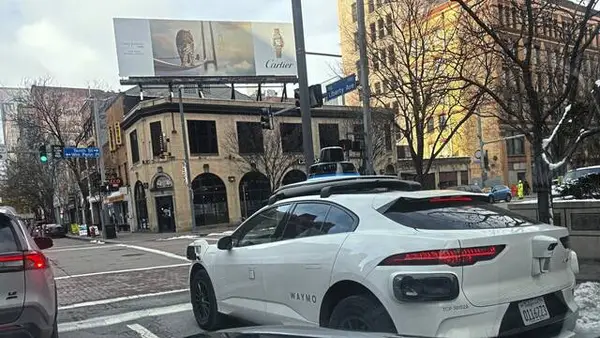
Driverless cabs are coming to Pittsburgh.
Autonomous ride-hailing service Waymo is expanding into the Steel City along with Baltimore, St. Louis and Philadelphia, the company announced in a blog post Wednesday.
Human-led test drives will start this week in Downtown Pittsburgh as Waymo confirms its technology works on the city’s roads. This phase will take a matter of months, the post said.
There’s no firm date for when Pittsburghers can start calling robotaxis.
Waymo works much like other ride-hailing apps, allowing people to summon a vehicle to their location in just a few taps.
The cars don’t require any human input, instead relying on a mix of cameras, radar and lidar to perceive the world around them.
Based in California, the firm started as a project of Google, which is owned by Alphabet, before becoming its own Alphabet subsidiary in 2016. As of May, Waymo had garnered more than 10 million paid rides — and no profits.
The company is operating in five markets — Austin, Atlanta, San Francisco, Phoenix and Los Angeles — and is testing or planning to launch services in 21 more, including a few abroad.
Waymo’s presence in Pittsburgh and Philadelphia will be regulated by the Pennsylvania Department of Transportation rather than city governments.
Nonetheless, company spokesman Ethan Teicher said city leaders will be briefed on Waymo’s “technology, safety record, approach to expansion and how we work with local officials and emergency responders.”
Pittsburgh’s driverless past
Pittsburgh has a “special place in autonomous vehicle history,” Waymo noted in its post, crediting Carnegie Mellon University as an early leader in driverless technology.
Waymo already knows the city, having run a small office in Bakery Square since 2021.
Additional infrastructure and personnel will flow into Pittsburgh as Waymo’s local service ramps up, according to Teicher.
When Uber started testing robotaxis about a decade ago, Pittsburgh was one of the first cities selected. The company introduced a small fleet of autonomous Volvos in 2016.
City officials quickly soured, claiming the company reneged on promises to hire Hazelwood residents to staff a nearby test track and support a federal transportation grant application.
Uber’s driverless program never got going again in Pittsburgh after one of its vehicles fatally struck a pedestrian in Arizona. Two years later, the company sold the entire division to Aurora, a Pittsburgh-based competitor that has since become the industry leader in self-driving trucks.
Brian Kennedy, senior vice president of operations and government affairs at the Pittsburgh Technology Council, characterized the bad blood as mostly a personal dispute between then-Mayor Bill Peduto and then-Uber CEO Travis Kalanick.
He said he does not anticipate a similar outcome with Waymo.
The appeal of Waymo
On its website, Waymo positions itself as a safer alternative to human-operated cars, claiming its vehicles are involved in 91% fewer serious crashes.
The all-electric fleet also has some green credentials.
And according to Richard Mudge, a board member of the Transportation Channel, an industry media platform, Waymo has shown an ability to take market share from Uber and Lyft.
“They are clearly competitive since they’re expanding,” Mudge said.
That’s despite being pricier. A June report from Obi, a rideshare price comparison service, found Waymo rides cost an average of 41% more than Lyft and 31% more than Uber.
Pushback expected
Waymo has not been universally welcomed.
Vandalism of the vehicles has been reported in Los Angeles and San Francisco.
In New York City, San Diego and Seattle, taxi drivers and their unions have tried to stop the arrival of driverless competitors.
The technology council’s Kennedy expects some skepticism to emerge in Pittsburgh, too. The doubts about Waymo’s cars probably won’t go away “until every Pittsburgher has been in one,” he said.
Laura Chu Wiens, executive director of Pittsburghers for Public Transit, said many concerns raised by her organization over Uber’s arrival almost a decade ago apply to Waymo.
The service might draw riders away from public transit, reducing much-needed ridership and revenue, or worsen traffic in the city’s most congested corridors.
Chu Wiens bristles at talk of how robotaxis represent a social good.
“Their point is to serve Waymo, not us,” she said.