
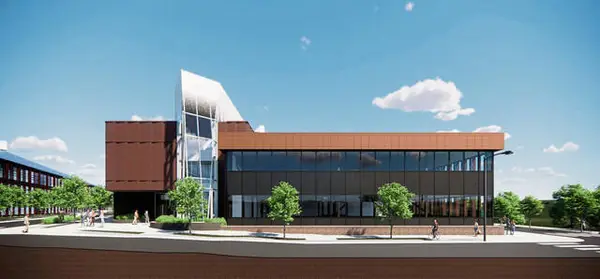
The University of Pittsburgh will borrow funds through a federal tax credit program to partially fund construction of BioForge, a $250 million cell and gene therapy manufacturing facility in Hazelwood Green.
Pitt’s Finance and Budget Committee on Friday unanimously approved entering into the New Markets Tax Credit program for BioForge.
As part of the deal, Pitt is required to place a 30-year obligation totaling about $9.1 million on its balance sheet. At the end of a mandatory seven-year tax credit program period, the obligation will be forgiven.
The net effect of the transaction is that it will yield approximately $1.5 million in new funding, which Pitt can use to offset a small amount of the building construction cost.
Pitt trustees approved acquiring the development in December 2022, and approved core and shell construction of a 185,000-square-foot building in June 2023.
“From a mission and impact perspective, BioForge will support cell and gene therapy translational research while growing the commercial gene and cell biomanufacturing industry in Pittsburgh,” said Dwayne Lee Pinkney, Pitt’s executive senior vice chancellor for administration and finance and chief financial officer. “This project qualifies for the federal New Markets Tax Credit program, as it is located entirely within an area that is characterized by economic distress and inadequate access to capital and lenders. Further, the project is expected to create jobs and local economic impact in the project area and other low-income communities.”
According to the U.S. Department of Treasury, the New Markets Tax Credit program incentivizes community development and economic growth through the use of tax credits that attract private investment to distressed communities.
Jack Tighe, chair of the trustees’ Finance and Budget committee, applauded the university’s efforts to go forward with the New Markets Tax Credit program.
“It’s innovative. It’s forward-thinking in a response to the current environment with these tax credits,” he said. “This is really good work to bring this before the committee.”
Pinkney said BioForge’s base building is “substantially complete,” with completion expected by the end of January. Interior work will be complete by May, he said.
About three-quarters of the facility will be leased to Massachusetts-based ElevateBio.
Officials said in 2022 they anticipated the biomanufacturing center to create more than 170 permanent full-time jobs, 900 construction jobs and 360 off-site support jobs.
Officials have said they hope to complete the project by 2027.