
They called them mom and dad.
It was a family of sorts, two adults and five children, cobbled together from different biological parents. The pictures that Kourtney Eutsey and Sarah Shipley posted on their Facebook pages showed the typical trappings of raising kids — matching pajamas at Christmastime, New Year’s Eve selfies and a group shot celebrating Father’s Day.
Posts of the kids stopped in late 2023, only to resume on Sept. 3, 2025, when 9-year-old Renesmay Eutsey was reported missing to police.
At 7:10 p.m. that day, Kourtney Eutsey posted a photo of Renesmay and said: “Please help us find our little girl and bring her home.”
State police believe Renesmay was already dead.
• • •
Renesmay Ann Eutsey was born at 2:16 p.m. June 10, 2016, in Uniontown Hospital. She weighed 6 pounds, 7 ounces.
Her mother, Christina Benedetto, was 16 and relied on help from her own mother to care for the newborn. Renesmay started walking at 10 months, and the blonde-haired, blue-eyed girl with chubby cheeks loved to eat liver and onions, according to her mother.
“She was the best, and she meant so much to us,” Benedetto said.
Renesmay was 3 in August 2019 when state troopers accompanied Fayette County Children & Youth Services caseworkers to serve an order from a county judge. Two children were to be removed from the Dunbar Township home, according to court papers.
Police reported trash and dirty diapers were strewn throughout the house when they arrested Benedetto, then 19, for child endangerment. She spent eight days at the Fayette County Prison, unable to post bail, and later was sentenced to two years of probation.
During her incarceration, Benedetto said, she got a call from a relative that Sarah Shipley, her cousin, could take in Renesmay and the youngest child, who was just shy of 1 at the time.
Over the next few years, Benedetto had two more children, both of whom went to live with Shipley, 35, and Kourtney Eutsey, 31, who is a cousin of Renesmay’s biological father.
The makeshift family most recently lived in a white house with peeling paint and a cracked foundation, perched on a hillside in Dunbar Borough, about a mile from Benedetto’s home. That’s where family, friends and state troopers would first gather Sept. 3 to look for Renesmay.
Troopers soon grew suspicious that the girl wasn’t actually missing. Their fears were confirmed in the early morning hours of Sept. 4 when Eutsey led them to Renesmay’s body at a spot along River Road near Smithton. Renesmay was stuffed in a trash bag weighted with six large rocks. The bag holding the girl had been left behind in the Youghiogheny River, according to police testimony.
Investigators who examined her body said Renesmay had wounds to her backside and under her chin, along with injuries to her right eyebrow, feet and legs. A cause of death has not been released.
Police filed homicide charges against Shipley, whom the kids called dad, and Eutsey, whom they knew as mom.
The women, accused of abusing two of four other children in their care, also are charged with aggravated assault and related offenses.
At the time of Renesmay’s death, Fayette County Children and Youth Services did not have active involvement with any of the five children who lived with Shipley and Eutsey, according to Fayette County District Attorney Mike Aubele.
“Either one or both Eutsey/Shipley were legal custodians of the five children in the home,” Aubele said. “For Renesmay, Shipley was the legal guardian.”
One of those children, a then-11-year-old girl who is not Benedetto’s child, told investigating troopers she heard Renesmay screaming and crying as Shipley and Eutsey beat her in an upstairs bedroom and reported the pair said they were going to take her to a river. Eutsey carried Renesmay’s lifeless body down the steps and later left, returning around 6 a.m., the girl told Trooper Nicole Sigwalt, according to preliminary hearing testimony.
“She was very scared because she didn’t want to end up like Renesmay,” Sigwalt testified at a preliminary hearing Nov. 14.
Eutsey eventually led troopers to Renesmay’s body. The four remaining children, ages 11, 6, 3 and 2 at the time, were taken to UPMC Children’s Hospital for evaluations.
The exact paths through which Shipley and Eutsey came to have custody or guardianship of the five children are unclear. There were no public civil records found in a check at the Fayette County prothonotary to indicate how the arrangements happened.
It’s also unclear if the couple underwent any sort of evaluation before taking on the five children or if they were receiving any reimbursement for caring for them. The director of Fayette County’s Children & Youth Services said she couldn’t talk about any cases or confirm whether a case existed.
• • •
As Benedetto remembers it, she agreed to a guardianship arrangement with Shipley in 2019. Then 19, Benedetto said the process was, and still is, confusing to her. She said she couldn’t afford an attorney.
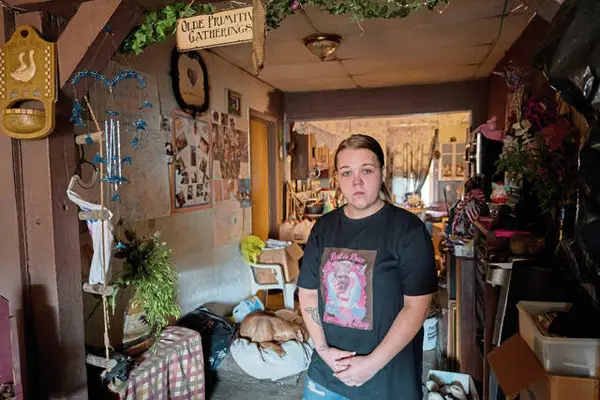
Sitting in a home surrounded by images and mementos of her children, Benedetto recalled child welfare caseworkers and the judge involved telling her the two children would be safe with Eutsey and Shipley.
There was no reason to believe they wouldn’t be, she said. Plus, she thought there would be an opportunity to get her kids back one day.
“It made me feel OK, to better myself before bringing them back into a life that I didn’t even want to live at that time,” Benedetto said.
Today, all that’s left of her firstborn, Renesmay, is ashes inside a butterfly-shaped urn.
“If she would’ve still been with me, she would’ve been alive,” Benedetto said. “My daughter couldn’t have done nothing to deserve this.”
Benedetto said her two younger children — now 2 and 3, born after Benedetto entered recovery from a drug addiction — also were put in the care of Shipley and Eutsey. She recalled Fayette child welfare caseworkers being involved, but it’s unclear when oversight from caseworkers might have ended.
Even when a case is closed, a family might still need services that a child welfare agency can provide, said Emma Grimm, who founded Grimm Advocacy to turn her own experiences in the system into advocate and consulting work. If a child’s educational or medical needs aren’t being monitored, their visibility can slowly be erased, a situation she said could be addressed by periodic checks.
“Children can effectively disappear from oversight once court or agency involvement ends,” Grimm said.
• • •
Child protective service agencies have a variety of means to help keep families together, which is their goal, said Cathleen Palm, founder of the Center for Children’s Justice, a Pennsylvania nonprofit advocacy group. But in instances where a child’s safety would be best served outside their home, caseworkers can seek out placements with a foster family or someone related to them, known as kinship care, while a biological parent works to regain custody.
“Everything in this world of child welfare is a balancing act,” Palm said. “Nobody wants to haul families into court.”
In traditional placements, there is supervision. More informal arrangements, such as guardianship, have value, but a child might get lost in the system, she said.
The number of Pennsylvania children in foster care has been dropping over the past few years. There were 15,500 in 2019, which fell to 11,250 in 2024, according to the federal Adoption and Foster Care Analysis and Reporting System. The state averages about 2,000 exits from the system into adoption annually.
Prospective foster parents must undergo a criminal background check and child abuse clearances and be subject to a home approval process, which includes an evaluation of family history, living quarters and financial stability, according to the state Department of Human Services. Foster parents are reimbursed for costs associated with caring for a child, most of whom eventually return to their biological parents, the agency said.
Placing a child with a relative they know rather than an unknown foster family can be reassuring to a biological parent and offer a sense of security, Palm said.
In some ways, she said, that’s beneficial, but she questioned if child protective agencies have been fixated on more informal methods in an effort to keep foster placements low and perhaps close out cases earlier than they should. Doing so can be problematic for caregivers who are struggling, but also tough for vulnerable children, such as those who can’t communicate, have a disability or aren’t attending school.
“Now, you have the situation where they can literally fall off the radar of anyone,” she said.
Palm said she is curious to see how much Renesmay’s death ultimately impacts state legislation and policy discussion.
“If she isn’t an anomaly — and she doesn’t appear to be an anomaly — we have to … figure out what got us here,” she said
Palm said it’ll be important for child protective agencies to pay attention to what happened and see if anything could have been prevented.
“There really does need to be a really important explanation of what are the processes and what are the practices that played out across multiple children across multiple years,” she said.
• • •
Benedetto said her efforts over the years to set up in-person or video meetings with the kids were canceled or ignored by Shipley. According to Benedetto, the few photos she did get of the kids were of such poor quality, it was nearly impossible sometimes to distinguish who was who.
She said Shipley and Eutsey told her the children didn’t want anything to do with her. The pair blocked Benedetto and her family from seeing their Facebook pages where pictures of the children proliferated.
Police testimony also indicated Renesmay was homeschooled.
Dr. Margaret Russell testified during the preliminary hearing last month for Shipley and Eutsey that there was far-reaching physical, emotional and educational abuse and neglect at the house with the 11- and 6-year-olds. They both had teeth removed with pliers by Shipley, Russell said. The older child described being beaten if she didn’t complete chores and having her looks compared to those of a rat by her caregivers. She told troopers neither she nor Renesmay were allowed to celebrate their birthdays, according to court papers.
The 11-year-old’s vision was so bad that she couldn’t identify letters or numbers, even at a close range, and was unable to read, Russell said. The girl was tasked with handling her own homeschooling.
“That’s how she described it to me,” Russell said. “She described asking for help with her education and not being granted that by her caregivers.”
The 6-year-old boy’s physical condition was indicative of chronic malnutrition, Russell said. Both he and the 11-year-old girl had last seen a doctor in July 2024.
“My conclusion was that he was subject to physical abuse as well as medical neglect … and emaciation from malnutrition,” Russell testified. “Ultimately, I diagnosed him with torture.”
• • •
One week after the Nov. 14 preliminary hearing, Aubele filed notice of intent to seek the death penalty against Shipley and Eutsey, both of whom remain behind bars without bail. The aggravating circumstances prosecutors cited include that Renesmay died by means of torture and that she was younger than 12, according to documents Aubele posted on social media.
The death penalty would be sought if either woman is convicted of first-degree murder. Their next court date is a formal arraignment Dec. 18.
Eutsey’s attorney, acting chief public defender Nicholas Clark, reiterated his argument made at the preliminary hearing that the only evidence against his client was hearsay and prosecutors hadn’t produced an autopsy report showing how Renesmay died.
“My client is innocent until proven guilty, and Mr. Aubele will be met with a vigorous defense,” he said.
Shipley’s attorney did not return a message.
• • •
In the immediate aftermath of Renesmay’s death, community members rallied, holding fundraisers and vigils. As a result, Renesmay’s funeral expenses were paid in full, according to her obituary.
A memorial of candles and stuffed animals remains outside the Dunbar house, tucked away on a dead-end street at the edge of town.
While the homicide and assault cases work their way through the court system, Benedetto has hope that she will be able to someday regain custody of her remaining three children.
“My babies aren’t going nowhere but home,” she said, “where I know they’re safe.”