

They are among the most dangerous and unpredictable incidents first responders face: Vehicles crashing into buildings.
In a few chaotic seconds, a routine drive transforms into a complex emergency involving potential mass casualties, fire hazards and the threat of structural collapse.
For first responders, it is the call that typically elicits one of the highest initial responses.
“That’s considered a high-hazard call,” said New Stanton Volunteer Fire Department Chief Rob Cammarata. “It would bring multiple companies. For us, a readout like that would bring our fire and our rescue units.”
The hazard level is because of several potential emergency situations: possible injuries to people in the vehicle; possible injuries to people in the building; and the structural integrity of the building itself, which could put everyone at the scene in danger.
“You’re in trouble no matter what when a car hits a building,” said New Kensington Fire Chief Ed Saliba Jr. “But if you hit a corner (of a structure), you’re in real trouble. And you’ve got to think about utilities — is there gas, water, electrical wires in that wall? If you create a gas leak and you’ve got a running car with an ignition source, you can end up with an explosion.”
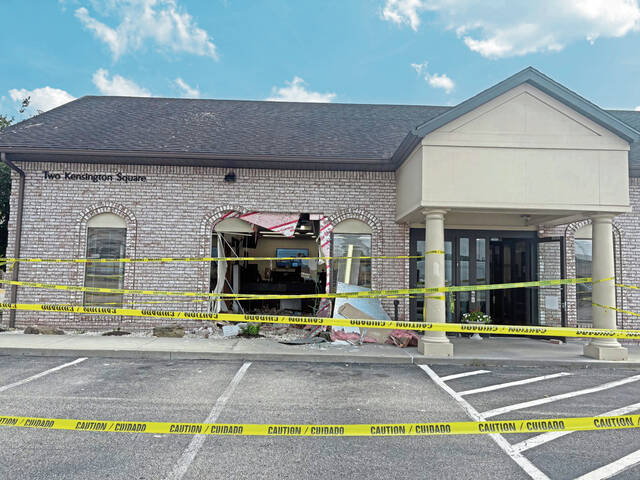
Surge in crashes
These incidents, ranging from simple to severe, have become alarmingly frequent in the region since fall, even while their numbers have declined statewide.
Among the more than 30 incidents of vehicles crashing into buildings across the Pittsburgh region since late September:
• A driver accidentally reversed their SUV into a building on Monroeville Boulevard, causing minimal damage.
• A truck ran off Route 22 in Murrysville and into the front door of a commercial building.
• A car struck the side of a car wash on Saw Mill Run Boulevard in Pittsburgh’s Carrick neighborhood, taking out an air pump and damaging the building badly enough that a building inspector was called to the scene.
• A woman was taken for evaluation at a local hospital after driving her vehicle into the Pittsburgh Technologies building in Washington Township.
Statewide, there were more than 2,800 such crashes in 2024.
Saliba’s department responded earlier this year when a car slammed into the First National Bank building in downtown New Kensington, sending two people to the hospital.
“There were people inside doing business, and if it had been worse, they could’ve been killed instantly,” Saliba said. “Thankfully there wasn’t damage to any load-bearing walls, so the tow truck could pull it out without a problem. But we assisted East Deer about six years ago where a vehicle hit a gas meter. That natural gas found the ignition source and sparked a fire that took down two buildings.”
It didn’t go that far for Pinnacle Auto Sales owner Kenneth Moore, but that didn’t make it any less frightening when a car crashed through the vestibule of his Hempfield business along busy Route 30 in April.
“The sound that all of that quarter-inch glass made when it broke was impressive,” said Moore, who was in his back office and didn’t see the crash initially.
“When we came out, we saw part of the car in our storage room with the back end still kind of bobbing up and down.”
Responders prioritize life, structural integrity
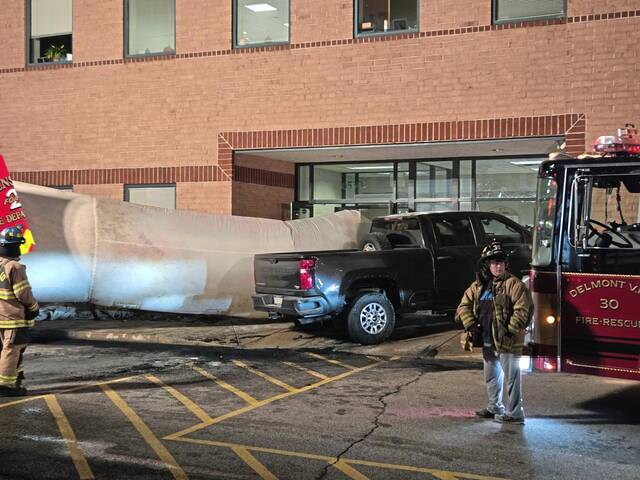
Responding to these crashes requires both rapid medical care and engineering expertise. Latrobe VFD Chief John Brasile said his first job is an assessment of life-threatening injuries.
“The first thing is patient care, but you also can’t put anyone else in jeopardy whether it’s the people in the house, or your firefighters,” he said.
Trafford Fire Chief Brian Lindbloom agreed, noting that immediate danger dictates the speed of extraction.
“If someone is trapped in the vehicle or the structure, you assess the situation,” Lindbloom said. “When someone’s in danger from fire, for example, we don’t worry too much about arm or leg injuries — we get them out of there. If they’re not in immediate danger, you can spend more time stabilizing them before you move.”
The next task is assessing the building that’s been struck.
“If the structure is compromised, our whole way of thinking changes,” Brasile said. “I had a salvage company and have all kinds of stabilization jacks and other tools. We also have salvage trucks equipped with lumber along with our two rescue trucks. So we do a walkaround and ensure that none of the load-bearing walls are compromised.”
Brasile has responded to cars that have gone into a house and said the fire department can temporarily shore up part of a house using 2-by-4 or 4-by-4 wooden beams and stabilization jacks.
“If a load-bearing wall is compromised, you can guarantee that house is going to move at some point,” he said. “I’m by no means an engineer, but you’ve got to be aware of the damage and do the best you can to make it safe.”
Lindbloom, who used to work as a building code official, has experience assessing structural integrity.
“Other places, they’d probably call in their local code officer or building inspector. We have some personnel that can make that assessment in-house. But if we need additional resources, we’ve got them readily available (from nearby departments).”
In addition to New Stanton firefighters training for building crashes, Cammarata noted that several members of the department also work as carpenters or engineers and bring that expertise to a crash scene.
“They’re a really good resource,” Cammarata said.
Distraction cited as primary cause
Nationwide, there were more than 4.4 million crashes in 2023 that caused property damage, according to National Highway Transportation Safety Administration data. In Pennsylvania, that number has gone down in recent years, from 3,358 in 2021 to 2,866 in 2024, according to PennDOT data. The primary three causes are typically driver error, driving under the influence or distracted driving.
According to the National Safety Council, out of an estimated 5.9 million crashes in the U.S. each year, smartphone usage is involved in 27%, or nearly 1.6 million.
“Inebriation is a factor a lot of times, but the state has really cracked down on DUI driving,” Brasile said. “Cellphone distraction is a big issue. We had a girl who wasn’t drinking at all, who hit a parked car and rolled her car over. If I had to guess, she was probably on her phone and not paying attention.”
State Farm Insurance spokesperson Dave Phillips said looking into cellphone use or distractions is a regular element of their insurance investigations.
“This includes asking if the driver was cited for a cellphone violation from the police responding to the accident,” Phillips said.
In June, state legislators passed Paul Miller’s Law, which prohibits the use of any hand-held device while operating a vehicle. The law defines hand-held device usage as a primary offense and a legitimate reason on its own to conduct a traffic stop. Police are currently issuing warnings and will begin issuing citations with fines in June 2026.
Pennsylvania State Police spokesman Trooper Cliff Greenfield said police are somewhat limited in their investigations of property-damage crashes when it comes to a driver’s device usage.
“A lot of it comes down to whether the driver is truthful with us following the crash,” Greenfield said. “If they admit to us that they were on their phone or texting, we’d document that as part of the investigation.”
For more severe cases, police may pursue a deeper investigation.
“We’d need a warrant to serve the phone carrier, or if they were using some sort of third-party app, we’d need to serve a warrant to that company,” Greenfield said. “But we wouldn’t typically go that far unless we’re talking about a fatal crash or one with serious injuries.”
A 2023 national observation survey by the National Center for Statistics and Analysis found that 2.1% of drivers stopped at intersections were talking on hand-held phones, and a higher number, 3%, were observed manipulating a hand-held device. An Insurance Institute for Highway Safety survey the same year showed one-fifth of the respondents reported engaging in at least one smartphone-based distraction on most or all of their trips.
The survey concluded that regular distracted driving is widespread among drivers younger than 50 years old. Statistics published by the Unified Judicial System of Pennsylvania support this, showing that 76% of 10,291 tickets issued for distracted driving went to people younger than 50. According to the data, Allegheny County is the most distracted in the state, accounting for 9% of the total distracted driving violations statewide.
Greenfield thinks the new laws are having an effect, based on anecdotal evidence.
“In my travels since the law went into effect, I do see fewer people holding their phones while driving, or even when they’re stopped in traffic,” Greenfield said.