
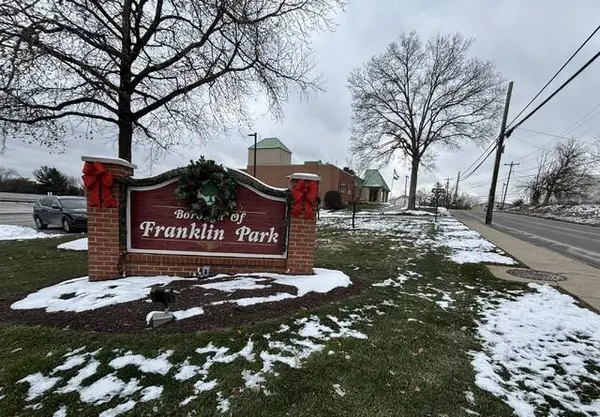
Franklin Park residents will see a 63% jump in taxes in 2026.
The millage rate was increased by 1 mill, to 2.59 mills from the current 1.59 mills, to address deficits in the budget and reserve funds.
While the budget passed unanimously Dec. 3, the millage rate passed 4-2, with board members Lucas Myslinski and Thomas Schwartzmier voting against the tax increase.
With an average assessed value of a home in Franklin Park at $279,800, a homeowner will pay about $725 in 2026, roughly $280 more than in 2025.
Those voting for the increase said it’s a necessary move to fund the budget’s core expenses. At the current rate, the borough would face a $1.5 million shortfall, according to the 2026 Franklin Park budget. The budget is available online at franklinparkborough.us.
“The new 2026 budget is designed to be fiscally proactive. It mandates keeping the general fund at a two-month expense reserve and officially funds a capital reserve to avoid future surprises,” said Uday Palled, council president.
Over the past five years, general fund expenditures have increased by nearly 47%, from approximately $9.9 million to a projected $14.6 million in 2026, according to the budget.
This is due to cost increases in police operations, public works and infrastructure maintenance, and parks, recreational and cultural programming.
With an increase on the table, Myslinski said there is an option to wait until January and let the new board vote on it. He and Schwartzmier lost their seats to Democratic challengers Venu Paruvelli and J. Curtis Neil II, respectively. Dennis O’Keefe, mayor since 2010, also lost his seat to a Democrat, Cristen L. Fiffik.
“I believe that this decision should be up to those still serving on council in 2026 and those newly elected members. I did vote for the budget, as our staff did incredible work to make it as fiscally responsible as possible, and it was unanimously supported by council,” Myslinski said.
Schwartzmier agreed with Myslinski’s stance on the raise.
In 2025, Franklin Park had the fifth-lowest millage rate of the 130 municipalities in Allegheny County.
Since 2020, the borough kept the budget balanced by drawing from its financial reserves and funding from one-time federal funds, such as the American Rescue Plan Act, according to borough Manager Zachary Filous.
There also have been rising costs of insurance and funding for retirements for police and general employees.
If the tax increase was not approved, the borough would be forced to decrease services in public safety and response, road structure and infrastructure maintenance, snow removal, park improvements and recreational programming, and stormwater and other environmental work, according to Filous.
The mayor, council and staff studied cost-saving steps in all of its departments with the goal of minimizing the tax increase, resulting in a decrease from $20.5 million in expenditures to $19.2 million for 2026, according to Filous.
The budget process included six comprehensive meetings to discuss strategy, millage and long-term capital needs. Deferring expenses was not a viable option, according to Palled.
“The key challenge is that the borough’s previous approach spanning the last decade — freezing the millage rate while utilizing reserves — did not adequately plan for future expenses. This brought us to a critical decision point,” he said.
Putting more money into the capital reserve fund will be an ongoing initiative for the borough, including transferring $1.4 million from the general fund to the capital reserve fund this coming budget cycle, according to Filous.
“We need to start rebuilding our capital reserve fund for emergency situations and to allow for grant writing,” Filous said.
The capital fund can be used as a savings account for large projects and as a match for grant writing. Moving forward, the general fund will balance every year with any surplus being transferred to the capital reserve, Filous said.
Overall, the general fund budget is approved at $14.6 million, with an expected revenue listed at $13.6 million. The bulk of the budget goes to public safety ($4.4 million), public works ($3.8 million) and culture and recreation ($2.3 million).
Some general fund projects for next year include approximately $1 million for 5-plus miles of road paving; $96,000 for police upgrades, including patrol units and updating computers; and $260,000 for a new dump truck and car replacement.
The borough also contributes to the fire fund, which supports the Franklin Park Volunteer Fire Company.
Several projects planned for the borough will be completed only if it is essential, state-mandated or if grant funding is secured, according to the budget. This includes ADA-eqiupment at Blueberry Park for $475,000, which already has been awarded a $205,000 grant.
And $300,000 worth of stormwater improvements will be completed on Montgomery Road, thanks to a $214,500 grant.
The funding of the MS4 program, or municipal separate storm sewer systems, is a costly requirement to the state. Upcoming MS4 work for Franklin Park includes streambank restoration and stormwater detention retrofits at more than $1.7 million, which will be financed by $200,000 in grants and $1.5 million in low-interest loan.
A necessary transfer of funds also will be distributed across the five operational funds.
“We are starting 2026 with $5,000,866 across all funds and ending 2026 with $5,388,666. Although the general fund shows a loss, we are just restructuring how borough funds are being stored,” Filous said.
In 2024, the budget outspent its revenue by approximately $794,000. In 2025, a projected shortfall of $58,000 in revenue is expected.
Other revenue comes in earned income or wage tax, accounting for 44% of the general fund, and is shared equally with the North Allegheny School District.
The school district also is proposing a tax increase for the 2026-27 school year at an estimated 20.43 mills from the current 19.74 mills, according to a Nov. 12 school board meeting. A proposed final budget will be voted on by the school board on May 20.