
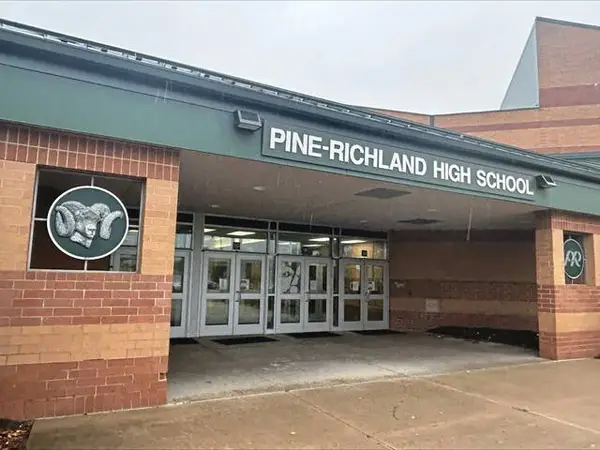
Property taxes in the Pine-Richland School District could increase up to 5.2% if the state allows the school district to exceed its inflation limit.
District administrators and the school board are considering ways to increase revenue, a property tax increase among them, along with spending reductions to tackle a $4.9 million deficit for the 2026-27 school year.
To close the deficit, the district is exploring various ways to reduce spending and increase revenues. Among them is refinancing one or two outstanding bond issues to save money, while a new cellular antenna at the district’s stadium is being eyed as a revenue generator.
While the district is limited by the state to a 3.5% property tax increase, it could qualify for another 1.7%, for a total of 5.2%, based on special education costs, Chris Juzwick, director of financial and operational services, told the board at its meeting Monday, Dec. 8.
If the state allows Pine-Richland to increase its property tax rate by more than 3.5% because of special education costs, that does not mean the district must use it, Superintendent Brian Miller said.
The district’s tax rate is now 19.5867 mills. A 5.2% increase would take it to about 20.6052 mills.
If that were to happen, the annual school tax bill for a property at Pine’s median value of $335,200 would increase about $342, from $6,565 to $6,907. In Richland, where the median property value is $168,300, the increase would be about $172, from $3,296 to $3,468.
Administrators, including Miller, have said a tax increase of at least 3.5% is needed, which would increase the tax rate to about 20.1687 mills. That would increase the school tax bill in Pine by $196 to $6,761; in Richland, it would increase $98 to $3,394.
Seeking approval to exceed its tax increase limit will require Pine-Richland to follow a different budget schedule.
Juzwick said the preliminary budget will be discussed at the board’s Jan. 12 meeting, with notification made to the public on Jan. 16. The board will vote to adopt the preliminary budget on Feb. 9.
The district also is considering refinancing one, and possibly two, of its outstanding bond issues, if market conditions make it favorable to do so.
The district has 11 outstanding bond issues totaling about $77 million. They would all currently be paid off in 2038.
Much of the debt is “legacy debt” from the build-out of the district in the late 1990s and early 2000s, Anthony Misiti, managing director for PNC Capital Markets, told the board.
A bond issue from 2014 is the most likely candidate for refinancing, if interest rate cuts occur and boost projected savings from a current 1.7% to the district’s desired target of 3%. If that happens, it would save more than $400,000, Misiti said.
The $17.9 million 2014 bond was a refinancing of an $18 million, 30-year borrowing from 2003 for part of Eden Hall Upper Elementary and other projects. As of October, the district still owes $14.8 million, and it will mature on Nov. 1, 2033.
A 2015 bond would be the next candidate, Misiti said. The $9.5 million bond was a refunding of a $18.9 million borrowed in 2005 for 30 years, also for Eden Hall. As of October, the district still owes about $5.9 million on it, with a maturity date of July 15, 2034.
If refinanced, the district would not extend the term of the debt, but would save money through lower interest rates and the district’s upgraded credit rating, which Standard & Poors placed at “AA stable” in April 2024, credited to positive financial performances and management of district reserves.
The board is expected to vote at its Jan. 12 meeting on the potential refinancing of the bonds and to engage Dinsmore & Shohl as bond counsel.
The board also will vote Jan. 12 to approve the installation of a cellular antenna by Smartlink and land lease agreements with Verizon Wireless, AT&T and T-Mobile. The project is now under review with Pine Township.
Smartlink, a Verizon subcontractor, has proposed installing cellular equipment at the high school campus by extending an existing stadium light pole on the home side.
A new pole that can handle the weight of the antenna arrays would be erected, Miller said.
According to the district, the project would improve cellular coverage for area residents and businesses, and resolve communications gaps now faced by emergency services in the area.