
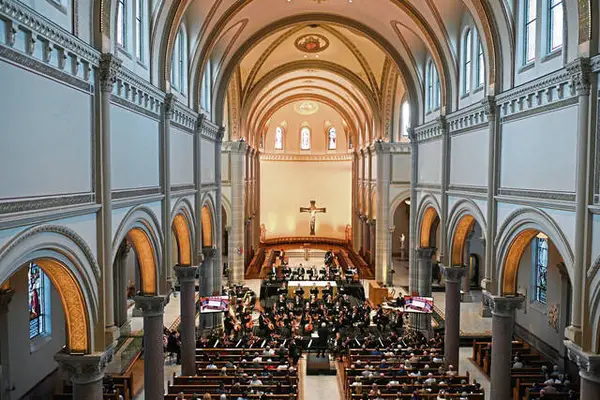
Chaz Bowers of Elizabeth has been admiring the St. Vincent Camerata for quite some time now. Over the years, he’s played the organ for several of the chamber ensemble’s concerts, and the music they perform is at the heart of St. Michael the Archangel Parish, where he serves as music director.
This week, Bowers, 37, will conduct the camerata in its “Nata Nox — A Night at the Manger” concerts in Greensburg and Unity, with organist Chris Pardini and camerata associate conductor and director emeritus the Rev. Stephen Concordia conducting the concert’s Gregorian chanting.
Bowers spoke with TribLive about the history of the camerata and how he chose the pieces in the performance.
This interview has been edited for length.
Q: What is a camerata and what is its history within the Catholic Church?
A: A camerata traditionally refers to a chamber ensemble — usually a smaller group of highly trained singers or instrumentalists brought together for music of particular refinement, clarity, and intimacy … Throughout the church’s history, these chamber ensembles were often responsible for the most artistically sophisticated liturgical music, singing everything from chant to complex motets in monasteries, cathedrals and collegiate chapels. Today, a “camerata” honors that tradition: a focused ensemble capable of delivering historically informed, expressive and deeply prayerful performances of sacred repertoire.
Q: How do you go about choosing pieces for a holiday performance, and is there something that ties it together musically?
A: When choosing music for a holiday performance, I look for works that not only stand beautifully on their own but also speak to one another — pieces whose texts and musical language together create a meaningful arc for the listener. “Nata Nox” captures the quiet mystery of Christmas, and the subtitle, “At the Manger with Mary,” tells us how we experience that mystery throughout the program: Through the eyes and heart of the mother of Christ.
This Marian focus does not require any particular religious background to appreciate. Mary is, in many ways, a universal symbol of tenderness, courage, and wonder—a young mother confronted with a moment of profound significance. Every piece on the program reflects some facet of that scene: the stillness of the night, the awe of new life, the sense of love unfolding in simplicity and humility.
Renaissance composers like Hassler and Victoria shaped every melodic gesture around the meaning of the text, creating intricate layers of devotion. Contemporary composers such as Górecki and Biebl do the same through a more modern harmonic language. Across the centuries, they all paint the same emotional landscape: serenity, wonder and the unmistakable softness of the Christmas night.
Q: What makes a Christmas song sound like a Christmas song? Are there particular chords or chord progressions that tend to show up more often in Christmas music?
A: There are several musical fingerprints that make something “sound like Christmas.” First, singers have something no other musicians have: words. The text is our primary instrument, shaping color, phrasing and emotional intention. Even when the language comes from centuries-old poetry or Scripture, the imagery of Christmas — light breaking into darkness, the intimacy of mother and child, the quiet wonder of the shepherds — still speaks with warmth and immediacy.
Harmonically, Christmas music often draws on elements that have deep roots in the church’s musical tradition. Ancient modes from Gregorian chant permeate early carols and Renaissance motets, giving them a sound that feels both sacred and timeless. Plagal cadences — the familiar IV-I “Amen” cadence — lend a gentle, pastoral lift that we instinctively associate with the season.
In more modern arrangements, added seconds and soft suspensions create that shimmering, “snowfall” quality in the harmony. And open intervals like thirds and sixths evoke the purity of early music as well as pastoral traditions such as shepherd songs.
Q: What is your favorite of the pieces chosen for “Nata Nox” and why?
A: It’s always difficult to choose a favorite, but Górecki’s “Totus Tuus” holds a special place for me. The piece demands absolute simplicity and absolute honesty — its long lines leave no room for anything but pure intention. The text, “Totally yours, Mary,” lies at the very heart of our program, and Górecki sets it in a way that it dialogues between the faintest whisper to a radiant, soaring climax before gently dissolving back into silence.
Last December, “Totus Tuus” was heard around the world at the reopening of Notre Dame Cathedral in Paris. It was a remarkable moment: the nave filled with world leaders, dignitaries and even the firefighters who had battled the blaze; the Archbishop welcoming the president of France into a newly restored, light-filled cathedral; and instead of a triumphant fanfare, the ceremony began with the pure, intimate sound of Górecki’s music. In that choice, the cathedral was returned not only to public life, but to its spiritual roots — prayer, beauty, and liturgy.
“Nata Nox” will take place at 7 p.m. Dec. 12 at Blessed Sacrament Cathedral, 300 N. Main St. in Greensburg, and Dec. 14 at the St. Vincent Basilica, 300 Fraser Purchase Road on the school’s Unity campus.
Admission is free, and a goodwill offering will be taken.