
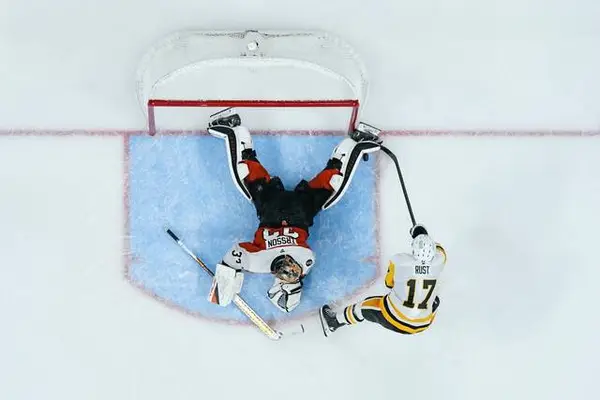
Sidney Crosby has dazzled with a collection of iconic moments over his 21 seasons in the NHL.
Arguably, the first notable moment of that anthology came fairly early in his rookie season with the Pittsburgh Penguins in 2005-06.
During a home contest on Nov. 10, 2005, against the Montreal Canadiens, the team he grew up rooting for, Crosby took to the ice for a shootout.
Neither team had scored on the first five attempts. After Penguins forwards Mark Recchi and Mario Lemieux were denied by Canadiens goaltender Jose Theodore, Crosby was sent over the boards by coach Eddie Olczyk.
As fans offered a standing ovation to Crosby for simply taking the ice, the 18-year-old surged down the middle of the slushy ice of the Mellon Arena. Approaching the cage, he lifted his right leg, faked a forehand shot (twice), then flipped to his backhand. Forcing Theodore to commit to the would-be wrister(s), Crosby lifted a backhanded shot over the goaltender’s left leg that struck Theodore’s water bottle, sending it into orbit and a listed crowd of 16,254 onto Centre Avenue with delirious delight over a 3-2 victory.
— EN Videos (@ENVideos19) December 11, 2025
“Just being excited for the opportunity,” Crosby said when asked to relive that moment on Thursday. “It’s nice when you have a chance to shoot to win. The pressure is off a little bit more in that sense. I remember watching the previous shot and kind of committing to my move. I came in there pretty fast.
“It was fun against the team I grew up watching and getting that goal.”
No such fun has existed for Crosby and company recently when it comes to the shootout. They have lost all five games that have gone to shootouts this season and have a nine-game losing streak in contests that require shootouts dating back to last season.
Their latest such setback unfolded in repugnant fashion during a 4-3 home loss to the Anaheim Ducks on Tuesday.
After yielding a game-tying goal with one-tenth of a second in regulation, the Penguins were unable to put any of the seven shots they registered in overtime into the cage. Then, they were blanked on all three shootout attempts they had against Ducks goaltender Ville Husso.
In contrast, Ducks forward Leo Carlsson scored the lone goal of the shootout for either team, beating goaltender Arturs Silovs.
“Some of those games probably shouldn’t even go to a shootout,” Crosby said of his team’s futility in shootouts. “We’ve had leads. Those are some games that probably shouldn’t even get there. It’s easy to be critical of the shootout but there’s a lot that has to happen to get to a shootout. But those are valuable points and we have to find a way to be better in (shootouts).”
They worked towards that endeavor on Thursday. Towards the end of their morning skate in Cranberry, the Penguins had a fairly extensive shootout drill.
For some reason, shootouts are being worked on at the end of the morning skate: pic.twitter.com/lKc9z0fIre
— Seth Rorabaugh (@SethRorabaugh) December 11, 2025
“We’re going to work on it more,” coach Dan Muse said. “We’ve got to find the time. Right now, we’re in this stretch where there’s not a lot of practice time. So, even after a pre-game skate, if we just chip away at it a little bit and just put guys in situations where they can get reps, we’ll be working with them and trying to provide what we can there to help with it. It’s an area we need to get better at. We’re going to find time to work on it.”
While refinement is the obvious purpose of such a drill, it’s also a time for some research and development with different moves (forehand vs. backhand) or approaches (swinging wide or going right down the middle of the rink).
“Just getting a couple of extra touches doing it and having a little bit of fun doing it when it really doesn’t matter, you can try some things and you can be a little bit more creative,” Penguins forward Bryan Rust said. “From there, that builds that confidence.”
The shootout is a fairly granular part of the game, at least in terms of how much time or energy it commands. That’s to say, aspects of hockey that otherwise happen in the first 60 minutes of regulation or the five minutes of overtime for a regular season game – such as faceoffs or breakouts – occur far more regularly.
As such, the bulk of the finite time allowed for practices are usually devoted to what happens in typical game settings. Shootouts can often be an afterthought in that respect.
But given that they are directly tied to claiming one or two points in the standings, they clearly carry quite a bit of gravity.
“We spend a lot of time on doing breakaways and goalie stuff,” Crosby said. “We’ve worked on it a lot. You want to do better for sure. But you’ve just got to stay with it. That’s all you can do.”
Goaltenders are also obviously a major component of that success (or failure). And perhaps no one embodies the Penguins’ futility in the shootout more than Silovs.
Entering Thursday, Silovs had allowed a league-high eight shootout goals on 10 attempts.
“You can practice as many as you can … but I can be better,” Silovs said after Tuesday’s loss. “We can be better, in general. We’re going to find a way.”
Rust suggested a way to find improvement.
“We’ve got to have a little bit more fun with it,” Rust said. “Mentally, it might be a block in terms of guys doing what they really are capable of and using the deception that they are capable of. Because just like everything, if you lose a little bit of confidence, you become a little bit rigid and you kind of overthink things. Just going back to doing it freely and loose.
“Let’s be honest, it’s not going to get any worse. So, might as well go out there and have some fun with it.”
How much strategy goes into how a shooter attacks the net?
“It depends on what goalie you’re going against,” Rust said. “Some of them are more aggressive than others. Some are more athletic than others. Some hold their gloves in different spots. There’s a lot that does go into it. Guys take all that information (and) they use their strengths along with knowing what the goalie does.”
The Penguins are clearly putting a lot of thought into finding a solution. At the same time, they don’t want to put too much thought into it.
“What you don’t want in those situations is somebody indecisive, overthinking,” Muse said. “Sometimes, too much information or pressure is going to lead to that. You do want to avoid that. There are different things to look at and try. That’s where practice is good to be able to take that time if you want to try something new.
“If somebody is going to give an idea, that would be the time in practice. But when it comes to a game, guys, they’ve got to go out there and play on their instincts.”
The NHL introduced the shootout in 2005 as a way to eliminate ties in regular season play. That innovation arrived at the same time Crosby made his NHL debut. He has seen, first-hand, how the shootout has become less and less of a novelty and more and more of a necessity, at least in terms of overall success.
“I don’t think there’s the same excitement as when it first started because it was so new and that sort of thing,” Crosby said. “Before, it was almost like everyone was excited for the entertainment value of it. Now, every single shot, this is important. These are meaningful points. You look at the conference (standings), shootouts are the difference between making the playoffs or not.”
By hook or by crook, the Penguins are doing what they can to fix the problem.
“Ultimately, you’ve just got to find a way to win one, however you do that,” Crosby said. “Whether it’s our goalie stealing one or three guys scoring, you’ve just got to find a way to win one. Hopefully, when we get one, we’ll get more.”