
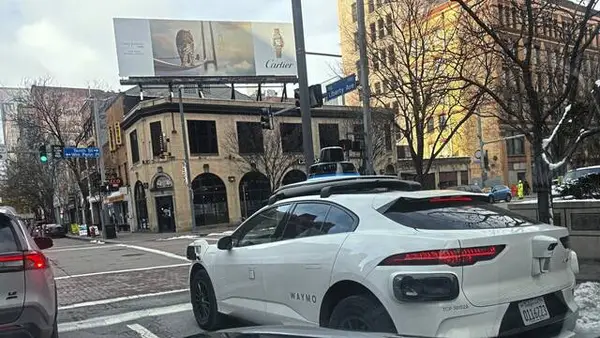
When the driverless taxi company Waymo recently announced it would be coming to Pittsburgh, the news was met with cautious skepticism by some of my old-timer friends. Pittsburghers are generally slow to embrace change, remaining loyal to the reliable past, and it may take a minute for us to accept the idea of driverless cars.
Some social media posters responded with concerns about our hills, bridges, narrow streets and bad weather — nothing Waymo hasn’t already seen elsewhere. And problems Waymo has recently encountered — including reports its cars have ignored school bus signals — were highlighted. But Waymo has shown its technology continues to learn from its mistakes.
The company’s safety statistics show that Waymo is safer than human drivers. Through June 2025, after 96 million rider-only miles, Waymo reported 91% fewer crashes resulting in serious injuries or worse, 92% fewer pedestrian crashes with injuries and 89% fewer motorcycle crashes with injuries.
Just this week, as I saw two vehicles engaged in high-speed pursuit on a crowded Parkway East, endangering us all, it was clear that driverless vehicles could even reduce road rage. Whatever drives a driverless vehicle, it will never explode in anger because of some imagined threat to its manhood.
I wasn’t always a believer. That changed when our daughter Addy surprised us with a Waymo during a recent visit to San Francisco. I sat up front, watched it maneuver through crowded intersections, pull over for an ambulance and not let us disembark until it found a safe place to stop.
The decision to bring Waymo here is a signal to others that Pittsburgh is a legitimate contender for more tech investment. And how Pittsburgh handles changes like Waymo will determine the region’s economic future.
A July 2025 article in Government Technology magazine concluded, “The Pittsburgh region’s push to transform itself into a global tech and artificial intelligence hub has notched a lot of wins of late, but work remains to keep the momentum going.”
But that momentum can be slowed by struggling and unprofessional local government. Pittsburgh city government and the Pittsburgh Public Schools are both struggling in ways that can cause prospective companies and employees to think twice about settling here.
After years of acquiescing to bad management practices by the outgoing mayor’s administration, Pittsburgh City Council members are now wringing their hands over a massive financial crisis. One council member has proposed a huge 30% real estate tax hike as the only solution, while others want to cut services beyond the bone.
At the city school board, nothing says “dysfunction” more clearly than the board’s recent vote to reject a plan that would have closed 12 schools and nine buildings in response to declining enrollment and operating deficits. With nine members elected by district, the school board struggles to cast votes in the best interest of the entire city.
If neither government gets its act together, state intervention and oversight may be the only things that will provide the confidence in local government that prospective employers and investors need before they stake their futures here.
The dilemma was perfectly stated in Giuseppe Tomasi di Lampedusa’s classic Italian historical novel “The Leopard,” when one principal character famously said, “If we want things to stay as they are, things will have to change.”
If Pittsburgh wants to maintain its reputation as a city that reinvents itself to grow and prosper — to become a tech and artificial intelligence hub this time around — the way that our local governments have been doing business lately will have to change.