
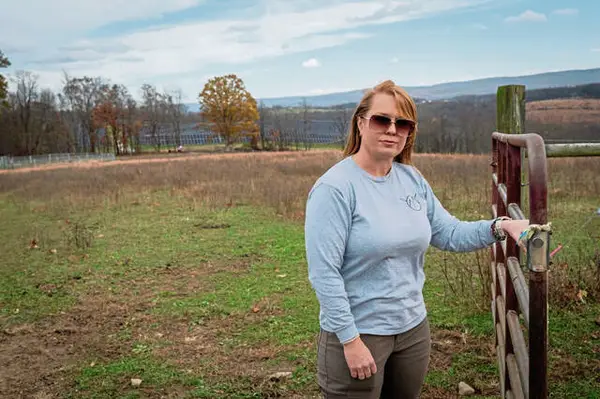
Brandi Umbaugh planned to build a home on her 70-acre farm that would have a commanding view of surrounding fields and woods hugging the eastern side of Westmoreland County’s Chestnut Ridge.
A massive solar panel array changed those plans.
The panels were installed on a former Cook Township farm across Mansville Road from Umbaugh’s, prompting her to shift her home site farther back on her property.
“It’s just heartbreaking,” said Umbaugh, 40, who works as a nurse while raising two children and tending beef cattle, horses and other animals. “I had to move my house. (A solar farm is) not what you want to look at on your front porch.
“Mansville was a beautiful, tree-lined road. It’s all gone now.”
Rural Cook Township lacks property zoning and, until August, didn’t have an ordinance regulating solar installations.
Known as solar farms, the sites can cover a few acres to dozens of acres. Commercial solar arrays generally are meant to provide power to local facilities, while utility-scale arrays — like the one in Cook — are intended to generate electricity for sale on the regional power grid.
Municipal governments have been racing to get ahead of, or at least catch up with, growing developer interest in building such sites in the Southwestern Pennsylvania countryside.
In 2021, Hempfield saw the arrival of two solar farms: a group of nearly 11,000 solar panels intended to provide about 3 million kilowatt-hours of electricity each year for the Municipal Authority of Westmoreland County’s sewer plant; and an array of about 3,200 panels to help power maintenance buildings along the Pennsylvania Turnpike’s Amos K. Hutchinson Bypass.
Bob Buterbaugh, who was elected in November to join the board of supervisors in Buffalo Township, Butler County, isn’t thrilled about an 8-acre solar farm planned near his Grimm Road home. But he considers it a good thing that the township had an ordinance in place governing such arrays.
“Without the ordinance, my understanding is that solar companies could have done whatever they wanted,” he said.
The Grimm Road solar array is one of two that Atlanta-based developer SolAmerica has planned on agriculturally zoned land in Buffalo Township. The other would cover about 13.5 acres along Bear Creek Road.
The solar projects have drawn fierce opposition from residents concerned about potential fire hazards at the sites and a negative effect on property values.
The projects received initial approval in August from the supervisors in a 4-1 vote. Township Solicitor Brian Farrington indicated the sites seemed to fall in line with township ordinances.
SolAmerica didn’t return messages seeking comment for this story.
During the township meeting in August, SolAmerica representatives and its engineering consultant told residents that they were unaware of any toxic chemicals in the solar panels. They promised the panels would be positioned so as not to create glare for neighbors.
Buterbaugh, who will take his seat as a township supervisor in January, said he would have voted against approval of the SolAmerica sites if he’d been a supervisor at the time.
“I appreciate the steps the company is seemingly taking to make sure residents’ issues are being addressed,” he said.
But, he added, “We’re taking the cornfields and kicking the animals out, and we’re pretending this is better for the planet?”
According to the U.S. Energy Information Administration, the average U.S. household uses about 10,500 kilowatt-hours of electricity in a year. A kilowatt-hour equals 1,000 watts of power expended for one hour.
The generating capacity of many solar farms is measured in megawatts, with 1 megawatt equaling 1 million watts.
The Gaucho Solar 20-megawatt farm went online in June 2023, with about 55,000 solar panels on a 68-acre site near Pittsburgh International Airport. It sits at the border of Findlay Township in Allegheny County and Independence Township in Beaver County.
It’s meant to supply electricity to the University of Pittsburgh for two decades.
Proposals for more utility-scale solar farms also have cropped up across the region — including in Derry and Ligonier townships.
Community leaders are being pulled into the debate over solar farms, including property rights, environmental concerns and farm preservation.
And legislators in Harrisburg are considering bills that could provide statewide control over where solar arrays can be installed and how they should be cleared after their use comes to an end.
Cook Supervisor Luke Grimm said officials in the township south of Ligonier Borough originally believed there was little they could do to control solar farm development. They moved to adopt an ordinance as residents reacted negatively to the array installed along Mansville Road.
Developer MN8 Energy placed the array of nearly 32,000 solar panels on about 72 acres of a 134-acre property. It was part of a $2.8 million land purchase in July 2023. The array was brought online in November 2024, with a generating capacity of 13.8 megawatts. It is expected to have a lifespan of more than 30 years.
“Mostly, a lot of people are upset because it ruined their view,” Grimm said of the solar array. “It will probably be an ongoing thing with people saying they have to look at that every day.”
Grimm said he understands the objections.
“Eventually, if you keep on taking the farmland away, there will be no land to farm,” he said. “Then you’ve got other people saying that it’s their property, they should be able to do what they want with it.”
The Cook ordinance limits a solar array to no more than 10% of the surface area of a lot, which must be at least 15 acres. It requires a minimum 200-foot setback from the property line.
The ordinance considers a solar farm to be abandoned if it has not generated power for 12 continuous months. The owner then has one year to remove it and must restore the land to its original condition.
MN8 team member David Krewson said the company planned to reach out to the local fire department to help prepare the firefighters for responding to any emergency that may occur at the fenced-in array. The company has offices in New York City; Boca Raton, Fla.; Dallas; and Pozuelo de Alarcón, Spain.
Grimm said the company proposed a weekday meeting, when most firefighters are at work. As of Wednesday, he said, a meeting had yet to be arranged.
Looking for guidance
Pennsylvania municipalities so far have looked to each other and to organizations such as the state Association of Township Supervisors for guidance on establishing requirements for solar farms.
Two bills under consideration by lawmakers could set statewide ground rules.
Senate Bill 349 focuses on decommissioning requirements for any solar array with a generating capacity of more than 2 megawatts. It would allow up to 18 months to decommission an array once it has stopped producing electricity.
The bill passed in the Senate by a 49-1 vote and was moved ahead by the House Environmental and Natural Resource Protection Committee.
“The bill passed the House committee unanimously on June 2 and received first consideration by the full House of Representatives that same day,” said Elizabeth Weitzel, communications director for prime sponsor Republican Sen. Gene Yaw. “It was then tabled, which essentially means set aside by the majority party.”
With the legislative session set to continue into 2026, Weitzel said, “The bill remains active and eligible for further consideration by the full House.”
Senate Bill 336 prohibits a solar farm with a capacity in excess of 2 megawatts from locating on agricultural land with higher-quality soil that is deemed Class 1 or Class 2, according to guidelines of the federal Natural Resource Conservation Service.
In addition to farming, those classes of soil are most desired for a variety of uses —including residential and commercial construction projects, according to Dan Brockett, state energy team leader for Penn State Extension.
“It’s easier to work with,” he said. “It’s well-drained soil that’s flatter, where you’re not fighting rocks and roots and hillsides. You’re not fighting against slides and slippage and erosion and sedimentation as much.”
Jim Pillsbury, a hydraulic engineer with the Westmoreland Conservation District, said Westmoreland County might have some land containing Class 2 soil but would not be a place to find the highest-quality Class 1 type — which is the best for farming.
According to Ian Harrell, district manager for the Butler County Conservation District, that county occupies a total of about 500,000 acres. Included are roughly 80,000 acres of prime farmland, 112,000 acres of Class 2 soil and just 309 acres of Class 1 soil.
Senate Bill 336 offers a limited annual tax credit of 3 cents per kilowatt ($30 per megawatt) for an array that locates on brownfields, warehouse rooftops, parking facility canopies, capped landfills or abandoned mines — instead of on farmland.
The bill was referred to the Senate Agriculture and Rural Affairs Committee in February and remained under review as of Friday. “Currently, we don’t have a timeline for movement on the legislation,” said committee Executive Director Lily Ott.
Sharon Pillar, executive director of the Pittsburgh-based nonprofit Pennsylvania Solar Center, said Senate Bill 349 has broad support from the solar industry. She indicated it would provide developers predictability in the amount of funds they need to set aside for decommissioning.
The nonprofit doesn’t support the bill that seeks to restrict solar arrays on farmland.
In cases where a solar developer leases land, Pillar said, it provides the farmer a new source of income and allows agricultural use to resume once the array is removed.
Pillar suggested the bill’s tax credit is inadequate to provide developers an incentive to place arrays in brownfields.
Mitchell Kurek, state and local affairs specialist for the Pennsylvania Farm Bureau, said there are two sides when considering solar installations.
“Farmers aren’t too thrilled with the idea of solar companies taking up farmland,” he said. “For at least a couple of decades that farmland would be out of commission.”
On the other hand, Kurek said, “We respect private property rights. We don’t want one farmer telling another farmer what they can do with their land.”
David Sanko, executive director of the Pennsylvania State Association of Township Supervisors, argued that statewide laws may not be the best vehicles for governing solar farm development. He noted they could supersede and sweep away carefully crafted provisions of municipal ordinances.
He said PSATS has compiled dozens of sample solar farm ordinances with language local leaders could pick and choose from to help in drafting measures best suited for their township.
“Each community is different,” Sanko said. “Some are concerned about farmland loss and some are concerned about stormwater runoff.
“Somebody is going to make rules that work in a lot of places, but it doesn’t work everywhere.”
Sanko said many township officials have expressed concern about how solar farms would be decommissioned, wanting to prevent their taxpayers from being saddled with any related cleanup costs.
Sanko believes solar arrays have a place in Pennsylvania’s energy industry, but he said their lasting impact on the land remains in question.
“You could have short-term environmental gains but maybe long-term environmental damage,” he said. “There’s a lot of uncertainty.”
He said developers’ eagerness to get solar arrays up and running may clash with townships’ desire to proceed cautiously into unknown territory.
“They want to do it fast, and our (township officials) want to do it right,” he said. “They aren’t interested in being obstacles but in making sure their communities are safe.
“Sometimes you can find a middle ground.”
Township ordinances valued
The Buffalo Township solar ordinance, passed in September 2024, requires the solar developer to cooperate with emergency services and to develop a response plan for any incidents at the site. The owner of the array has six months to remove it after it ceases operations.
Back in Westmoreland County, Hempfield had an ordinance in place before granting conditional approval for two new solar farms.
Illinois-based SunVest Solar is proposing a 3-megawatt array along Everglade Road. Colorado-headquartered Bear Peak Power is planning a 3,000-kilowatt facility off Penn Valley Road.
Hempfield adopted its solar regulations in March 2023.
“We were a little bit ahead of the curve,” township planning manager Matthew Pernelli said. “We require a 150-foot setback from all property lines, and we also have a decommissioning bond requirement.”
Derry, Ligonier and North Huntingdon townships are among other Westmoreland County municipalities where proposed solar farms have passed an initial step in the approval process.
Solar farm proposals have had a mixed reception in Unity.
The township zoning hearing board granted special-exception approval for a 4-megawatt array proposed by New York City-based CVE North America on a leased 13-acre section of a reclaimed former stone quarry along Bethel Church Road.
The Unity zoning panel, by a 3-2 vote, earlier denied a similar exception sought by GreenKey Solar/Ninemile Run Solar Master Tenant LLC for a proposed solar farm on part of a 62-acre property along Charles Houck Road.
The panel, according to Unity’s solicitor, decided the array would exceed the maximum 20% “coverage” that was allowed on the agriculturally zoned property. The board rejected Oregon-based GreenKey’s contention that it would be using slightly less than 17% of the property.
GreenKey has appealed to the Westmoreland County Common Pleas Court, arguing that the zoning decision isn’t supported by evidence in the case, contradicts other case law and relies upon incorrect mathematical calculations.
The Unity supervisors this past spring revised township rules to prohibit the arrays on agricultural land, limiting them to a sparsely populated conservation district bordering Chestnut Ridge.
“You have to have a place for them,” Unity Supervisor Mike O’Barto said of solar farms. “By putting them in the conservation district, for the majority of that area, it’s not around homes and it’s not taking up any agricultural area.”
GreenKey has filed suit against East Huntingdon Township, where the company has considered solar development on three properties. It argues that the supervisors in February hastily and improperly adopted an ordinance that effectively bans solar farms in the township.
In preliminary objections, the township argued that GreenKey lacks standing to bring the suit and that it failed to first seek a remedy under the state’s Municipal Planning Code.