
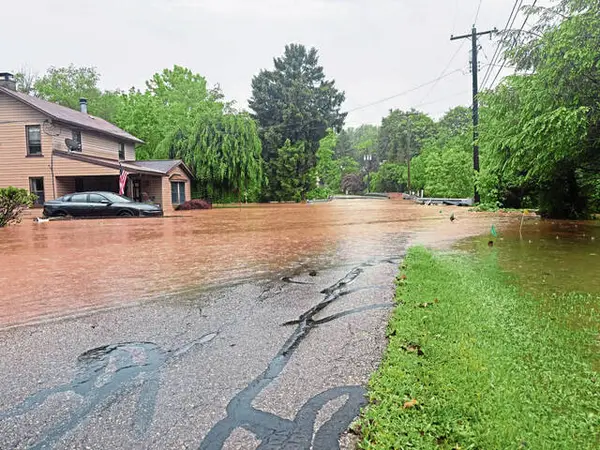
Murrysville property owners will see a new $7 monthly stormwater fee starting next year, after council members approved a measure aimed at fixing the municipality’s aging infrastructure and meeting state environmental mandates.
Prior to the 5-1 vote this week, council members debated whether the fee — which the Pennsylvania Commonwealth Court ruled in 2023 is legally a tax — was being applied equitably.
“I know stormwater improvements are an unfunded mandate and we have to figure out where that money will come from,” Councilwoman Jamie Lingg said. “But I think when you have a community as property-diverse as Murrysville, a random sampling doesn’t always reflect the community.”
The fee is a response to annual pollution-reduction goals set by the Pennsylvania Department of Environmental Protection. As part of its municipal separate storm sewer system (MS4) permits, Murrysville is required to take on projects that will lower the amount of pollution in the town’s stormwater runoff.
As recommended by a commissioned engineering study, the flat $7 monthly fee applies to residential properties with up to 5,800 square feet of impervious surface — areas such as roofs and driveways that do not absorb water. More specific calculations would be done on lots of 3 acres or more, and commercial structures’ impervious surface would be calculated individually.
Lingg asked if staff could instead formulate a fee based on property values.
“Usually a property that’s assessed higher is going to have more impervious surface — not always, you’d have exceptions,” she said.
However, council President Dayne Dice countered that a value-based system would essentially be a property tax increase.
“This way, we’re identifying the main contributors to stormwater issues in the municipality and there’s incentive for them to install more stormwater mitigation,” Dice said.
Murrysville also will initiate a credit program for properties developed in recent years that have included more stormwater controls, addressing a concern raised by Choice Auto Sales owner Kirk Rettger, who spent about $200,000 on stormwater mitigation measures when he relocated his business a few years ago.
The credit program would reward property owners such as Rettger, and would also serve as an incentive for older property owners to employ better stormwater controls.
The need for immediate action was underscored by Councilman Mac McKenna, who pointed to the increasing severity of local flooding.
“For years, I feel like we’ve been kicking the can down the road,” McKenna said. “I mean, we had emergency services taking kids to graduation in a boat because of stormwater.”
While Lingg maintained that the current calculation unfairly charges older, smaller homes the same rate as newer estates, the majority of the council was not keen on hiring another engineer for another study.
“I feel like the conclusion will be very close to what we have already,” Councilman Carl Stepanovich said.
Communities across western Pennsylvania have adopted stormwater fees in recent years, ranging from $5 to $11 per month. They are almost always calculated using a base unit of square footage, and larger commercial properties are either charged for multiples of the base unit, or their fees are calculated individually.
Murrysville’s fee is anticipated to bring in between $965,000 and $1 million annually. Chief Administrator Michael Nestico said this revenue would help the town shift from reactive to proactive maintenance.
“We’re not managing our stormwater infrastructure to the level we need,” he said. “We budget for the things that are necessary or imminent. But we’re not budgeting in a way that will allow us to get ahead.”
Nestico said staff will begin work on the credit program and will present it for council’s approval during the first quarter of 2026.
Councilman Eli Diacopoulos was not present for the vote, in which Lingg cast the lone “no” vote.