
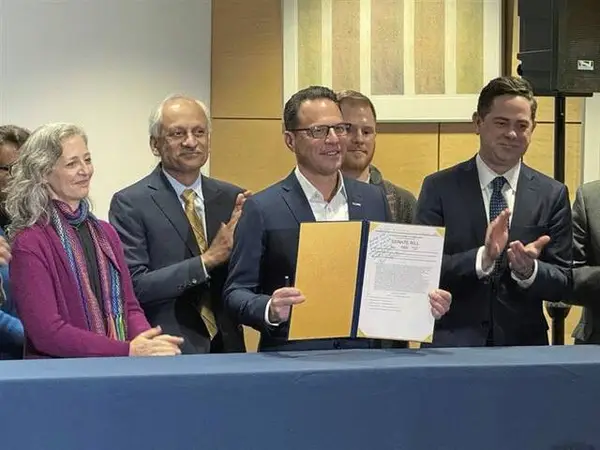
Gov. Josh Shapiro chose the University of Pittsburgh as the backdrop Friday to unveil a new $5 million research grant in the state’s 2025-26 budget — a nod to Pitt’s prominent role in neurodegenerative disease research.
Scientists based in Pitt’s Biomedical Science Tower in Oakland walked Shapiro and state Health Secretary Dr. Debra Bogen through ongoing work examining how Alzheimer’s, Parkinson’s and ALS damage brain cells.
Although the demonstration underscored Pitt’s credentials, the administration explained that the funding will be awarded competitively, open to major research institutions across the state.
Bogen said that the applications are open to institutions such as Pitt, Carnegie Mellon University, Duquesne University, University of Pennsylvania and Penn State University.
Neurodegenerative diseases are progressive conditions where nerve cells in the brain and nervous system gradually die, leading to Alzheimer’s, Parkinson’s and ALS, otherwise known as Lou Gehrig’s disease.
“Neurodegenerative diseases claim far too many lives and impact too many families, and we need to do more research,” Shapiro said during a news conference. “We need to trust science.”
Applications for the grant — led by Shapiro and state Rep. Kyle Mullins, D-Lackawanna — will open after the new year.
Nationally, more than 7 million Americans live with Alzheimer’s, which is projected to nearly double by 2050. In Pennsylvania, over 280,000 people ages 65 and older are currently living with Alzheimer’s disease, Bogen said.
Across the state, caregivers of those living with neurodegenerative diseases provide an estimated 822 million hours of unpaid care a year, she said.
Bogen explained that the diseases don’t just harm patients — they also take a toll on caregivers. Those caring for people with dementia are six times more likely to struggle with depression and frequently develop their own serious health issues from the stress.
Dr. Chris Donnelly, a Pitt researcher, said one goal is to explain what causes brain diseases and why neurons fail.
“We know that as our population ages, the risk of developing these increases,” Donnelly said. “Many of these disorders lack any effective treatment, and so there’s not much we can tell patients.”
During Friday’s news conference, some Pennsylvania lawmakers shared their own personal experiences with loved-ones who were diagnosed with a neurodegenerative disease.
Mullins spoke about his father, who died from ALS in 2022.
“Shapiro was elected 14 days after my father passed away, and less than three months later, he had me in his office to talk about the very funding we’re celebrating,” Mullins said.
Bogen said two of her uncles battled Parkinson’s disease and her sister-in-law has Alzheimer’s disease, which requires Bogen’s brother to provide 24-hour care.
Shapiro recounted meeting the late Dr. Raymond Wesley Rose, who was a biology professor at Arcadia University, in 2005.
“Wes (Rose) sat down across the desk from me and told me he had just been diagnosed with ALS, and he wanted me as his representative to do something about it,” Shapiro said.
The two stayed in contact, speaking regularly, until Rose died in 2018.
In 2024, Shapiro created the Alzheimer’s, Dementia and Related Disorders (ADRD) Office to support older adults living with the disease and their caregivers.
The Pennsylvania Department of Aging funds research on diseases like Alzheimer’s, ALS and Parkinson’s in some of the nation’s top research institutions.
“This new grant will begin early in 2026 and will prioritize high impact, collaborative research that bridges the gap between the laboratory bench and the patient’s bedside,” Bogen said.