
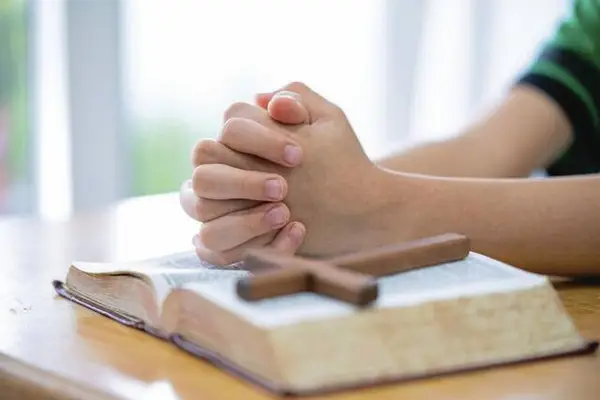
In Westmoreland County Prison, the freedom to worship is treated less as a right than a whim.
On multiple occasions, prayer or Bible study gatherings have been disrupted by corrections officers.
Tim Williamson of Jeannette spent about a month at the prison related to a misdemeanor arrest. He says he was praying with a group of nine men. They were ordered to stop.
In the weeks since his release, he has compiled accounts from others that show similar experiences. Two separate statements seen by the Trib indicate multiple examples of disrupted prayer groups. Williamson received a call from the jail telling him of another incident that day.
The pattern is not just reported by the incarcerated. It is acknowledged by prison leadership.
While Warden Steve Pelesky doesn’t concede that religious groups were targeted, he does confirm that gatherings have been quashed. There are formal schedules and times, separated by unit.
“That’s the way we’ve always done it. Individuals cannot gather by themselves. There has to be a designated place,” he said.
But if inmates are permitted to gather to watch TV or play games, it is hard to see why prayer must be confined to a schedule.
The First Amendment still permits — one could argue it demands — people in prison to have the same freedom of religion afforded everyone else. The federal Religious Land Use and Institutionalized Persons Act of 2000 compels jails to have firm basis for any limits and that those restrictions on religion be as loose as possible.
This is not just a question of Christians and Bibles. It is not the first time religious legitimacy has come up even this year.
Kort Noel Eckman is awaiting trial. He has had his ability to appear in court disrupted and been hospitalized for malnutrition, both related to the jail failing to recognize his assertion of Jewish faith.
Eckman was arrested while in the process of converting to Judaism but had not completed it. The prison would not allow him to wear a yarmulke in court and denied him kosher meals. While both have since been allowed, it was only after the county brought in a rabbi to test Eckman’s faith. That’s not a job the Constitution requires.
Former warden Bryan Kline points to these failures as a chasm between a duty to enforce the law and protect security and a responsibility to recognize rights and humanity.
“Only then can (Westmoreland County) begin to restore faith in the values our justice system claims to embody,” Kline wrote in an op-ed this month.
Individually, disrupted prayer groups and denied kosher meals might be dismissed as anomalies. Taken together, they are harder to ignore. They lead to a question the prison and the county leadership need to answer:
Is faith being locked out of Westmoreland County Prison?