
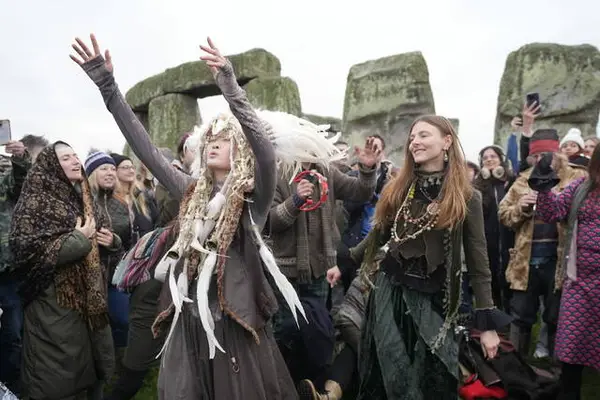
LONDON — Thousands of people cheered and danced around Stonehenge as the sun rose over the prehistoric stone circle on Sunday, the winter solstice.
The crowds, many dressed as druids and pagans, had gathered before dawn, waiting patiently in the dark and cold field in southwest England. Some sang and beat drums, while others took time to reflect among the huge stone pillars.
Many make the pilgrimage to the stone circle every summer and winter and consider it a spiritual experience. The ancient monument, erected between 5,000 and 3,500 years ago, was built to align with the movement of the sun on the solstices — key dates in the calendar for ancient farmers.
English Heritage, the organization that manages Stonehenge, said some 8,500 people celebrated Saturday at the monument on Salisbury Plain, about 75 miles southwest of London. It added that its livestream of the festivities drew over 242,000 views from around the world.
Sunday is the shortest day of the year north of the equator, where the solstice marks the start of astronomical winter. It’s the opposite in the Southern Hemisphere, where it is the longest day of the year and summer will start.
The winter solstice is when the sun makes its shortest, lowest arc, but many celebrate it as a time of renewal because after Sunday, the sun starts climbing again and days will get a little longer every day until late June.