Saying its hands were tied, Springdale Council approved an application to construct an AI data center in the borough.
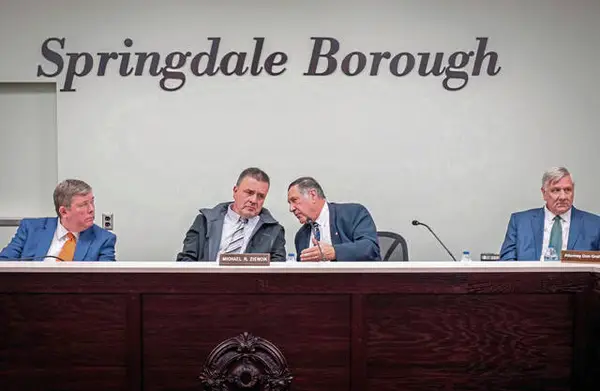
After months of meetings and debate, council voted, 5-2, Tuesday night to approve a conditional-use application from developer Allegheny DC Property Co. to build a massive complex at the site of the former Cheswick Generating Station.
Among the council members who voted to approve the project, several expressed reservations but said a doomed legal battle with developers likely would be the result of a rejection.
Michael Ziencik, Jason Overly, Dan Copeland, Dolly Stephens and Joe Kern voted to approve the project. Toni Robbins and Jeff Hartz voted to reject it.
Hartz — the first to cast a vote — spoke for about 10 minutes about his concerns before voting against the application.
Like other council members, he said he was concerned developers would sue the borough to appeal a rejection, which would mean the borough would lose its rights to apply conditions to the proposal.
“The way I look at it is: If you have to sue a small community like ours to invade it — then you should probably not come,” Hartz said.
Kern and Overly said they shared Hartz’s concerns about a legal battle but opted to approve the center.
A statement read by Springdale Manager Terry Carcella said the borough had consulted outside counsel and determined the developer’s chances of winning an appeal were “highly probable.” The application clearly demonstrated that the developers were compliant with borough ordinances, he said, making approval “mandatory and not discretionary.”
He said approving the center with conditions was “in the best interests of the borough.”
Anna Jewart, an attorney representing the developers, said that if council had rejected the data center, she would have had to confer with her client, but an appeal would be “always an option.”
The conditions
Along with the application, council approved 19 conditions to the project.
Included in the conditions is an obligation for the developer to enter a development agreement and community benefits agreement with the borough.
That condition says the agreement may require developers to cover the cost of “equipment and apparatus reasonably necessary for police, fire and emergency services” to provide their services.
Noise concerns are also addressed in the conditions.
One requires that testing of backup diesel generators only occur between 8 a.m. and 6 p.m. on weekdays, and another would have developers cover the cost of annual sound modeling to be reviewed by a third-party engineer.
The final condition also asks Allegheny DC to evaluate whether the site can be accessed via Pittsburgh Street instead of Duquesne Avenue, where previous models have placed the its entrance.
The residents
Council made its decision in the face of stark resistance from some borough residents and other locals.
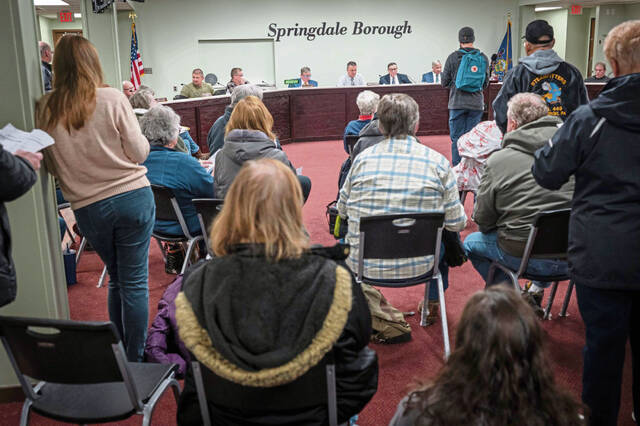
Dozens of people packed the council chambers, which provided mostly standing room with few chairs, unlike previous meetings.
Residents have consistently raised concerns over the amount of noise the center could emit, its large power demand and the project’s environmental impacts — especially emissions from the more than 100 diesel backup generators planned for its roof.
On Tuesday, the meeting often became rowdy as attendees alternately jeered and cheered while residents and council members spoke.
When Stephens said she had spent many sleepless nights considering the proposal, one attendee cried: “You’ll have many sleepless more.”
Springdale police approached several attendees to instruct them to quiet down.
One speaker had the crowd participate in an informal referendum, asking them to raise their hands if they disapproved of the project. Hands shot up throughout the room.
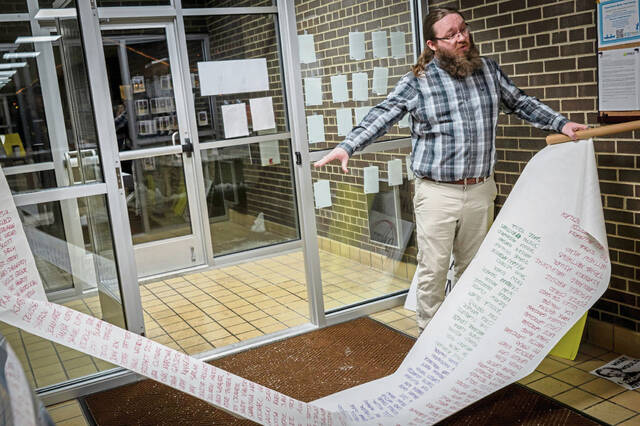
Speaking during the meeting’s public comment period, resident Matthew Lang unfurled a lengthy banner with the names of residents he said had signed a petition opposing the center. He read them aloud for about two minutes.
Lang later said he was “disappointed” with the vote, saying it didn’t seem fair that the size of the developer’s purse seemed to be the deciding factor.
Springdale resident Jim Marsili, who has spoken against the center at several previous meetings, said things simply came down to money.
“We don’t want to get sued, but they’ve got the money,” he said.
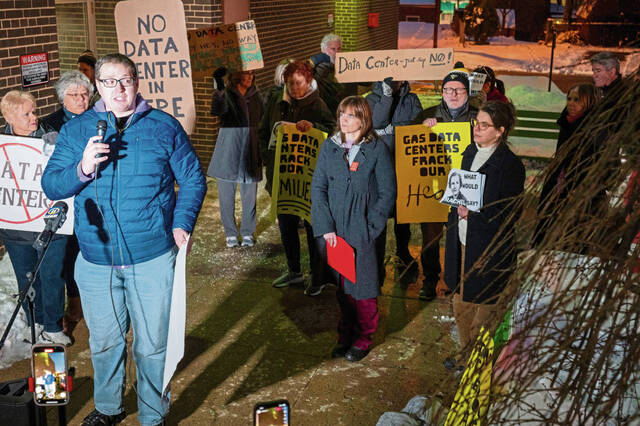
Local environmental groups and residents held a rally to oppose the center just before the meeting began.
There, residents held placards as they filed to the microphone to make their case against the project.
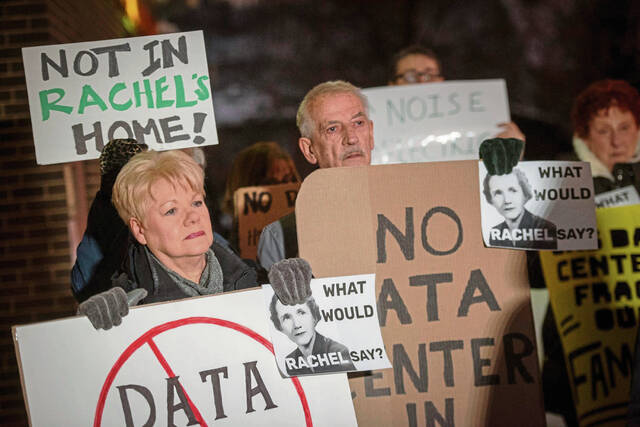
Many bore signs reading “What would Rachel say?”, referencing famed environmentalist Rachel Carson, born in Springdale in 1907.
Springdale resident Devon McCullough said before the vote that he understands the importance of data centers. But he said he doesn’t want his community to be test subjects for the project, which developers have said is a unique design not yet found in the United States.
“I would very much prefer to not be a guinea pig,” McCullough said.
The future
The vote marks the last major hurdle Allegheny DC had to clear ahead of the land development process. Allegheny DC is backed by New York-based hedge fund Davidson Kempner.
But Brian Regli, a consultant for Allegheny DC who has served as main spokesman for the project, said the vote only marks the end of the first chapter of the process.
The project will now enter its design and development phase, which Regli said will likely last about nine months.
He said he hopes to be back in Springdale in early spring with a more detailed design.
The land development phase of the project involves dealing with Allegheny County officials to obtain permits.
Regli said that, in the meantime, he’ll continue to try to win over residents who oppose the center.
But he said he understood some simply won’t come around to the proposal.
Phoebe Reese, a director at the Breathe Project, a Pittsburgh-based nonprofit focused on air quality, said her group will stay involved in monitoring the project.
“We’re going to keep fighting for public health,” she said.