
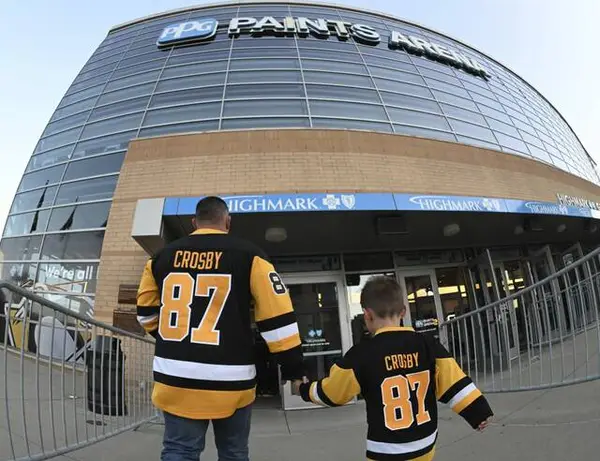
An agreement has been reached for Fenway Sports Group to sell the Pittsburgh Penguins to the Hoffmann Family of Companies, an investment group based in Chicago, according to multiple reports Wednesday.
A spokesperson with Fenway said he was aware of the reports but stated, “there is no formal agreement in place to confirm or announce at this time” via an e-mail with TribLive.
An inquiry with the Hoffmann group was not returned.
National hockey reporter Frank Seravalli first reported the agreement.
ESPN and TSN have reported a purchase price between $1.7 and $1.8 billion. Fenway bought a controlling interest in the Penguins from Mario Lemieux and Ron Burkle in 2021 for $900 million.
Any sale would require approval by the NHL’s board of governors, a formality that typically unfolds with little difficulty.
Discussions of a sale have been speculated upon since the summer.
Headed by David Hoffmann, 73, the Hoffmann group has interests in various fields ranging from aviation to media. The group is also the owner of the Florida Everblades, one of the model teams of the ECHL.
Nearly a year ago, in January, it was initially reported that Fenway sought investors to take on minority shares in the franchise in order to raise equity.
Fenway’s tenure as Penguins owners has not been successful on the ice. The Penguins lost to the New York Rangers in the first round of the playoffs a few months after the deal was announced in December of 2021, then missed the playoffs the following three seasons.
Off the ice, Fenway has made numerous investments into the front office, starting with the hiring of president of hockey operations Kyle Dubas in 2023, as well as upgrades to PPG Paints Arena. In contrast, several business staffers were laid off in 2024.
As for the arena, the lease the team signed with the Allegheny County Sports and Exhibition Authority in 2007 does not expire until 2040.
One major unresolved issue is the future of Sportsnet Pittsburgh. The television network is jointly owned by Fenway and the Pittsburgh Pirates, with the Fenway-owned NESN network handling much of the daily operations.
A change in ownership is not likely to make any meaningful change to the team’s payroll. The league’s collective bargaining agreement includes a salary cap and floor with teams mandated to spend, this season, a minimum of $70.6 million and a maximum of $95.5 million on player salaries. Because of the relatively small range from top to bottom, the depth of an ownership group’s pockets rarely impacts the amount of cash teams spend on players.
The Penguins ownership situation has been much more stable since the turn of the century than it was in the 33 years prior.
An ownership group headed up by state senator Jack McGregor and Peter Block paid a $2 million expansion fee to the NHL when the team was founded in 1967.
In 1975, the team’s offices were padlocked by the IRS and the club was forced into bankruptcy.
The ownership of Edward DeBartolo brought a period of relative stability from 1977-91, but a 1991 sale to a group fronted by Howard Baldwin nearly proved disastrous when the team filed for bankruptcy again in 1998.
Lemieux bought the team out of bankruptcy in 1999, using money he was owed in deferred salary from his playing days to help finance the sale.
His leadership brought about the most prosperous period in franchise history, including Stanley Cup championships in 2009, 2016 and 2017 and the opening of a new arena in 2010.
It is not known what role, if any, Lemieux will have with the Hoffmann ownership group.
He and Burkle maintained a minority ownership stake during Fenway’s tenure.
Developing the property around the arena — specifically the site of the former Civic Arena — has been an issue that has plagued the Fenway and Lemieux/Burkle ownership groups. While the FNB Financial Center — colloquially known as the FNB Tower — formally opened in February and construction is ongoing for a concert venue, much of the 29-acre site remains untouched.
In October, the Penguins relinquished their rights to develop the site as an agreement with the Pittsburgh’s Urban Redevelopment Authority and Sports & Exhibition Authority expired.