
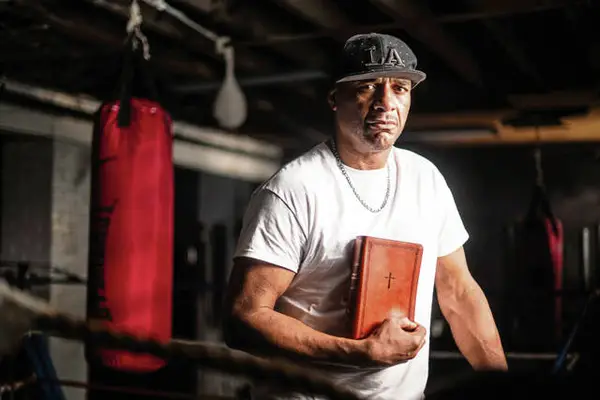
Tim Williamson was praying with a group of nine men at Westmoreland County Prison when a guard ordered them to stop — an encounter he says is part of a pattern of officials blocking religious expression at the Hempfield jail.
Since his release this month, the Jeannette resident has been collecting statements from other incarcerated men who reported similar incidents over the last several weeks.
Williamson believes the dispersion of these informal groups violates their constitutional rights.
“There were times when some (corrections officers) didn’t say nothing, but there were times when some did,” Williamson said.
Warden Steve Pelesky confirmed that some gatherings have been dispersed but denied that informal Bible study sessions are being singled out. He said those held at the jail are permitted to gather only in designated areas at specific times.
The Westmoreland County Prison has nondenominational religious services weekly, Pelesky said. Formal nondenominational Bible study sessions also are held weekly in separate units.
“Bible study meets by unit, and we have separation for a reason,” Pelesky said. “That’s the way we’ve always done it. Individuals cannot gather by themselves. There has to be a designated place.”
While the jail allows people to watch TV, play cards or talk in common areas, Williamson noted a double standard: Groups meeting to play games or watch sports are often left alone, while those meeting to pray are sometimes stopped.
Pelesky maintained that any gathering can be broken up if it occurs in a restricted area, such as the gym, or involves people who are not permitted to be together.
Act protects religious freedoms
Religious freedoms for people who are incarcerated are protected under the Religious Land Use and Institutionalized Persons Act. The law prohibits regulations that impose a “substantial burden” on an institutionalized person practicing their faith unless the agency can show that the rule has a “compelling governmental interest” and is the least restrictive way to adhere to it, according to a 2020 U.S. Department of Justice report on the 25th anniversary of the law being enacted.
Officials had opened about 70 investigations under the act in those 20 years, filed three lawsuits and penned about 20 court briefs addressing the interpretation and application of the law specific to institutionalized people, according to the report.
Those cases were related to religious diet, access to religious texts and articles, opportunity to participate in religious group meetings, religious headwear and accommodation of religious grooming practices.
Legality questioned
A Nov. 28 statement from a fellow prisoner obtained by the Trib indicated that informal prayer groups were broken up a few times and guards told them it was a potential safety risk. Another statement, from Nov. 23, indicated prayer groups were broken up three times for the same reason.
A phone call from the jail reportedly received by Williamson this month indicated a prayer group was dispersed that day. Williamson said typically about 10 people would gather during the informal sessions.
“It’s illegal what they’re doing; it’s against constitutional rights,” he said.
People in jail can seek, or depend on, religion to find peace while incarcerated or to help them get through, he said. Gatherings of like-minded people, whether secular or religious, can provide a social support that may help prevent reoffending, said Bryan Kline, corrections expert and former warden at the county jail.
“Just because you’re incarcerated, you don’t lose your religious freedoms,” he said. “Failure to uphold religious rights and liberties is a systemic failure that erodes trust in our correctional system.”
Pennsylvania Prison Society prison monitor director Noah Barth said the nonprofit advocacy group periodically gets reports of jails interrupting or discouraging incarcerated people to gather and practice their religion.
“While the jails do need to be careful about gatherings and potential security concerns, where this interferes with practice of spiritual belief, it can raise serious questions about basic freedoms and care being provided to people in the county’s custody,” he said.
Policies at the Westmoreland County Prison were questioned this year when a man being held there was not transported to a hearing at the courthouse because of security concerns that contraband could be concealed in his yarmulke. He observes Jewish traditions and wears the yarmulke, a head covering worn by Jewish men, according to attorneys.
In a December court appearance, attorneys said some kosher meals now are being provided after a rabbi taught jail staff how to prepare them, but the man had been hospitalized for malnutrition.
Grievance is first step
Both Barth and Alexandra Morgan-Kurtz, deputy director of the Pennsylvania Institutional Law Project, said the first step for incarcerated people who find themselves in such a situation would be to file a grievance.
“The statutes and the law are clear, and there’s such a benefit for individuals to be able to exercise their constitutional rights generally,” Morgan-Kurtz said.
It’s an area of law that has strong protections for religious freedom, but jails and prisons don’t seem to take such requests seriously, Morgan-Kurtz said.
Part of the Westmoreland inmate handbook obtained by the Trib indicates the prison “will provide for the accommodation of religious activities consistent with the security needs and orderly administration of the prison.”
Security is typically the most common issue cited by institutions, but a governmental agency has to show that they tried to come up with other ways that are the least restrictive possible to address those concerns before infringing on a person’s rights, Morgan-Kurtz said.
People held at the Westmoreland jail have to request a grievance form from a guard, Pelesky said. The inmate handbook indicates prisoners should try to resolve a concern informally in writing before filing a grievance, which must be done within 15 days of the situation at issue.
Williamson expressed frustration that grievance forms aren’t more readily available on cell blocks.
“That’s how you would address something like this,” he said. “There’s no way for you to get any justice on the block. It stops at the (corrections officer) or it stops at the sergeants.”
Staff writer Rich Cholodofsky contributed.