
A move by the Trump administration to exclude nursing from a list of professional degrees for student loan purposes could have far-reaching impacts on the future of the profession, medical experts say.
“Nursing is a serious profession that is about lifelong learning,” UPMC Chief Nurse Executive Maribeth McLaughlin said. “The medical profession is always changing, and the ability to learn is important.
“I’m concerned that this is going to affect the student pipeline.”
The exclusion, under the One Big Beautiful Bill Act, does not affect the licensing or legal standing of nurses. But it will limit access to financial aid and, subsequently, curtail opportunities for advanced education, officials said.
The average cost for an advanced nursing degree in Pennsylvania varies, with accelerated BSNs costing up to $70,000 and master’s or doctoral programs potentially topping $100,000, according to absn.org, an online platform about Accelerated Bachelor of Science in Nursing programs. There are additional fees for books, uniforms and equipment.
Duquesne University’s average total cost for a master’s in nursing is about $69,000. A doctoral program at the University of Pittsburgh costs about $54,000.
The Geisinger Nurse Anesthesia program at Bloomsburg can cost more than $100,000 for in-state students.
Beginning in July, students seeking to earn their master’s degree, Doctor of Nursing Practice or Ph.D. will be limited to $20,500 in loans each year with a lifetime cap of $100,000. That’s compared to $50,000 a year, and lifetime cap of $200,000, for students pursuing designated professional degrees like medicine or law.
“At a time when health care in our country faces a historic nurse shortage and rising demands, limiting nurses’ access to funding for graduate education threatens the very foundation of patient care,” Jennifer Mensik Kennedy, president of the American Nurses Association, said in a news release.
“In many communities across the country, particularly in rural and underserved areas, advanced practice registered nurses ensure access to essential, high-quality care that would otherwise be unavailable.”
Kennedy’s group is lobbying for reconsideration by the Department of Education. There is also an outcry from the American Association of Colleges of Nursing (AACN), which said the edict affects affordability for advanced degrees like nurse practitioners and nurse anesthetists, and can deplete the supply of nursing teachers.
The Department of Education, however, said the effects won’t be so far-reaching.
“Data indicates that 95% of nursing students borrow below the annual loan limit and therefore are not affected by the new caps,” a Department of Education spokesperson said in an email to TribLive.
But the AACN, in material published on its website, says the change disproportionately harms cash-strapped students who rely on loans to seek higher degrees.
“The announcement took me by surprise,” McLaughlin said. “I don’t think anyone would have expected us to be in this category. How would we continue to grow the profession?”
The nursing shortage is already dire.
According to the Health Resources and Services Administration, authorities project a shortage of more than 63,700 full-time registered nurses by 2030.
Through 2032, more than 193,000 registered nurses will be needed to fill job openings each year, according to the Bureau of Labor Statistics.
The Advanced Practice Registered Nurse workforce, which includes nurse practitioners and nurse anesthetists, will require about 29,000 new hires a year to meet the rising demand for primary and specialty care.
McLaughlin said UPMC will work to circumvent the effects of the new loan exclusion by continuing to offer tuition reimbursement to employed nurses seeking advanced degrees.
The health system also is adding $23 million for wage increases for its nonunion nurses this year.
Gloria Kreps, a UPMC spokesperson, said the starting base wage for nonunion inpatient nurses in urban hospitals with a four-year BSN degree will be $41.75 an hour. Starting rate for nonunion inpatient nurses in urban hospitals with non-bachelor degrees will be $40 an hour.
“That, in combination with the tuition reimbursement, will help them be able to go back to school,” McLaughlin said. “It’s important that we meet this need.”
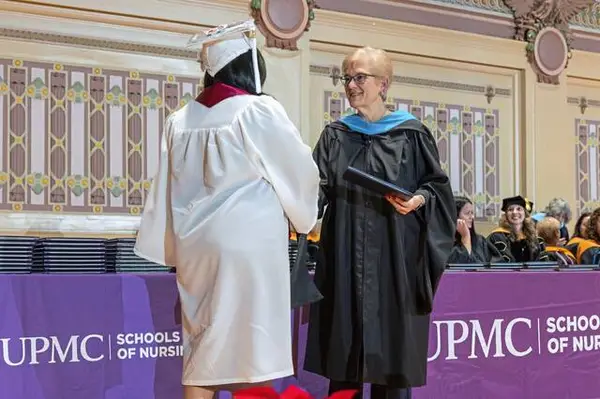
UPMC last week celebrated the graduation of more than 380 nursing students across seven campuses, with nearly 80% of the students accepting jobs within the health care system.
McLaughlin said she is hopeful the new ruling will be reversed, especially after more than 100 members of Congress submitted a letter to the Department of Education on Dec. 12 to argue against it.
“You can clearly see the tie,” McLaughlin said. “If you don’t have the advanced degrees, you stifle the pipeline.”