
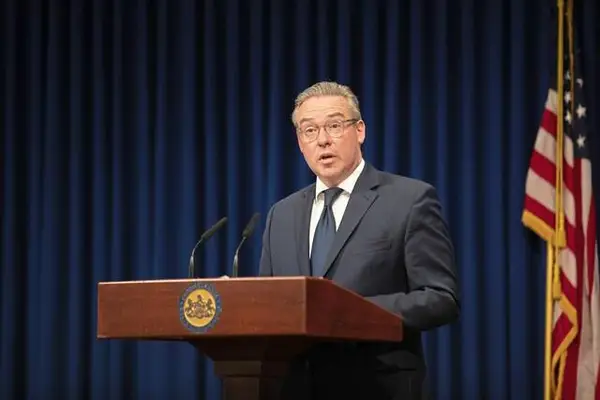
Pennsylvania’s top election official wants a judge to toss out a lawsuit by the federal government demanding “highly sensitive personal information” about the state’s voters.
The U.S. Department of Justice sued Pennsylvania in September after the state initially failed to turn over data about its nearly 9 million registered voters.
Those records included names and dates of birth, as well as driver’s license numbers and Social Security numbers, Secretary of the Commonwealth Al Schmidt has said.
In a 33-page brief filed last week in federal court, lawyers for Schmidt claimed the Justice Department is not authorized under various laws to obtain the information.
“The Department of Justice now seeks to usurp the authority Congress granted Pennsylvania,” according to the Dec. 16 brief.
“It demands complete and unfettered electronic access to Pennsylvania’s voter registration list — ostensibly to ensure that Pennsylvania is conducting a general program of list maintenance, but without any allegation that Pennsylvania’s list maintenance practices are deficient.”
The Justice Department requested the data in June — then again in July and August, Schmidt said.
Officials later sued Pennsylvania and seven other states, including California, Michigan and New York. Only one of the states sued — New Hampshire — is run by a Republican governor.
‘Unprecedented and unlawful’
The Justice Department told Schmidt in a letter to ensure “registrants who are ineligible to vote due to non-citizenship are identified and removed from the statewide voter registration list.”
Attorney General Pam Bondi stressed the lawsuits, filed in federal court, were necessary to ensure states managed “clean voter rolls.”
“Clean voter rolls are the foundation of free and fair elections,” Bondi said in a news release. “Every state has a responsibility to ensure that voter registration records are accurate, accessible and secure — states that don’t fulfill that obligation will see this Department of Justice in court.”
But Schmidt said federal officials don’t need Pennsylvanians’ Social Security or driver’s license numbers for election oversight.
“The department does a robust job of ensuring that all of Pennsylvania’s 67 counties comply with their list maintenance responsibilities,” Schmidt wrote.
Schmidt had called Bondi’s demands “unprecedented and unlawful” and maintained he would “vigorously fight the federal government’s overreach in court.”
None of the three laws Bondi’s team cited in their lawsuit “authorizes (the Justice Department) to obtain this highly sensitive personal information about every Pennsylvania voter,” according to the filing.
“Nor is this data necessary,” Schmidt’s lawyers added, “to establish that Pennsylvania has a general program to remove deceased and moved registrants or duplicate records.”
Schmidt’s initial response
According to the government’s lawsuit, the attorney general’s Civil Rights Division first requested Pennsylvania’s voter roll data on June 23.
The government’s letter sought information and documents detailing the process “by which registrants who are ineligible to vote due to non-citizenship are identified and removed from the statewide voter registration list.”
It also asked for a description of the process used by Pennsylvania officials to “carry out its list maintenance obligations” under the Help America Vote Act, which requires all states to create a standardized statewide voter registration list.
The lawsuit alleged Schmidt’s response a month later did not explain whether non-citizens were identified and what steps were taken to remove them.
However, according to an 11-page letter to the Justice Department, Schmidt laid out in explicit detail Pennsylvania’s voter registration process, which is controlled by the state’s 67 individual counties.
Schmidt’s letter also went on to talk about non-citizens.
“An individual who states that they are not a U.S. citizen is not qualified to vote, and their application would be required to be rejected by the county voter registration commission,” the letter said. “False statements misrepresenting an applicant’s citizenship on a voter registration form are crimes punishable under both state and federal laws.”
The letter also noted that neither state nor federal law requires a person applying for voter registration to provide documentation of citizenship.
President Donald Trump and his allies have for years spread unfounded claims that immigrants living illegally in the United States are voting in large numbers. Numerous studies have found election fraud to be extremely rare in the United States.