
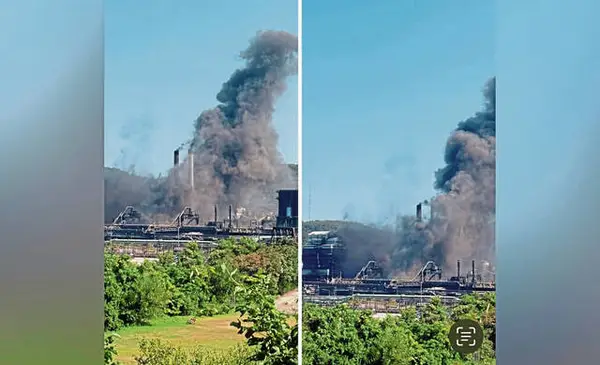
An independent, nonregulatory federal agency investigating a deadly explosion at the U.S. Steel’s Clairton Coke Works plant this fall issued two interim safety recommendations Tuesday.
The U.S. Chemical Safety and Hazard Investigation Board recommends U.S. Steel thoroughly evaluates all buildings at the Clairton facility that are currently occupied or could be occupied, to identify and assess any potential hazards to workers based on where the buildings are located.
The board also recommends U.S. Steel addresses and reduces any safety risks identified in the facility evaluation, following accepted industry safety principles, the report said.
Asked about the recommendations, U.S. Steel said in a statement: “We continue to cooperate with the CSB and other relevant agencies. Throughout this process, our unwavering focus remains on prioritizing the well-being of our employees and their families. As always, safety first remains our core value.”
On Aug. 11, coke oven gas was released from process piping in the Battery 13/14 transfer area at the facility and ignited, causing an explosion, according to the U.S. Chemical Safety and Hazard Investigation Board.
Two U.S. Steel employees, Timothy Quinn, 39 and Steven Menefee, 52, were killed; and 11 others were injured.
CSB’s investigation determined both of the workers that were killed, and two others that were seriously injured, were inside or near buildings in the area where the explosion occurred.
The CSB also found that the occupied buildings in the Battery 13/14 transfer area were not capable of protecting occupants from explosion hazards.
U.S. Steel rebuilt the damaged coke oven gas supply piping in almost the same layout and location as it was prior to the explosion, according to the CSB.
“Although the company is relocating the control rooms for Battery 13/14 to a building approximately 100 feet away from the area, the CSB has concluded that without a facility siting evaluation, it is not clear that U.S. Steel has chosen a safe location to relocate its workers,” the CSB said in a statement.
The Clairton facility operates four other coke batteries with personnel-occupied buildings located near potentially hazardous processes, the CSB said. A facility siting evaluation would identify and assess hazards in those buildings.
“Without a comprehensive facility siting evaluation, it is not clear that workers are being relocated to buildings that are safe from future fires, explosions or toxic releases,” said Drew Sahli, investigator in charge.
The CSB has yet to release their final investigation report.