
The 2025 year in local college sports featured a blend of results on the scoreboard on top of major administrative maneuvering, as athletic directors adjusted to a new revenue-sharing ecosystem.
Pitt football, behind a surprise change at quarterback, looks like a team potentially ready to be a legitimate contender in the ACC.
Jeff Capel’s new-look Pitt basketball squad, following a spring roster exodus, sprinkled in a few exciting wins over rivals into a highly unappetizing start to the season, while Dan Fisher, Olivia Babcock and Co. suffered a heartbreaking fifth straight Final Four volleyball defeat.
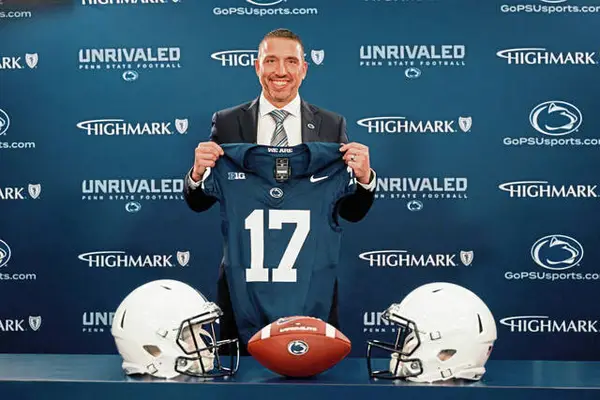
But the year’s biggest sports story was not in Oakland. Instead, it transpired in State College, as Penn State football imploded out of the national conversion, prompting the dismissal of 12th-year coach James Franklin and eventual hiring of Matt Campbell.
Franklin’s firing less than a year after the Nittany Lions suffered a three-point loss to Notre Dame in the College Football Playoff semifinal, followed by athletic director Pat Kraft’s tumultuous search to find his replacement, was among the most seismic events across college sports in 2025.
PSU’s new era
On the heels of a 27-24 loss to Notre Dame in the Orange Bowl, coupled with plenty of key returners like quarterback Drew Allar and tailbacks Nick Singleton and Kaytron Allen, few programs had higher expectations in 2025 than Penn State.
The Nittany Lions opened the year ranked No. 2 in the country and proceeded to clobber their nonconference opponents: Nevada, Florida International and FCS foe Villanova.
But on Sept. 27, tougher opposition arrived at Beaver Stadium in the sixth-ranked Oregon Ducks, who left town with a 30-24 double-overtime win.
Franklin and the Nittany Lions sought to shake off that loss — disappointing, but far from catastrophic — one week later at UCLA.
But disaster followed, as the Bruins, already led by an interim coach and then one of the worst teams nationally both offensively and defensively, won 42-37.
That loss dropped Penn State out of the Top 25 and sent shock waves through State College.
However, it got only worse from there, as the following week, Penn State lost at home to Northwestern, 22-21.
A day later, accompanying news that Allar had been lost for the season with an injury, Kraft fired Franklin. Losses to Iowa, No. 1 Ohio State and No. 2 Indiana followed, as interim coach Terry Smith struggled to stabilize the floundering team.
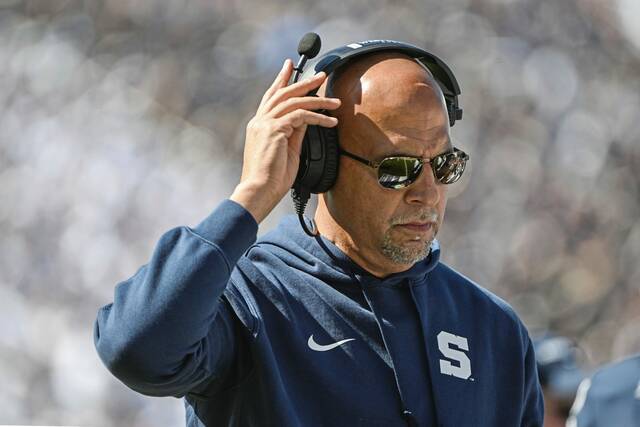
To Smith’s credit, he ultimately succeeded, guiding Penn State to three straight wins to finish the regular season. The Nittany Lions (7-6, 3-6 Big Ten) defeated Clemson, 22-10, in the Pinstripe Bowl on Saturday.
In between the rally under Smith and the hiring of Campbell from Iowa State on Dec. 5 were 54 days of uncertainty, as Kraft swung and missed repeatedly to find Franklin’s successor.
Kraft approached and was rebuffed by the likes of BYU’s Kalani Sitake, Indiana’s Curt Cignetti, Nebraska’s Matt Rhule, Missouri’s Eli Drinkwitz, Vanderbilt’s Clark Lea and Louisville’s Jeff Brohm.
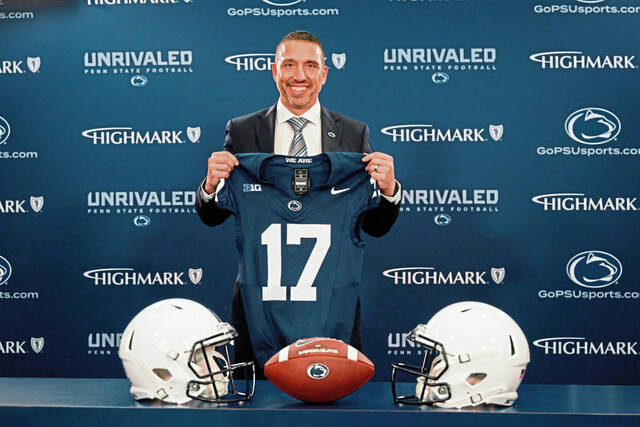
Finally, with Penn State’s 2026 recruiting class whittled down to just two (Franklin, hired at Virginia Tech on Nov. 17, flipped several Nittany Lions commits ahead of signing day), the Nittany Lions introduced Campbell, who inked an eight-year, $70.5 million contract.
Campbell was 72-55 (50-40 Big 12) over 10 seasons at Iowa State and led the Cyclones to their first 11-win season in 2024. He will now be responsible for maintaining a standard of pushing for the CFP with Penn State.
Campbell must now round out his coaching staff, scour the transfer portal and finalize the Nittany Lions’ roster heading into spring.
Campbell’s debut campaign at the helm in State College will be among 2026’s top sports storylines.
Pitt football ends with a dud
The drama at Penn State may have dominated national headlines, but Pitt football earned its fair share of attention, competing for both a CFP berth and ACC title game appearance, if ultimately falling short in both cases.
Pat Narduzzi’s Panthers hosted ESPN’s “College GameDay” on Nov. 15 at Acrisure Stadium for a ranked-on-ranked matchup with No. 9 Notre Dame. The Panthers fell 37-15, and were unable to match the pregame hype with a win.
But the following week, Pitt scored its most impressive victory of the year, throttling No. 16 Georgia Tech on the road 42-28 to set up a regular-season finale with No. 12 Miami. Had the Panthers won, they would have advanced to the ACC championship.
It was not to be. The Hurricanes won 38-7, spoiling Pitt’s aspirations and contributing to the Panthers’ eventual selection for the Military Bowl.
To be sure, the Military Bowl was far from the ACC’s finest bowl destination as well as a step down from playing for a league championship.
But entering its bowl game, Pitt could take pride in having won as many games as it did, in the manner it did so.
The Panthers’ expected blueprint for success in 2025, following a lopsided 7-6 campaign that began with a 7-0 win streak and ended with an 0-6 skid, revolved around the development of quarterback Eli Holstein.
Instead, Holstein struggled with decision-making and turnovers through the season’s first month and was benched by Narduzzi with Pitt riding a two-game losing streak, having blown fourth-quarter leads to both West Virginia and Louisville.
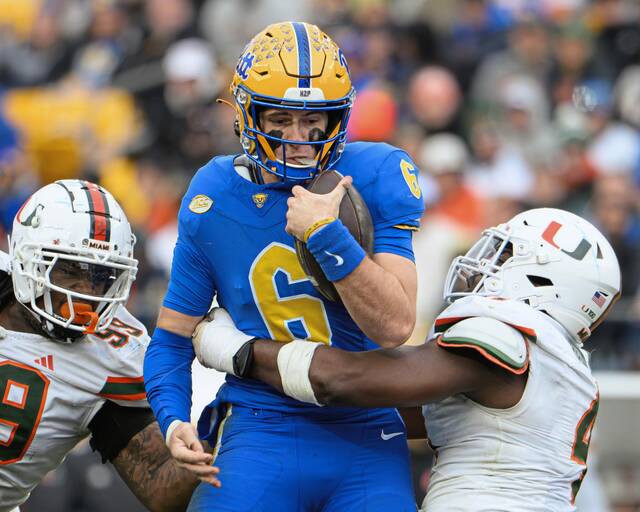
Beginning on Oct. 4 against Boston College, true freshman Mason Heintschel entered the scene behind center and largely excelled.
In his first college start, Heintschel threw for 323 yards and four scores, as Pitt pummeled the Eagles.
He proceeded to lead Pitt to five straight conference wins, saving the season from the brink of ruin.
Heintschel went on to start 10 games, going 7-3. The Panthers (8-5, 6-2 ACC) ended the season with a 23-17 loss to East Carolina in the Military Bowl.
That postseason loss — Pitt’s second in a row to a Group of Five opponent — dropped Narduzzi to 2-6 in bowls and significantly altered the outlook on the season.
Instead of winning their ninth game for only the sixth time since 1983, the Panthers stumbled against a depleted opponent missing its starting quarterback, running back, tight end and two wideouts due to opt-outs, on top of losing both coordinators earlier in December.
For the fourth time in 11 seasons under Narduzzi, Pitt went 8-5. Since 2015, Narduzzi has averaged 7.27 wins per season.
As the disappointment of the Military Bowl fiasco lingers, Narduzzi and the Panthers must look ahead to building a foundation for 2026.
All-American tailback Desmond Reid and linebacker Kyle Louis declared for the NFL Draft. The transfer portal is sure to claim players on both sides of the ball, whose production will need to be replaced.
Pitt also displayed inadequacies on the offensive line against its most elite competition, with portal maneuvering critical this offseason to acquire experienced help.
Winning as much as Pitt did in the face of numerous injuries and after being forced to deviate significantly from the preseason game plan was commendable.
But the Panthers looked unprepared in the Military Bowl, committing five turnovers and allowing the season to conclude on a sour note.
Revenue-sharing reality
Pitt’s quest to retain Heintschel and others underscores the new reality of college athletics in the post-House settlement world.
Over the summer, U.S. District Judge Claudia Wilken approved a 10-year, $2.8 billion settlement that concluded years of litigation, formally paving the way for direct revenue-sharing with student-athletes.
Beginning July 1, Division I institutions could begin sharing up to $20.5 million in revenue with student-athletes across all sports, with that number set to rise each academic year through 2035.
For Pitt’s Allen Greene, Duquesne’s Dave Harper, Kraft at Penn State and their peers across the country, wide-ranging efforts are in the works to ensure their programs can make attractive financial commitments to players, remaining competitive across the board.
How those funds will be raised and distributed across sports remains to be seen.
Here in December, so soon after Wilken’s ruling came down, the institutional approaches that could strongly position an athletic department vs. put it on a slippery slope have yet to be revealed as successful or untenable.
Will Pitt see its star players poached in the transfer portal, or have the resources to defend and hang onto its on-field assets?
Time will tell.
For Pitt a positive sign was visible on the recruiting trail, as the Panthers signed their Class of 2026 recruits, the first who enter college in this new world of revenue-sharing.
Pitt appeared to have little trouble signing the recruits it wanted, as 21 pledged, with 247Sports ranking the Panthers’ 2026 class as 44th in the country.
Pitt men’s basketball struggles
Capel’s Panthers, having averaged 23 wins over the previous two seasons, entered 2024-25 with more NCAA Tournament expectations.
As the calendar flipped to 2025, Pitt was 10-2 and those aspirations appeared very much within grasp.
But as ACC league play commenced, the Panthers proceeded to crumble, suffering three separate four-game losing skids before bowing out of the first round of the conference tournament, having gone 17-15 (8-12).
During the offseason, Capel navigated significant roster turnover, as star guard Jaland Lowe, the Diaz Graham twins, Amsel Delalic and Marlon Barnes transferred while seniors Ish Leggett, Zack Austin and Damian Dunn graduated.
Into the portal Capel then went for reinforcements, landing center Dishon Jackson, guards Damarco Minor and Nojus Indrusaitis plus guard/forward Barry Dunning Jr.
Capel also welcomed true freshmen Omari Witherspoon, Macari Moore, Kieran Mullen and Australians Henry Lau and Roman Siulepa.
Before the year got underway, Jackson was ruled out indefinitely with an undisclosed medical condition.
Upon beginning the season, the retooled Panthers got clobbered on the road at West Virginia and fell to Central Florida, dropping their first two Power Five nonconference games by a combined 32 points.
Then, the Panthers suffered humiliating mid-major losses at home to Quinnipiac and Hofstra.
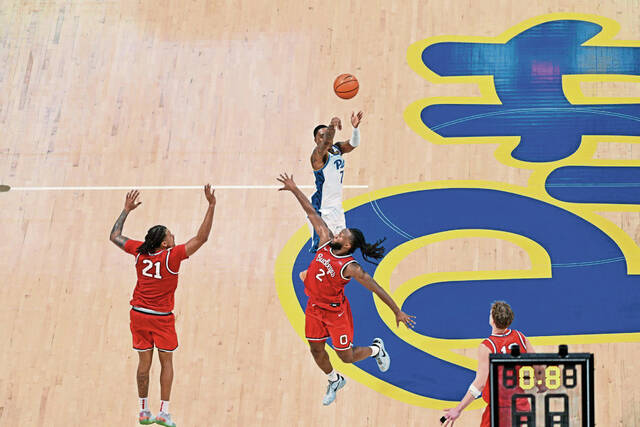
However, Pitt did score an electric buzzer-beating win over Ohio State on Nov. 28, with Minor’s 3-pointer lifting the team to a 67-66 victory at Petersen Events Center.
Pitt then concluded the nonconference slate with a blowout 80-46 win over Penn State in Hershey, to take a 7-6 record into ACC play.
Volleyball’s heartbreak
Few if any programs at Pitt have a stronger claim to being the university’s best team than women’s volleyball, which rode four straight Final Four appearances heading into the 2025 campaign.
As it would turn out, the Panthers advanced to their fifth straight national semifinals, running the table as an NCAA Tournament regional host and No. 1 seed.
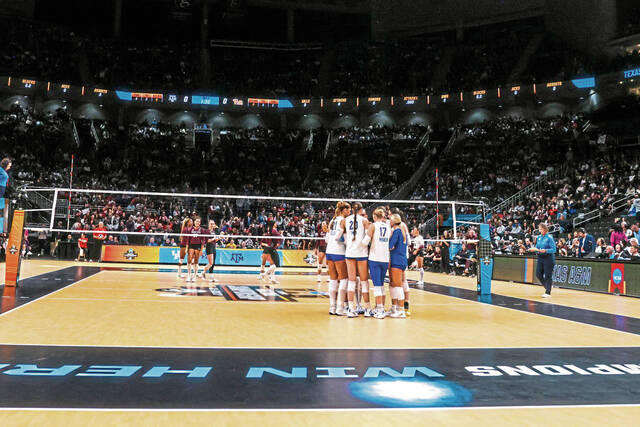
Pitt met Texas A&M in the Final Four with a 30-4 record, having won a share of the ACC title with Stanford.
But against the Aggies, on the biggest stage of the season, Pitt put forth its worst performance of the year, suffering a 3-0 sweep, the first of the season, 29-27, 25-21, 25-20.
Olivia Babcock captured her second straight AVCA National Player of the Year award along with a host of other regional and national honors, but the Panthers again saw their season end short of a trip to the national title game.
RMU goes dancing
One of the best Pittsburgh college sports stories in 2025 was Robert Morris men’s basketball making the NCAA Tournament for the first time since 2015.
In Year 6 after joining the Horizon League, coach Andy Toole led the Colonials to a 26-9 (15-5) record, conference tournament championship and automatic berth into March Madness.
Robert Morris, coming off a ninth-place finish in-league a year prior, assembled a largely new team, which jelled well together and helped tie the school record for single-season wins.
Alvaro Folgueiras won Horizon League Player of the Year, Amarion Dickerson was named Defensive Player of the Year and Toole earned Coach of the Year honors.
No. 15 Robert Morris took on No. 2 Alabama in Cleveland, going punch for punch with the high-octane Crimson Tide before falling 90-81 in the Round of 64.
Under Toole, the Colonials were regular contenders in the Northeast Conference, but since 2020-21, had struggled to find a footing in the more competitive Horizon League.
After last season, and a strong start to 2025-26 — with another largely new roster — Robert Morris looks to maintain a renewed standard on the hardwood.