
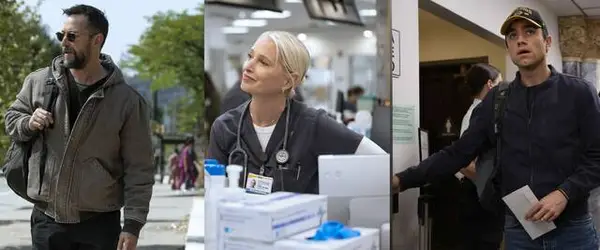
“The Pitt” only films scenes in Pittsburgh a few days each season, but in season two, the Emmy-winning HBO Max ER drama continues to represent the region in large and small ways, from name-checking neighborhoods to Nurse Dana’s yinzer accent.
“It’s very focused, what we use Pittsburgh for, because we don’t go outside very often,” said “Pitt” star/executive producer Noah Wyle during a season two press conference in early December. “Intentionally, this is a claustrophobic, immersive experience that keeps you in the emergency department as much as we can.”
But the show and its cast benefit from those September trips to Pittsburgh.
“It gives us an opportunity to break the monotony of production in Los Angeles, to take a field trip, to have everybody get to go away and really bond as a cast on location,” Wyle said. “It’s a great ambassadorship to the city of Pittsburgh, which has opened its arms to us, and Allegheny General Hospital, to allow us to shoot there. We try to be really good and responsible stewards of that.”
“Pitt” executive producer John Wells, a 1979 Carnegie Mellon University grad, said there are other considerations that impact filming “Pitt” scenes on location.
“Because it all takes place in one day, in our trip to Pittsburgh, the weather has to look exactly alike,” Wells said. “The writing staff is under the difficult assignment of writing for the entire season, even though we do the [Pittsburgh] shoot sometime in the middle of the season or towards the beginning of the season, so it’s very specific things that we can and can’t do in Pittsburgh.”
Wyle, who stars in “The Pitt” as Pittsburgh Trauma Medical Center as Dr. Robby, said the September 2025 Pittsburgh filming did not feel the same as when they shot scenes for season one locally in September 2024.
“We landed in Pittsburgh about 13 hours after we’d all won the Emmys the night before,” Wyle said in a one-on-one interview last month. “So we celebrated our victory with the great men and women of Children’s Hospital and Allegheny General and everybody else in the city. It was a really special trip.”
Wyle’s visit was brief – two days at most.
“The thing I remember most is going through the hospitals and seeing the same staff that I had visited a year before, but now they’d all seen the show and owned the experience of being part of the show,” Wyle said. “That was extremely gratifying to walk those halls and feel that sense of both gratitude and validation. It was really cool, really special.”
In season two, set 10 months after the events of season one and streaming its first episode at 9 p.m. Jan. 8, “The Pitt” maintains its Pittsburgh bona fides, beginning with the use of “Better Off Without You,” by Pittsburgh band The Clarks, in the opening scene and continuing with references (through episode nine) to West Penn Hospital, Garfield, New Castle, Carrick, Kennywood, Zambelli fireworks, 7 Springs, Giant Eagle, PNC Park, Frick Park Lawn Bowling Club, Oakland, Anthrocon, Allegheny Community College, Point Park University, Rodef Shalom Synagogue (Robby’s grandparents were members there), Millvale’s Fourth of July parade, Sonny’s Tavern, Brashear High School (including its mascot’s mid-‘90s name change from Bullets to Bulls) and the Tree of Life shooting (a patient even quotes the current fundraising campaign, “Remember. Rebuild. Renew.”).
Executive producer R. Scott Gemmill said Tree of Life was not a reference considered for season one.
“We had our hands full just trying to get the show up and running and figuring it out,” Gemmill said. “The luxury of the second season is we know what we’re doing. … And it seemed like that was such a big story, there are elements of that story that weren’t really part of the news cycle and that we felt were important to be told and when you have your lead is a Jewish doctor, it only seemed natural that we should address that in some respect.”
Among the show’s lead characters, perhaps the most-loved, most-admired by the PTMC staff and viewers alike is the one who sounds most like a real Pittsburgher. Katherine LaNasa won the best supporting actress Emmy for her role as no-nonsense, big-hearted charge nurse Dana Evans. She said adopting a Pittsburgh accent was important to her because of her own background.
“I’m from Louisiana, and a lot of my family’s from New Orleans and that has a very specific accent that’s different than the rest of the South,” LaNasa said in a December interview. “And the rest of the South also has very different regional dialects, and we Southerners are very offended by people that get it wrong when they have someone from Atlanta speaking in a Cajun accent.
“So I knew that if I didn’t adopt a Pittsburgh accent, I would sound maybe like I was from New Jersey or just sort of vaguely east coast [place],” she continued. “Honestly, out of respect for the people of Pittsburgh and how I feel as a person from [a place] that has a very specific regional accent, I just wanted to try to get it right.”
Gemmill confirmed, “We didn’t talk accent, I don’t think. That was something that she dove into on her own to bring as much authenticity to the character as possible.”
LaNasa said she couldn’t find a dialect coach in Los Angeles who knew Pennsylvania accents, but she saw a “Mare of Easttown” feature on the Delco County accent in that HBO series.
“The dialect coach came on, so I looked her up on IMDb Pro, and she connected me with someone from Pennsylvania named Susanne Sulby, who does a lot of the Pittsburgh and regional Pennsylvania accents for TV and film,” La Nasa said. “And being from Pennsylvania, I trusted her. She’s wonderful.”
After the first season of “The Pitt” blew up into a critical and commercial hit, the show’s creators could only blame themselves for having a hard act to follow. The second season’s day in the life of the emergency department doesn’t go according to expectations, but through nine episodes made available for review, there’s no hint of an event as traumatic as season one’s mass shooting at Pittfest.
“We definitely wanted to avoid doing something big every year … because then we’re back into sweeps world, where we’re talking about, ‘What’s the thing that happens in November? What’s the thing that happens in May? In February?’ ” Wells said. “That becomes a trope we’re trying really hard to avoid.”
At the start of each season, the show’s writers (including Wyle, who wrote episodes three and 14 and directed episode six in season two), set up interviews with medical professionals to pick their brains, a way for the writers to identify ideas for plots in the new season.
“What stories aren’t being told? What stories do you think should be told? That’s how we get the nuggets of some of the medical stories that we do,” Gemmill said. “Ultimately, the stories are told through our characters and what’s going on with them, but we’re trying to keep our fingers on the pulse of what’s going on in medicine as up to date as we can be.”
Wells said, sadly, there are plenty of stories to tell.
“American healthcare [is] in a crisis,” Wells said, “and that crisis is not getting better by pushing eight to 10 million people off of the insurance rolls, which means that they’re not gonna be getting the primary care, which keeps them from showing up in the emergency room with far more significant problems.”
One issue “The Pitt” deals with this season is using artificial intelligence in medicine.
“The use of it in your charting and in your dictation [allows] you to be hands-free and to look in the eyes of your patient and not have to type everything into a screen,” Wyle said. “[It] really creates more of a sense of intimacy and a sense of presence in the room. And it’s pretty accurate. It’s not totally accurate, as we depict, but it’s getting closer and closer.”
The use of AI may improve efficiency, but will it also replace people?
“A suspicion which often happens with new technologies is, with the additional time that the physicians will get back from being able to use this technology, will they be able to use that to spend more time with patients?” Wells said. “Or is it simply going to be accelerating how many patients you’re supposed to see? Is the expectation that the technology allows you to be a better practitioner or that it accelerates how you have to practice? That’s the real fear of the medical community.”
As “The Pitt” team gets more experience making the show, sometimes they find their efforts begin to look too smooth, too polished, too choreographed for a chaotic, urban ER.
“[Our actors] didn’t know what they were doing at the beginning, literally physically didn’t know what they were doing,” Wells said. “Then, doing it for seven months, you get better at it, but the character is one or two hours farther along in their training, not seven months farther along in their training.”
Dr. Robby, as the ER’s attending doctor, has experience, so it’s OK for him to look proficient, but those newbie student doctors do not.
“Others started to get too good,” Wells said, “and our camera crew started to get too good. Part of the rawness is bumping into things and not knowing exactly where you are and trying to keep up — because we’re really trying with the camera to say you are someone who’s trailing behind these physicians, and so you’re gonna be in the way and it’s not gonna be a perfect view and you’re not gonna see everything all the time. We had to remind ourselves to not get too good at it.”