
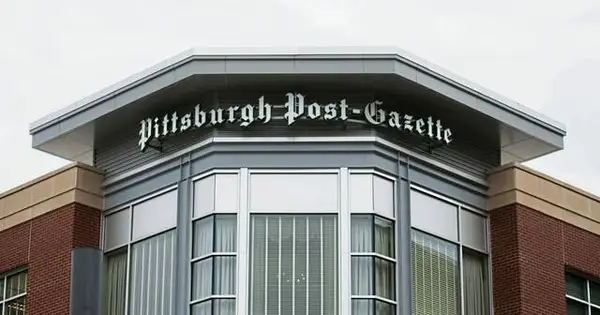
The Pittsburgh Post- Gazette traces its roots to 1786 — before the U.S. Constitution was created.
John Scull and Joseph Hall published the first edition of the Pittsburgh Gazette on July 29, 1786. Originally a weekly publication, the Gazette would be the first newspaper printed west of the Allegheny Mountains, according to a company history on the Post-Gazette’s website.
After Scull retired as editor in 1828, the paper passed to Morgan Neville, who renamed it the Pittsburgh Gazette and Manufacturing and Mercantile Advertiser — the first of several name changes. New owners would revert the name to the Gazette a short time later.
The paper became a morning daily in the 1840s. It leaned conservative and opposed slavery. Following Abraham Lincoln’s inauguration in 1861, about a month before the start of the Civil War, the Gazette wrote, “It may cost the nation a war to maintain itself against this mad rebellion. To yield to it must not for a moment be thought of.”
A partnership led by Nelson P. Reed acquired the Gazette a year after the Civil War ended and later merged it with another paper to create the Commercial Gazette.
That iteration would report on calamities including the Great Railroad Strike of 1877, which turned violent in Pittsburgh and left 61 people dead; the catastrophic Johnstown Flood that killed more than 2,200 people; and the bloody Homestead steel strike, which had a chilling effect on the labor movement in the steel industry.
George Oliver bought the paper in 1900 and renamed it the Gazette. A subsequent merger would create The Gazette Times.
The Pittsburgh Post-Gazette came into existence in 1927 following a flurry of moves. After William Randolph Hearst bought The Gazette Times and the Chronicle-Telegraph that year, Paul Block, then the owner of the Post and the Sun, orchestrated a trade with Hearst — exchanging the evening Sun for the morning Gazette Times. Block merged his holdings to create the Pittsburgh Post-Gazette.
The first edition was published Aug. 2, 1927. Copies sold for 3 cents apiece.
______________________________
Related:
• Pittsburgh Post-Gazette announces closure
______________________________
The Post-Gazette won a Pulitzer Prize in 1938 for a series of stories by Ray Sprigle that exposed Supreme Court Justice Hugo Black as a former member of the Ku Klux Klan. It also won a Pulitzer in 1998 and 2019. Martha Rial was honored for spot news photography in 1998, and the staff was recognized for its breaking news coverage of the Squirrel Hill synagogue shooting in 2019.
Paul Block’s sons, William and Paul Jr., assumed leadership of the Post-Gazette following their father’s death in 1941.
In 1961, the Post-Gazette entered into a joint operating agreement with the larger Pittsburgh Press Co. — allowing the P-G to maintain control of its news and editorial departments, while the Press handled its production, circulation and advertising. That agreement would ultimately transform the local newspaper market in unforeseen ways.
On May 17, 1992, union workers at The Press went on strike. Because of the joint operating agreement, it effectively shut down the Post-Gazette, as well. While the strike dragged on, the Tribune-Review, then based in Greensburg, launched the Pittsburgh Tribune-Review. The Pittsburgh Tribune- Review continued a print edition until late 2016, when it transitioned to an all-digital format. It continues to print editions in Westmoreland County and the Alle-Kiski Valley.
After the labor issues were resolved, the Post-Gazette — which had purchased The Press from the Scripps Howard company during the strike — discontinued The Press.
The Post-Gazette’s recent history also has been marked by a bitter labor dispute.
Journalists, mailers, production workers and advertising staffers went on strike in October 2022. Production and advertising workers accepted a buyout offer last March, but more than two dozen journalists remained on strike. In November, they voted to return to work following a federal appellate court ruling that the company negotiated in bad faith.
Company management warned then that the court decision, if upheld, could force the newspaper to close.
On Wednesday, the Supreme Court opted not to halt a court order requiring the company to make changes to its health insurance coverage for unionized workers. The company announced its decision to cease operations later in the day.