

Alianna Anselmi was surprised to see the pyramid structure make a comeback when the Trump administration released new dietary guidelines this week.
Anselmi, lead dietitian for medical weight loss at Allegheny Health Network, said the MyPlate visual has been used since 2011, when it replaced the MyPyramid model as a “more balanced approach.”
MyPlate was a dinner plate diagram that showed the former dietary guidelines published for the first time under the Obama administration.
Health Secretary Robert F. Kennedy Jr. and Agriculture Secretary Brooke Rollins released the new dietary guidelines this week — literally flipping the food pyramid on its head.
The new guidelines emphasize whole milk, cheese and protein like red meat.
“Protein and healthy fats are essential and were wrongly discouraged in prior dietary guidelines,” Kennedy said during a news conference. “We are ending the war on saturated fats.”
The MyPlate method had dairy “kind of off to the side” visually, so Anselmi believes the greater emphasis on dairy is why the guidelines were reverted to the pyramid structure.
The U.S. Dietary Guidelines for Americans are required by law to be updated every five years, and they affect the foods served in schools, hospitals, prisons, military bases and through federal assistance programs, the New York Times reported. However, they rarely change in substance during these updates.
Key differences
Though Anselmi believes much of the recommendations stayed the same, she said there were some notable changes.
“I’m glad to see that this isn’t a complete overhaul,” she said. “That was kind of my worry.”
Overall, the inverted pyramid includes “all good foods,” Anselmi said.
Specifically, the graphic depicts protein, dairy and healthy fats in the top left corner, vegetables and fruits in the top right corner and whole grains at the bottom point of the triangle.
“Seeing whole grains toward the bottom concerns me, because I’m such an advocate of whole grains and fiber,” Anselmi said.
The food pyramid prioritizes protein. Adults should now consume 1.2 to 1.6 grams per kilogram of body weight per day — 50%-100% more than what federal health officials have previously recommended (0.8 grams per kilogram of body weight per day).
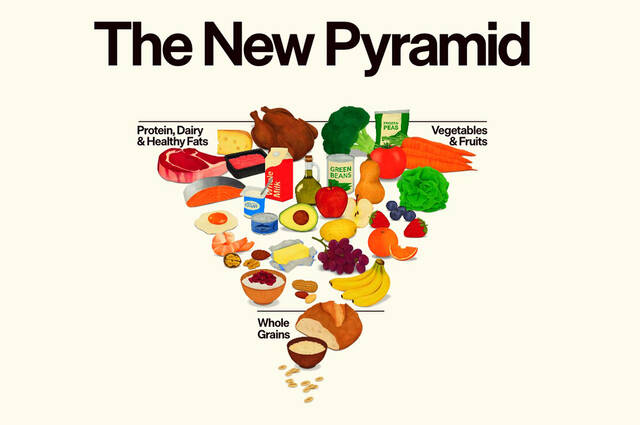
The increased call for protein is good, according to Anselmi, and she said she appreciated that visuals of canned and frozen foods were included in the pyramid as other ways to get produce.
Dairy, however, is what she said everyone has been talking about following the announcement.
The dairy recommendation stayed the same in terms of recommending two or three dairy servings per day as part of a 2,000-calorie diet. But previously, it included recommendations of lower fat dairy products, according to Anselmi.
“Those servings now include full fat dairy,” she said. “I agree with aiming for three servings. But if that’s all full fat sources … that adds up super quickly in terms of saturated fat intake.”
One glass of whole milk has around 5 grams of fat, according to Anselmi, and that’s not including any cheese or butter consumed.
Around 10% of your fat intake daily should be saturated fat, she said, which equals about 20 to 25 grams. And that’s for the 2,000-calorie diet, which she said most people aren’t at.
“That’s why I encourage low fats or unsaturated fats,” Anselmi said, as that number can definitely be exceeded with three dairy servings per day.
These options, which are mostly plant-based, can include:
• Olives/olive oil
• Avocados
• Walnuts
• Salmon
• Nuts
• Seeds
“There’s better fats essentially to choose,” Anselmi said. “We don’t have to get them just from dairy.”
For those with heart or cardiovascular diseases and risk of those diseases, recommending whole milk so highly could be problematic, as it increases cholesterol, she said. Cardiovascular disease is one of the No. 1 causes of death in America, she said.
“That’s the main concern that I have, that I know my peers have, that many dietitians are talking about,” Anselmi said. “We overlook heart health. That is the number one thing as a dietitian I think about.”
Custom recommendations
Anselmi said she would steer people toward reduced fat options in light of the new inverted pyramid’s release.
“It’s about moderation,” she said.
If a person is starting out at a higher weight or a history of heart or cardiovascular disease, Anselmi wouldn’t encourage full fat dairy at every meal. It could maybe be consumed in the morning, alongside low fats or unsaturated fats the rest of the day, she said.
A glass of milk can provide needed protein, but Anselmi said that’s not the case if there’s too much fat content.
“I think that the protein benefits of dairy are eclipsed when the fat content — especially the saturated fat content — is super high,” she said.
Notably, calcium, which is also found in dairy products, is important for women’s health and bone density. Around 1,000 milligrams of calcium per day is a “reasonable target,” she said.
“Dairy’s always been the star of the show when it comes to calcium intake, but knowing that there are other options like broccoli or leafy greens is really important,” Anselmi said.
No matter what someone’s current health or eating habits look like, the bigger picture issue, she said, is whether people have access to the foods recommended by the dietary guidelines.
“How are we making this successful and realistic for all people?” Anselmi said, referencing cost and location. “We should focus on that.”