
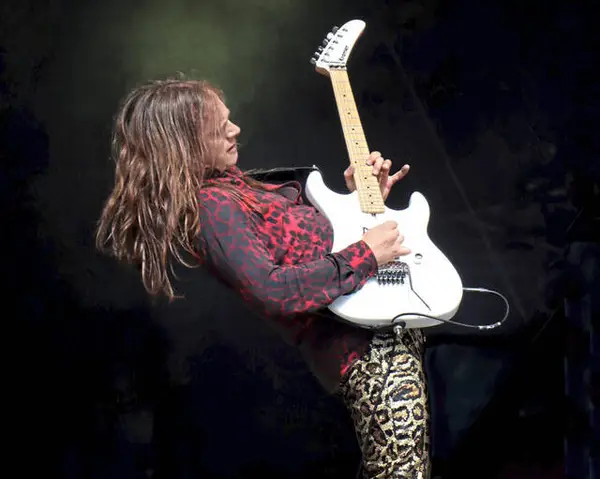
As Deraps gets set to kick off its first U.S. tour next month, singer/guitarist Jacob Deraps knows what he has in mind for 2026 for the high-energy rockers.
“Definitely touring and more touring and more shows and just as many shows as possible,” he said with a laugh. “I just want to play all the time. I’m looking forward to the U.S. tour and then hopefully the summer festivals and stuff like that.”
The “Viva Rock N’ Roll” tour — named after last year’s sophomore album — will visit Crafthouse in Whitehall on Feb. 9, with locals 9Sundays opening. It’ll be the first time in Pittsburgh for the Canadian-based Deraps.
While Deraps isn’t exactly sure what to expect from this tour, those who show up for the show can anticipate a night of music influenced by Van Halen, AC/DC and other 1970s and ’80s rock bands.
“We’re just getting out there to promote the band and get more fans and show what we can do,” he said. “I’m always having a good time on stage, no matter if the venue is packed or not, so it’s going to be a blast. We’re going to have a good time. It’s going to be fun. I’m excited about that.”
While the band is comprised of Australian drummer Josh Gallagher and Deraps, Gallagher won’t be on this tour, with the group instead touring as a power trio. The halfway-around-the-world distance may complicate touring, but it hasn’t been a problem for actually creating the music.
“It’s kind of the way that me and Josh work. I’ve always worked with the distance,” Deraps said. “We’ve done Van Halen covers that way, and we’ve done our first album that way. And that one, we mostly created the songs from a distance anyways. But it’s always how we’ve worked for the songwriting and the recording.”
In a Zoom conversation Monday from Quebec, Deraps spoke with TribLive about the new album, guitar influences and more. Find a transcript of the conversation, edited for clarity and length, below.
With this second album, how would you view the evolution of the band from the first one?
I think the second album is a lot more mature musically. The songwriting is just better. Josh and I, we have grown into better musicians, better songwriters, and I think we were more ready to create the songs and record them. It just came more naturally than the first album. The first album was a little bit more experimental. We had to do a lot of trial and error, and we had more experience because of the first album, so making that one was a lot more fun.
So maybe the first one was more like testing the water and the second one was just a lot more comfortable with each other and knowing what the band should sound like?
Yeah, the first one was definitely more of a learning curve. We were learning on the spot. There was still some learning in the process of the second one also. I mixed the entire thing and I mixed from scratch — it was the first time that I mixed an album — so I had to, because the first one was mostly Josh mixed it. But it was great, it was a lot of fun to do. It just came more naturally, and I was a better music arranger also, so I knew what I was going for, much more than the first album I would say.
With the production, the recording, the mixing, is that something you want to keep doing in the future or do you want to hand that off to somebody else?
I love to do that actually, and the more I do it, the better I get, so I would love to do it on the next album.
With Josh being so far away, how long did it take for you to get that chemistry as a group together?
The first time we played together, there was chemistry. (laughs) It’s funny, because the first time we actually played together in a room was at Toto’s soundcheck in Montreal, and we played “Rosanna” with the actual band and there’s a video of that on YouTube on my channel. You can actually see that was the first time that we played together.
In person?
That was the first time in person. We picked him up at the airport, went to the Toto show, and we got on stage and we played. That was the first time. (laughs)
No pressure there, right?
That’s pretty crazy, but it was fun.
With your music overall, who do you consider to be your guitar influences?
My main one is Eddie Van Halen, for sure, and the whole Van Halen band. And then Ozzy Osbourne with Randy Rhoads, Guns N’ Roses with Slash. I just love Guns N’ Roses, such a great band. And AC/DC, Led Zeppelin, Stevie Ray Vaughan, Toto. There are so many, Ratt, White Lion. Bands from the ‘80s and the ‘70s, I love them.
Do you mind whenever your band’s compared to Van Halen or is that something that you wear as a badge of honor?
Absolutely. I think it’s great. I love Van Halen, so if it can be compared to Van Halen, then in a way, I mean, that’s good. I know it’s different anyways.
“The Legend of Larrikin Laddie” felt like 1970s AC/DC whenever I listened to it.
Exactly. That’s what it is. It’s a tribute to Bon Scott. The lyrics are about Bon Scott. The song is similar in a way to “Whole Lotta Rosie” and “Let There Be Rock.” It’s inspired by this kind of thing.
Do you go in with the intent of writing a song that captures the spirit of some other bands or does it just come out sometimes?
Sometimes it happens, but mostly songs just come naturally from whenever I pick up a guitar. I start playing and there’s a riff that comes out, and sometimes I can write a whole song just like that, with the guitar unplugged, plugged, whatever. It just comes out naturally most of the time. But, for example, “The Legend of Larrikin Laddie,” we used to play “Whole Lotta Rosie” live and there was a section of the song that I started jamming, and I just went for a big jam and a big solo, a free jam, and I used to do a riff in the jam, which was the riff in “Larrikin Laddie,” so we took that riff and we made a song out of it, but that was the foundation of it, so it was very AC/DC.
When you look at guitar rock from that era, do you feel like it doesn’t get as much props as maybe it should nowadays?
Oh yeah, for sure. It’s not on the mainstream airwaves anymore. It’s still huge. These bands are still selling out. They’re still the biggest bands on the planet. They’re still the bands that sold the most records, and they’re still selling records and they’re still huge on streaming platforms. There’s bands like us, which are starting to draw more people and younger people. There’s such a huge young fan base for this type of music. People are passionate about this music. They’re discovering this music. And once you get into it, it’s so good. There’s so much emotion and feel that you just get obsessed with it. I think it doesn’t matter what age you are. I think it’s always going to be relevant. It’s always going to be big. I think it’s coming back.
Do you feel like you’re helping to bring back some of that joy, some of that swagger in rock music a little bit?
For sure, because I’m always working on spreading that kind of music on social media and live also that’s what we do. Live, we do our songs, but we also do classic rock covers because we love doing it, so I love to share my passion with the world and my passion for this kind of music and if it can help people discover it, then that’s great.
Related
• Top 26 concerts coming to Pittsburgh in 2026 so far
• Q&A: Wolfgang Van Halen on Mammoth’s new album ‘The End’
• 2026 Pittsburgh area concert calendar
How important are the vocal harmonies? Those stood out to me whenever I listened to the album.
It’s a huge part of my music and my passion for music. A lot of the bands that I listened to and I love, the bands that came out in the ‘70s and ‘80s, had huge vocal harmonies, huge choruses, catchy, big-sounding harmonies and choruses. I think it’s kind of a lost art, and not a lot of bands do it. Even the bands that focus on sounding like ‘70s bands, they don’t really do vocal harmonies anymore. I think it’s such a great sound. I love it.
Is there more new music on the way? Or are you just focused on the touring in support of the last album?
I’m always writing new music, but for now we’re focusing on touring and playing more live shows, and we’ll see in the future.