
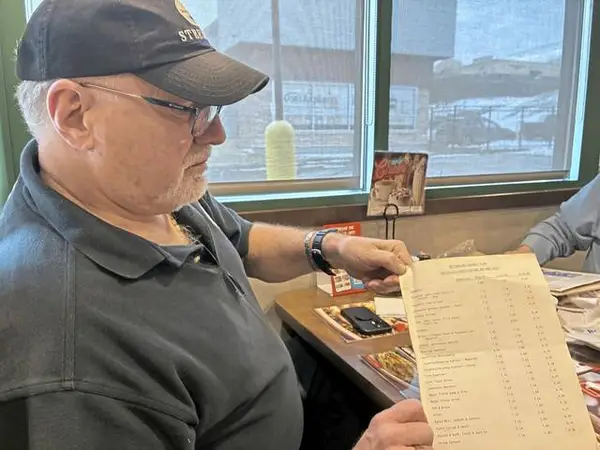
A group of former autoworkers at the Volkswagen of America assembly plant near New Stanton will gather Saturday to renew old friendships and reminisce about their experiences at the factory.
The reunion begins at 1 p.m. Saturday at Cabin Bar & Grille, 918 S. Center Ave., Hempfield, just a short distance from where the cars were once built.
The event typically attracts about 50 former VW workers, said Craig Ruokonen, 71, of Hempfield, who worked in the paint, materials and quality control departments.
The plant shut down more than 37 years ago, and thousands of workers lost their jobs after it operated from 1978 to 1988. Four of the former autoworkers said this week their co-workers are at the forefront of their minds, rather than the 1.1 million vehicles that came off the assembly line — about one every 62 seconds.
“It was a big family. Everybody took care of everybody,” said Bill Laczko of Mt. Pleasant Township, who worked in the supplies and quality control departments and as a manager.
“It was like a town,” with some 6,000 people in the sprawling plant when there were two work shifts, said Ralph Colorito, 72, of North Huntingdon, who worked in the parts shop and materials department.
“I loved working there. I still dream of the plant — like I was riding through the plant on my job,” said Blaine Stanziana, 67, of North Huntingdon.
For about 10 years after VW closed the plant and moved auto assembly operations to Mexico and later to Tennessee, the company sponsored reunions where around 1,000 workers gathered at Twin Lakes Park east of Greensburg, Stanziana said.
A core group of former workers has been organizing the reunions since the early 2000s.
The plant opened with great optimism in 1978. Former Chrysler Corp. President Lee Iacocca had originally planned to build Chrysler automobiles there before the automaker’s financial problems led it to scrap those plans.
During its tenure, the plant produced the VW Rabbit, Rabbit truck, GTI, Golf and Jetta models.
“You thought you had a job for life,” Ruokonen said.
However, the plant gained a reputation for difficult labor-management relations, with workers sometimes walking off the job because of work conditions. Ruokonen recalls working in the paint department with all the fumes from the paint, without a mask.
“You had legitimate reasons for the strikes. If cooler heads had prevailed, it would have prevented that,” Ruokonen said.
The late Jerry Lucia, former Mt Pleasant mayor and longtime fire chief, was credited with being “the perfect buffer” to labor-management disputes, Colorito said. “He brought a sensibility to that labor-management situation. He had a calming effect.”
The dream of a “job for life” ended in November 1987, when VW announced it would close the plant the following summer. Ruokonen said he had read about the pending closure in the trade magazine Automotive News before the official announcement.
Stanziana recalls going to lunch that day in November 1987 and finding the assembly line shut down for an hour, which was very unusual.
“I knew this wasn’t going to be good news,” Stanziana said.
Chet Bahn, the longtime company spokesman, told the Chicago Tribune in July 1988 that the company had built a sprawling assembly plant that was too big for the market for the cars it was producing.
“You had good people there trying to do their jobs under extreme conditions,” Ruokonen said.