
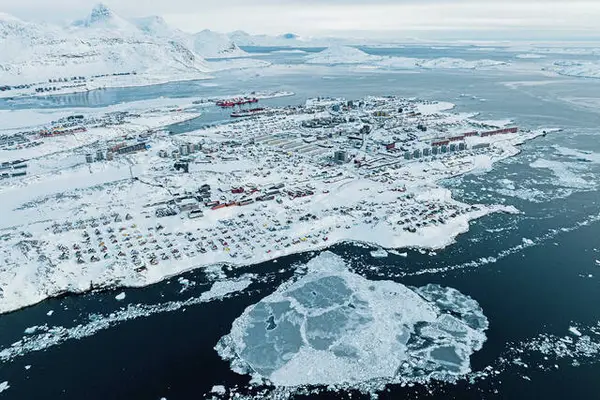
In American life, Greenland feels distant, an icy expanse far removed from daily routines in Pennsylvania or elsewhere in the continental United States. But in national security terms, Greenland is anything but remote. It sits on the front line of America’s homeland defense, and how the United States approaches Greenland will shape our security environment for decades to come.
At its core, Greenland’s significance is rooted in its geography. The shortest routes between North America and Eurasia pass directly through the Arctic. This means that long-range missiles, bombers and hypersonic weapons launched from Russia would cross over or pass near Greenland on their way to the United States. This is not mere speculation or diplomatic rhetoric; it’s a matter of physics. Geography is immutable; it doesn’t bend to diplomatic convenience or geopolitical considerations.
That reality is why the United States has maintained a continuous military presence in Greenland since World War II. The missile-warning and space-tracking systems stationed there provide early detection of launches aimed at North America. They buy time — time for decision-makers, time for defenses to activate and time that could mean the difference between deterrence and catastrophe. Without that forward presence, warning times shrink, risks multiply, and America’s margin for error narrows.
Greenland also anchors the security of the North Atlantic. Russian submarines operating out of the Arctic must pass through the narrow maritime corridor between Greenland, Iceland and the United Kingdom to reach the open Atlantic. This chokepoint, known as the GIUK Gap, remains one of the most strategically important maritime passages in the world. If control of that corridor weakens, so does the security of transatlantic shipping, undersea communications cables, and NATO’s ability to reinforce Europe in a crisis.
So, why has Greenland suddenly become a point of controversy?
As great-power competition has returned, Russia has significantly expanded its Arctic military presence, reopened Cold War-era bases and deployed advanced air, naval and missile capabilities. China, despite lacking an Arctic coastline, now describes itself as a “near- Arctic state” and has sought influence through infrastructure investment, research partnerships and access to strategic minerals. Greenland possesses rare earth elements and other critical resources essential to modern military systems. Beijing is aware of this.
This leads to an uncomfortable question: Why can’t the United States manage Greenland quietly through a bilateral agreement with Denmark?
After all, Greenland is part of the Kingdom of Denmark, and Denmark is a trusted NATO ally. Wouldn’t a discreet arrangement preserve alliance harmony and avoid unnecessary attention?
In theory, perhaps. In practice, that approach is outdated and risky.
First, Greenland has its own elected government and substantial political autonomy. Any arrangement that appears to sideline Greenlandic voices risks local backlash and domestic instability within Denmark itself. That doesn’t strengthen NATO cohesion; it undermines it.
Second, secrecy is no longer a virtue in alliance management. In today’s strategic environment, opacity breeds suspicion. When allies believe decisions affecting shared defense are being made behind closed doors, it creates openings for adversaries to exploit perceived divisions. Unity requires transparency, not quiet deals.
Third, Greenland is no longer just a Danish-American issue. It is central to NATO’s northern flank at a moment when the alliance is expanding deeper into the Arctic with the addition of Finland and Sweden. Treating Greenland as a side arrangement contradicts the collective defense principle on which NATO is built.
There is also a complex reality that cannot be ignored: Denmark cannot defend Greenland — or itself — alone against modern threats. No serious defense planner believes otherwise. Arctic surveillance, missile warning, undersea warfare and space tracking exceed the capacity of any single European state. Denmark needs the United States, just as the United States benefits from Denmark’s partnership. Acknowledging that fact isn’t an insult to sovereignty; it’s an acceptance of strategic reality.
The path forward is not confrontation or coercion, but clarity. The United States should be explicit about Greenland’s role in collective defense, transparent about its security interests and committed to trilateral cooperation with Denmark and Greenland’s government. That approach strengthens NATO, denies adversaries leverage and reduces the risk of miscalculation.
Handled openly and collaboratively, Greenland remains a stabilizing anchor in the Arctic. Handled quietly or ambiguously, it becomes a point of friction and vulnerability.
In national security, the most significant threats often arise not from aggression but from hesitation and strategic denial. Greenland deserves neither.