
Moments after delivering an election night victory speech, Corey O’Connor told reporters that, as Pittsburgh’s new mayor, “We have to start on day one.”
He’s done just that.
O’Connor, 41, spent the day before his inauguration setting up his new workspace, bringing paintings by his young kids and family photos to adorn the mayor’s office.
After that initial leisurely visit to the mayor’s office, O’Connor quickly ramped up his schedule.
He’s met with top officials, held walking tours through the city and made a a variety of public appearances, ranging from a stop at Gov. Josh Shapiro’s re-election campaign launch to visits at senior centers. He signed his first executive order, outlined a new strategy for snow removal and visited public safety facilities.
His calendar included nine back-to-back events in five different neighborhoods on his first full day in office, including a working breakfast at Grandma B’s in the Hill District with City Council President R. Daniel Lavelle. He still made time for a family dinner that evening.
“If Ed Gainey lost his seat because he was ineffective, then the new administration has to be 180 (degrees) away from that perception,” Alison Dagnes, a political science professor at Shippensburg University, told TribLive, referring to the former mayor O’Connor defeated in the Democratic primary last May.
“They have to hit the ground running,” Dagnes said. “The mayor has to be present and positive-minded to show that it wasn’t just that Gainey was bad — it’s that he’s going to be a good mayor.”
Dagnes said a new mayor should strive to make a positive first impression, building a track record of wins and earning trust.
“His first impression with his constituents has to be one of solid competence and solid governing,” she said, adding that constituents today are “very persnickety” and want to see quick progress from their elected leaders. “Anybody who’s elected to office has to show positive, active competence from day one.”
Chris Borick, a political science professor at Muhlenburg College, said a mayor’s first week is often a mix of symbolic acts and more substantial ones that signal to voters they’ll make good on campaign promises.
“The way he ran his campaign, his relative youth and his campaign pledges all suggested he wouldn’t enter office in a quiet way, that he’d want to fully engage the office from the first moments after the oath,” Borick said. “It looks like he’s everywhere.”
In his first week, Borick said, O’Connor is setting a pace for his administration.
“There will be expectations that he will be very much an active, engaged executive,” he said. “And I think that’s probably now become part of his identity for the city.”
The mayor has kicked off his term by focusing on many of the same issues he repeatedly raised on the campaign trail.
‘What’s up? I’m Corey’
While campaigning, O’Connor — who is raising his children, ages 2 and 4, in Pittsburgh — often said he wants the city to be every family’s first choice to raise their children.
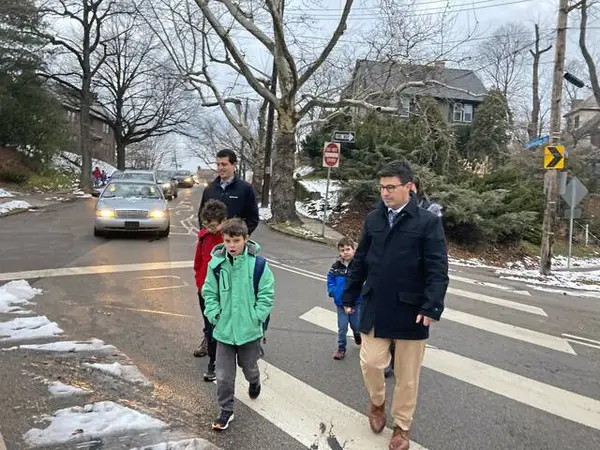
He started his first full day as mayor with that in mind, donning khakis and a floral blue tie to meet a local family so he could walk them from their Squirrel Hill home to Colfax elementary school.
“What’s up? I’m Corey. Nice to meet you,” the mayor said as he shook hands with the family’s fourth-grade, third-grade and preschool-age children.
The family — who asked their full names not be published — pointed out to O’Connor where they thought a crossing guard would make the intersection of Beechwood Boulevard and South Dallas Avenue safer. They told him about how construction work can make it harder for their kids to chart a safe path to school.
“It makes me feel like he really values his constituents, families in Pittsburgh,” said the kids’ mother.
O’Connor said he heard the family’s desire for a crossing guard and was contemplating whether better signage or narrower lanes in certain spots might make drivers slow down around kids commuting to and from school.
“We want every kid to get to school safely, and this is something we can control outside of the schools,” O’Connor, a Point Breeze resident, said.
Fostering growth
Pittsburgh has faced serious financial challenges, driven in part by declining Downtown property values.
O’Connor campaigned on a vision of growing Pittsburgh — more developments, more businesses, more housing for all income levels and more residents — to alleviate financial pressures.
He signed his first executive order less than 24 hours after being sworn in as mayor. It gives various city departments 60 days to report to the mayor on how they can revamp the permitting process to make it quicker to build in Pittsburgh.
Changes could include slashing the number of permits required for developments or finding ways to streamline the process so permits are issued faster, O’Connor said. He also created a liaison position to help people navigate the permitting system.
“Permitting is a No. 1 priority in growing Pittsburgh,” O’Connor said.
When he gathered his cabinet members for a meeting in the mayor’s conference room Tuesday, O’Connor urged department heads and authority leaders to “think about how you can help grow Pittsburgh.”
“We need shovel-ready sites,” he told them.
Improving Downtown
A $600 million revitalization of Pittsburgh’s Golden Triangle already was underway before O’Connor stepped into office.
The efforts — many of which are aimed at sprucing up Downtown before the 2026 NFL Draft in April — include improvements to Point State Park, a facelift for Market Square, the creation of a new outdoor civic space called Arts Landing and the conversion of empty office spaces into mixed-income housing.
O’Connor on Tuesday guided top officials on a walk around Downtown, paying particular attention to small details he wants to see fixed up, like graffiti on bridges, damaged sidewalks and storm drains that needed cleaning.
Looking up at a dilapidated sign with loose wires dangling from its remnants atop a building near the intersection of Sixth Avenue and Wood Street, Pittsburgh Downtown Partnership President Jeremy Waldrup shook his head.
“We can do better,” Waldrup said.
During the tour, Sheldon Williams, O’Connor’s nominee to head the Department of Public Safety, told TribLive he wanted to take a preventive approach to ensure officials don’t leave “any opportunities to breed problems.”
O’Connor said he wants to see more housing, businesses and opportunities for new entrepreneurs throughout the Central Business District. He told reporters he hopes to set up a revolving loan fund that would support new businesses, renovations for existing buildings and affordable housing projects.
He also pitched a vision of narrowing and beautifying the Boulevard of the Allies. The Pennsylvania Department of Transportation owns the road and would need to sign off on any such projects.
“It’s the little things that make you want to come Downtown,” O’Connor said. “You want to have that feeling of safety, cleanliness.”
‘Toughest jobs in the city’
O’Connor made time to visit police, fire and EMS stations during his first week in office.
At the Zone 3 police station in Allentown, O’Connor offered encouragement to a trio of officers who lined up before the mayor at the start of their shifts.
“We’re all behind you and supportive,” the mayor told them. “You’ve got the toughest jobs in the city.”
O’Connor has followed through on his campaign pledge to name a new police chief candidate right away, Jason Lando a veteran of the city’s police bureau.
Lando, who started this week as acting chief ahead of a confirmation hearing by council, was embroiled in a controversy in Frederick, Md., where he was police chief. Criminal investigators said they linked Lando’s name and phone number to anonymous, crude text messages sent to a former subordinate.
O’Connor on Wednesday took stock of an ambulance parked Downtown in the medic station along the Boulevard of the Allies.
When he asked how old the vehicle was, Emergency Medical Services Chief Amera Gilchrist told him it was from 1994.
O’Connor — and many other officials — have raised grave concerns about the city’s aging vehicle fleet and ambulances that have broken down on the job.
O’Connor talked with EMS officials about how long it can take to get a new ambulance — about two-and-a-half years — and how much a new ambulance can cost — $500,000 to $1 million, depending on the type.
Snow business
O’Connor on Thursday outlined changes he hopes will ensure the city is better prepared for the next snowfall.
The city often faces sharp criticism from residents who become frustrated by slick, snow-covered roads that are left untreated for days.
O’Connor’s initial solutions include launching a new Snow Response Command Center, where top officials will gather at the City-County Building to monitor snowplow routes, salt levels and vehicle maintenance.
He also plans to re-launch the city’s snowplow tracker, modify 17 trucks so they can tackle snow and ice, pinpoint more salt storage facilities to make it easier for drivers to refill and schedule additional driver trainings.
Talking to everyone
Before taking office, O’Connor and others criticized the Gainey administration for a lack of transparency and accessibility.
O’Connor every day during his first week has released his schedule to reporters, unlike his predecessor.
O’Connor has made a variety of stops throughout the community, chatting with parents dropping their kids off at school and seniors enjoying a crab cake lunch at a Beechview Healthy Active Living Center.
During his walking tour of Downtown, O’Connor jogged into the street to greet anyone who rolled down a window and called his name.
“It makes us feel special,” one woman at a senior center in West End told O’Connor.
O’Connor garnered feedback from residents during his stops, listening to Beechview seniors, for example, said they wanted to see litter cleaned up in a nearby parking lot and some kind of productive use for a neighborhood hillside lot that has long sat empty.
“I think it’s good to talk to neighbors,” O’Connor told TribLive from Beechview Healthy Active Living Center, where he played pool with a resident Wednesday.
Full circle
O’Connor ended his first week in office from the same place he started campaigning for mayor almost a year before: Cowley Recreation Center in Troy Hill.
Last January, O’Connor held his first press conference after announcing his mayoral bid from outside the shuttered facility, promising he’d work to reopen it.
The recreation center’s windows are shattered. A piece of plywood over the door is stamped with a warning: “No trespassing by order of Pittsburgh police.”
But O’Connor joined community leaders Friday in pitching a more optimistic future for the site — and for the Troy Hill neighborhood.
Pennsylvania Rep. Lindsay Powell, D-Lawrenceville, led O’Connor and other officials on a tour of the neighborhood, pointing to areas where she wanted to see the city and state work together to fund small businesses along the Lowrie Street corridor and at the recreation center.
Morgan Kasprowicz, president of Troy Hill Citizens, showed elected leaders a rendering of a new rec center, complete with a patio overlooking the city, an upgraded spray park and parking.
The existing structure, she said, will have to be demolished and replaced. She estimated the project would likely total about $10 million.
Kasprowicz acknowledged that the city’s budget is tight and such a project was unlikely to be funded right away — but she expressed hope for a public-private partnership where the city, state and others could get the center rebuilt within a few years.
She called it “one of the most important projects in our neighborhood,” describing it as a place where kids could safely play and neighbors could share meals.
O’Connor was on board.
“If you want families to stay and thrive in our city,” O’Connor said, “you need facilities like this.”