
Editor’s note: This is the first of a two-part series examining the changing face of the country’s two major political parties.
As former U.S. Sen. Mitt Romney prepared to step away from office in December 2024, he told reporters, “I’m a narrow slice, if you will, of what we used to call the mainstream Republicans.”
Romney said that stream was getting smaller. “It’s more like the ‘main creek Republicans.’ At some point, it’s going to be under the sand, and we’ll have to dig it up,” he said.
Romney, who opted not to seek a second term, is one of a growing number of moderate Republicans who chose to bow out of office in recent years. Their departures often were precipitated by — and paved the way for — a more populist wing of the party.
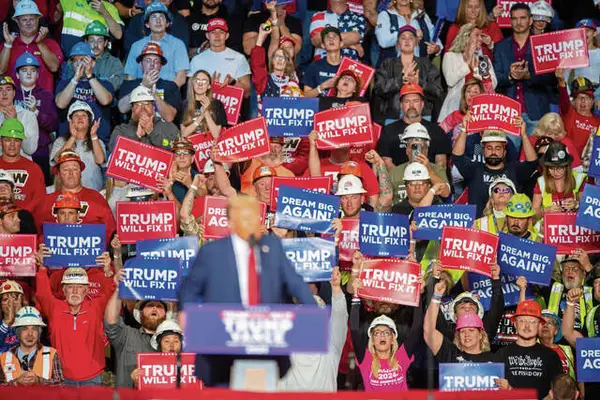
Many attribute the shift to the rise of Republican President Donald Trump and his Make America Great Again movement, but political science scholars believe party polarization and the rise of a populist movement akin to Trump’s have been in the works for decades.
The Republican Party’s recent political history reveals an ongoing shift of identity and ideology, from a new dominance in the South after the Civil Rights Movement to Newt Gingrich’s Contract with America and beyond. Whether the MAGA movement is a permanent shift in the party or one step in its evolution is yet to be seen, but experts believe the GOP’s current iteration has been a long time in the making.
Turning points
Michael Berkman, a political science professor and director of the McCourtney Institute for Democracy at Penn State University, said today’s polarization can trace its roots to the turbulent 1960s and the passage of the Civil Rights Act.
“This is when the parties really started to polarize and really take on the sort of identities they’ve gotten now,” Berkman said.
That landmark legislation — and the Civil Rights Movement around it — caused a massive geographic party flip.
“The Republican Party increasingly moved into the South, which would have been Democratic. The Democratic Party had this whole conservative wing that was based in the South, and that kind of went over to the Republicans … while African Americans in urban areas moved much more into the Democratic Party,” Berkman said.
As a result of these racial politics and new opportunities in Southern states, the Republican Party moved increasingly to the conservative side of the political spectrum in the following decades, especially on matters of social issues. Meanwhile, Democrats acquired a more diverse coalition of voters, including racial minorities, people in urban areas and those with higher degrees of education, Berkman said.
Jennie Sweet-Cushman, a political science professor at Chatham University in Shadyside, pointed to the 1994 midterm elections as another turning point.
That year, the Republican Party released its Contract with America, a legislative agenda promising a series of reforms if the GOP gained control of Congress. Released six weeks before the November election, it helped Republicans win a majority in the House and Senate for the first time in 40 years.
Contract with America co-author Newt Gingrich, who would go on to serve as speaker of the House from 1995 to 1999, “really starts to build a lot of party loyalty and cohesion around that conservative brand that was certainly there, but it was so marginalized in governing that it didn’t permeate the way it then started to,” Sweet-Cushman said.
Another moment of reflection came after the 2012 presidential election, when Romney was defeated by Democratic incumbent Barack Obama. The Republican National Committee launched what it called the Growth and Opportunity Project to find ways of attracting voters.
A March 2013 report called for broader outreach to a more diverse pool of voters, including women, minorities and people in the LGBTQ community.
“I think they were very intentionally thinking about how to be a more inclusive party at that point,” Sweet-Cushman said.
In the report, the Republican National Committee wrote, “Public perception of the Party is at record lows. Young voters are increasingly rolling their eyes at what the party represents, and many minorities wrongly think that Republicans do not like them or want them in the country. When someone rolls their eyes at us, they are not likely to open their ears to us.
“We must change our tone — especially on certain social issues that are turning off young voters. … We must be a party that is welcoming and inclusive for all voters.”
Rise to power
Although the RNC called for adopting a softer tone and tamping down the political rhetoric, that wasn’t the direction the party ended up taking, Berkman said.
“Trump came in and kind of said pretty much the opposite, that we could do better by moving even further to the extreme and picking up people that have kind of been out of the election process for a while and stealing some people that have become really disillusioned by the Democratic Party,” he said.
Trump’s rise to power in 2016 wasn’t expected or sought after by his own party at the time.
During the race for that year’s Republican nomination, candidates, including U.S. Sens. Lindsay Graham and Ted Cruz and then-U.S. Sen. Marco Rubio, would frequently engage in heated rhetoric with Trump, and even warned of the danger he posed to the party. Many former Republican opponents have since acquiesced — for example, Rubio serves as secretary of state in the second Trump administration.
“I’m hesitant to say that Donald Trump came in and disrupted everything, even though he did in a large way. But really, this is classic right-wing populism,” Sweet-Cushman said. “The rest of the world has stories of charismatic right-wing leaders and left-wing leaders.”
Berkman looked at anticipatory factors leading up to the 2016 election, including the 2008 financial crisis, economic globalization and cultural factors that made the environment fertile for a right-wing populist movement.
“It didn’t start with Trump. It’s been there,” he said.
Trump’s unfiltered public persona played into a certain mindset that made him attractive to some voters, especially on topics such as race, immigration and more liberal trade policies, Berkman expounded.
While Trump lost the popular vote but won the Electoral College in 2016, his 2024 victory was more decisive. A number of Republican congressional candidates in his mold also found success in the past three election cycles, including Marjorie Taylor-Greene of Georgia, Lauren Boebert of Colorado and Nancy Mace of South Carolina.
Although the MAGA wing of the party has dominated in recent years, it hasn’t been in complete lockstep with Trump. Taylor-Greene, once an ardent Trump ally, had a falling out with the president after disagreeing with the administration’s handling of the Jeffrey Epstein files, foreign policy in Iran and the Gaza Strip, and the increasingly toxic political climate. In November, she announced she would be stepping down from Congress.
A poll conducted in February by the Vanderbilt Project on Unity and American Democracy showed that, for the first time, a majority of Republicans identified more closely with the MAGA movement than with the traditional GOP. When the quarterly poll was first conducted in June 2023, about 37% of respondents identified more closely with MAGA. That number swelled to 52% by February 2025.
The Pew Research Center found that Trump achieved gains with voters in several key demographic groups during the 2024 election, including with Hispanic voters, men younger than 50 and, to a lesser extent, Black voters.
“The Republican Party is a big tent, and we find more and more people are coming on board,” said Jason Richey, chairman of the Republican Committee of Allegheny County.
He pointed to Pennsylvania voter registration numbers. Five years ago, registered Democrats outnumbered registered Republicans by more than 1 million. That number is down to 150,000.
Richey attributes the shift to the Republican Party’s “commonsense policies.” He said Trump’s policies are resonating with voters, using the sale of U.S. Steel to Nippon Steel as an example. Many of the voters he has spoken to were traditionally conservative Democrats who are switching sides.
“That’s where you’re seeing a lot of shift in voter registration. Just simple, real-world examples like that,” he said.
‘We have such a wide range’
Julia Cassidy is a junior at the University of Pittsburgh who serves as president of the university’s Young Republicans chapter. She said she has seen an increase in the club’s numbership, particularly since the assassination of conservative influencer Charlie Kirk on Sept. 10. The club currently has about 60 members.
“We have such a wide range. … We have students who are Libertarians that don’t even really agree with what Trump has done, but they align more with right-wing views, so they come to our meetings. And then we have members who are super contemporary, kind of that new face of the Republican Party that we see, who are really, really pro-Trump. And then we have those in the really traditional mindset. They’re critical of some things Trump has done, but they’re very happy with some other things,” Cassidy said.
Although she doesn’t see an ideological consensus among younger voters, Cassidy said the Republican Party has benefited from modern campaign strategies, including outreach through podcasts and social media platforms. Personally, she gets her news from a variety of sources, including the New York Times and the Associated Press, and also enjoys podcasts.
She is a Bucks County native who became politically active at a young age. As a sophomore in high school, she was influenced by the pandemic and seeing the Black Lives Matter movement unfold on social media.
“It was really scary to me to see the polarization before my eyes,” she said.
The Young Republicans group organizes a number of events on campus. Cassidy is generally optimistic about the future prospects of the Republican Party.
“I think people are generally happy with what Trump has done so far, the people who voted for him,” She said. “I think, too, that with everything that happened with Charlie Kirk, everyone’s feeling a sense of unity and empowerment going forward.”
Trump has remained overwhelmingly popular among Republican voters. A Quinnipiac University poll released Dec. 17 showed 85% of registered Republicans surveyed approved of the way Trump was handling his job. In the last six Quinnipiac polls, going back to June, Trump’s approval among Republicans has ranged from a high of 94% in October to a low of 84% in August.
During the same span, Trump’s approval among Democrats has ranged from 1% to 3%, compared to 30% to 35% among independents.
What’s next?
With Trump, 79, serving his second term, is there a figure for the MAGA movement and the Republican Party outside of him?
“That is the big question, isn’t it?” Berkman said.
Two-plus years is an eternity in politics, but a November analysis by the Washington Post identified Vice President JD Vance and Secretary of State Marco Rubio as “standout” contenders for the presidential nomination in 2028. Donald Trump Jr., Florida Gov. Ron DeSantis and U.S. Sen. Ted Cruz of Texas were deemed “middle of the pack” contenders. And the Post identified Trump himself, Homeland Security Secretary Kristi Noem, Health Secretary Robert F. Kennedy Jr., Director of National Intelligence Tulsi Gabbard and Utah Gov. Spencer Cox as “dark horses.”
“I think there is a contingent of MAGA that really is a cult of personality and is pretty dependent on Trump. But I also see within MAGA a really strong stream of Christian nationalism. … I wonder if that’s not the future of the party. I think that’s where the fight in the party is really going to be,” Berkman said.
“Mitt Romney’s not around anymore,” Berkman said. “I’m not sure how the establishment wing of the party really fights its way out of this.”