
Former President Bill Clinton once said that when it comes to elections, Democrats want to fall in love and Republicans just fall in line.
In 2024, after former President Joe Biden withdrew from the presidential race 3½ months before Election Day, Democrats appeared to just fall apart, according to political observers.
“2024 was an awful year for Democrats,” said Mike Mikus, a Democratic strategist from suburban Pittsburgh.
Mikus believes Democrats have learned from the mistakes of 2024 and, following electoral successes last year and the growing economic concerns of many Americans today, are positioned to make noise in this year’s midterm elections.
Pennsylvania’s ballots will include races for governor, Congress, and the state House and Senate.
But several political observers say a potential problem for Democrats lies just under the surface.
“There really isn’t a Democratic brand right now. If there were, it would be, ‘We are not (President Donald) Trump,’ ” said Alison Dagnes, a political science professor at Shippensburg University. “Generally speaking, that’s a pretty lousy brand — you’d rather be for something.”
Dagnes said opposing Trump administration policies could be a winning formula in the midterm elections, but Democrats eventually need to develop a stronger message — and a leading figure to deliver it.
The party appears to be in the midst of — or at least the early stages of — a shift.
Old guard members such as Nancy Pelosi, Jerry Nadler and Steny Hoyer have announced they are retiring at the end of their terms next January, and Senate Minority Leader Chuck Schumer has fallen under criticism from fellow Democrats as he struggles to unite various factions of the party.
“Democrats have always been diverse in terms of ideology,” she said. “The question is, is there someone out there who can bring all these very different ideological groups together? I don’t think we know the answer to that yet.”
Party divide
In 2024, Trump retook the White House while the GOP maintained control of the U.S. House, reclaimed the majority in the U.S. Senate and flipped dozens of seats in state legislative races.
In Pennsylvania, Trump defeated Democratic nominee Kamala Harris, Republican challenger Dave McCormick ousted longtime Democratic U.S. Sen. Bob Casey, and the GOP won 10 of the state’s 17 U.S. House seats and three statewide row offices. All while retaining a majority in the state Senate.
Democrats kept control of the state House by one seat.
The losses led to plenty of soul-searching within the Democratic Party — and reflected the divide between the party’s more progressive and moderate wings.
A December report by the progressive donor group Way to Win said voters’ frustration over inflation and affordability played a key role in the 2024 losses, and Republicans effectively tapped into that. Conservatives also “adapted much more aggressively to a fragmented media environment” to amplify their message, while Democrats failed to bring a “broadly persuasive” message to many of their campaigns.
The report said voters clearly wanted change, but many Democrats opted to “sit out” the election because they “didn’t think Harris would deliver (change), in part, because when asked what would change, her answer was that she couldn’t think of anything.”
An October report by the moderate WelcomePAC argued that party elites have focused on reshaping the party’s agenda since 2012, “decreasing our party’s focus on the economic issues that are the top concerns of the American people” and leading Democrats “to adopt unpopular positions on a number of issues that are important to voters, including immigration and public safety.”
“To win again, Democrats need to listen more to voters and less to out-of-touch donors, detached party elites and Democratic politicians who consistently underperform the top of the ticket,” the report said.
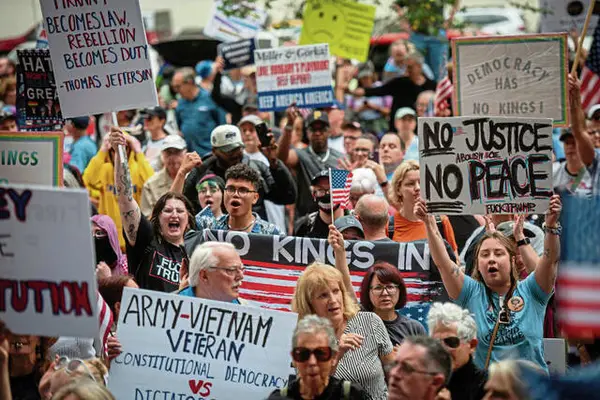
After Trump returned to the White House early this year, the Democrats’ often scattered response to the president’s flurry of executive actions also exposed divisions between the party’s moderate and progressive wings, political observers said.
By July, just 34% of Americans had a favorable opinion of Democrats, the lowest share since Gallup began measuring Americans’ impressions of the nation’s two major political parties in 1992.
Republicans weren’t much more popular. They had a favorability rating of just 38% in the July survey, down 6 points from the day after the 2024 election eight months earlier, according to Gallup.
As for the Democrats’ drubbing in 2024, Mikus said, “A lot of it had to do with the same problems Republicans are facing right now. Americans were upset with the state of the economy, inflation was too high, and Democrats were telling them that things weren’t as bad as they thought. Democrats seemed out of touch.”
“It’s the same with Republicans now. They told people that the affordability crisis was a hoax.”
That helped propel Democrats to a strong showing in November’s elections, said Pennsylvania Democratic Chairman Eugene DePasquale, a former state representative and state auditor general from Pittsburgh’s Uptown.
Pennsylvanians voted to retain three Democratic justices on the state Supreme Court, a Democratic Superior Court judge and a Democratic Commonwealth Court judge. Democrats also won contested races for Superior and Commonwealth courts.
In Allegheny County, local candidates running only as Republicans won just 15 municipal races. In Westmoreland County, where registered Republicans outnumber Democrats by nearly 44,000, the three Democratic Supreme Court justices were retained with about 53% of the vote.
Outside of Pennsylvania, moderate Democrats Mikie Sherrill and Abigail Spanberger won gubernatorial races in New Jersey and Virginia, respectively, while Democratic socialists Zohran Mamdani and Katie Wilson won respective mayoral races in New York City and Seattle.
‘Fusion’ politics
If Democrats want to build on that momentum in this year’s midterm elections and beyond, political observers say, they will need to build coalitions within their party and deliver a clear message that resonates with voters.
That presents challenges.
“Democrats have always been a collection of different identity groups and interests,” Dagnes said.
“That makes it more challenging to create a cohesive message for the party as a whole,” added Jennie Sweet-Cushman, a political science professor at Chatham University in Shadyside.
Democrats need to focus on economic issues that people are most likely to discuss around their kitchen tables, Mikus said.
“The only way we blow it is if we divert our attention away from the kitchen-table issues that matter the most and have the biggest impact on the daily lives of the average voter,” he said. “Are groceries affordable? Can I afford housing? Can I afford health care?
“When you’re not talking about the issues that voters are most concerned about, they’re going to feel disregarded, and you’re going to have problems.”
Chris Borick, a political science professor at Muhlenberg College and director of its Institute of Public Opinion, said he thinks Democrats need to look to create what he calls a “fusion.”
“Clearly within the party there’s a difference between the Josh Shapiros and the Mamdanis of the world,” Borick said, referring to voters in the mold of Pennsylvania’s governor, widely regarded as a moderate Democrat, and the far-left Democratic socialist Mamdani.
“Democrats can tap into some issues where there is alignment — affordability, the cost of living, combating the power of elite interests,” Borick said. “If they can find enough common ground on a handful of key points and fuse them together in a way that allows them to have some commonality among the different groups within the party, that could become their brand and that can sell.”
Put another way: “Democrats are going to have to wrangle all these cats in a way that’s beneficial to them,” Dagnes said. “Authenticity will be the coin of the realm.”
It’s unclear who the face of the national party will be going forward.
The Hill, a political news organization based in Washington, has begun ranking the field of Democratic hopefuls for the 2028 presidential race.
The nine people it identified: California Gov. Gavin Newsom, 58; U.S. Rep. Alexandria Ocasio-Cortez of New York, 36; former Vice President Kamala Harris of California, 61; Pennsylvania’s Shapiro, 52; Kentucky Gov. Andy Beshear, 48; Illinois Gov. JB Pritzker, 60; former Transportation Secretary Pete Buttigieg, 43; Michigan Gov. Gretchen Whitmer, 54; and U.S. Sen. Cory Booker of New Jersey, 56.
DePasquale, who took the helm of the Pennsylvania Democratic Party in September, echoed that sentiment in an October interview with TribLive.
“We’ve got to focus in on where we have 80% agreement on the issues. We’ve got to get back to understanding that if somebody agrees with us on all these core economic issues and some of the social issues, but maybe not all, that makes them a friend and an ally, not an enemy,” DePasquale said, paraphrasing a principle espoused by former Republican President Ronald Reagan.
In an interview last week, DePasquale said he embraces the diversity of viewpoints within the Democratic Party.
“I’d rather have a bigger tent with a broad coalition. That way you can govern in the best way for the region, the state and the nation,” he said. “My approach is never to go in and try to order people around and tell them what to do or how to think.
“You need to listen and try to convince them that it’s the right path.”