
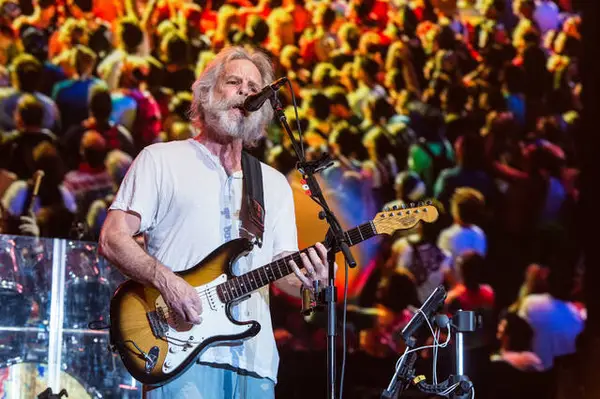
I was outside taking a set break during a gig with my band Saturday night, when several members of the group saw the same news on their phones — longtime Grateful Dead, RatDog and Dead & Co. rhythm guitarist and singer Bob Weir had died at the age of 78.
Obviously, we had to change the song list and kick off our late set with two of Weir’s classic Dead show staples, “Beat It On Down the Line” and their cover of Johnny Cash’s “BigRiver.” Every member of our band has been a Dead fan for decades.
Of the Grateful Dead’s original founding members, only drummer Bill Kreutzmann remains. His fellow Dead drummer Mickey Hart is alive and well, but he started playing in the band a couple years after they formed in 1965.
I taught myself how to play guitar in large part because I really liked the weird rhythmic guitar style of Dave Matthews. The oddly syncopated style of Bob Weir was a similar draw.
In a way, Weir had no choice but to create his own brand of rhythm guitar — he had to find a way to complement the loping, never-ending exploratory lead guitar lines of Jerry Garcia, the Grateful Dead’s co-founder. He did it by finding natural pockets in Garcia’s leads, where he could stab, jab and punctuate the music with an endless variety of chord inversions. Their musical partnership dates to 1963, when Weir was just 16.
Rhythm guitar can be a thankless role. It’s one of those things that, when it’s done right, a casual listener doesn’t notice. Bob Weir could do that, but he could also find his piece in the Dead’s jam-band puzzle, helping the band to lock in and push songs in various sonic directions.
But his other big strength was the songwriting partnership he developed with lyricist John Perry Barlow. In the same way that Garcia partnered with lyricist Robert Hunter, Weir and Barlow combined their talents to create a lot of what I would call miniature song suites. A lot of his songs are the sort of heavily arranged material that people don’t always associate with the Dead.
And let me tell you: Bob Weir loved all the chords. For someone like myself who’s steeped in the relatively simple chord progressions of bluegrass, trying to learn Weir tunes can be a downright nightmare — and I mean that as a compliment.
Here are a few of his best contributions to the Dead’s canon. (But don’t stop there. He has whole catalogs with his other bands, like RatDog and Wolf Bros.)
‘Black Throated Wind’
This song doesn’t get nearly enough run in the Dead’s live catalog, in my opinion. It gets a lot of play in the early 1970s, and then goes away for quite a while. The spacey guitar and some nice bar-band blues piano pairs nicely with Weir’s story of wandering, lost love and ultimately coming back home.
The chorus also illustrates another of Weir’s weirder tendencies. He loves oddly metered song structures, or skipping the last beat of a measure here and there. This version is from a 1972 concert in Veneta, Ore.
‘Sugar Magnolia’
One of the Grateful Dead’s true talents was to weave together big long strings of songs in their late sets, creating moments not just of jammy improvisation, but bringing the tempos, dynamics and energy up, down and back up, emerging from a dark, quiet moment into a joyful rocker. And no rocker was more joyful than “Sugar Magnolia,” a declaration of love that includes a cuckoo bird, a Willys Jeep and a key change.
Later in its life — and in this 1976 version from Passaic, N.J. — it also got what became known as the “Sunshine Daydream” coda, which cranked the energy even higher.
‘Greatest Story Ever Told’
This is another song that didn’t show up nearly enough in the Dead’s setlists over the decades. Is it a Bible story? Kind of. Does it also start with the line, “Moses come riding up on a quasar,” as Jerry Garcia lights up Pittsburgh’s former Stanley Theater (now the Benedum Center) with wah-wah guitar in 1979? Yes it does. It’s a mainstay during the band’s 1972 and ‘73 tours, and it’s a great example of the Dead taking some of the classic ’50s rock ’n’ roll they grew up on and putting their own psychedelic spin on it.
On a side note, this Nov. 30 and Dec. 1, 1979, run at the Stanley is worth listening to in its entirety, via the great website Archive.org. Both nights showcase the wide range of the band’s sound palette, there’s barely any repeat tunes, and both contain some killer jams including a “Dancing in the Streets” that goes completely bonkers.
‘The Other One’
Speaking of psychedelic, there are about 75 words in “The Other One.” That’s barely a four-sentence email. And yet many of its performances, including this one from a 1972 English music festival, could stretch out beyond a half-hour.
In between waves of cascading blues-guitar triplets, Weir sings, “The bus come by and I got on” — a reference to the infamous bus “Furthur” driven by Beat-era legend Neal Cassady and owned by Ken Kesey, whose Merry Pranksters pioneered LSD use at his Acid Tests (where the nascent Dead were the house band).
“The Other One” was an early vehicle for the Grateful Dead’s exploratory jams, stretching and bending a very simple riff into various shapes and genres, from raging rock to pulsing free jazz and dissonant runs of distorted bass and guitar that feel like the song is drifting into the darkness of outer space.
‘Weather Report Suite’
This two-song medley encapsulates everything great about Bob Weir’s musical legacy. It starts with what can only be described as a little bit of classical music with beautiful interplay between Weir, bassist Phil Lesh and keyboard player Keith Godchaux, before melting into a lovely romantic ballad accented with some rare slide guitar by Jerry Garcia.
As it transitions, it gains energy and becomes a full, driving rock song with several jam-heavy instrumental bridges. It’s got a million chords, weird timing and a deep emotional heart in its lyrics.