
Like his domestic policy that seeks to roll back the civil rights revolution and other 21st-century advances, President Donald Trump’s imperialist foreign policy is invoking the kind of unilateral approach that marked an earlier era.
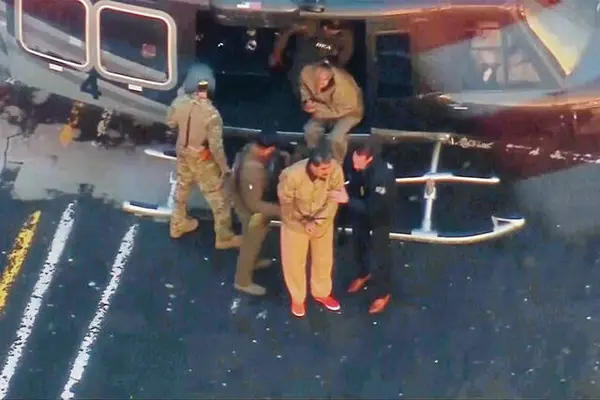
That’s the bottom line on the capture of Venezuelan President Nicolas Maduro, and his threats to take similar action against other unfriendly Western Hemisphere countries like Colombia and Cuba — and even Greenland.
Trump calls it the “Donroe Doctrine,” a muscular revision of the 1823 Monroe Doctrine by which the United States asserted its authority over the Western Hemisphere. Noting how past presidents intervened militarily within the region, perhaps it should be subtitled “Gunboat Diplomacy — on steroids.”
Along with such moves as last year’s bombing of Iran’s nuclear sites, it reflects Trump’s authoritarian approach to the presidency and shows what he meant when he vowed to abandon the multilateral approach of recent presidents to adopt a unilateral “America First” policy.
It includes not only ignoring any constitutional role for Congress in approving use of American troops abroad but goes beyond the practice of other recent presidents by not even trying to inform key lawmakers in advance of pending action.
And it marks a sharp reversal from Trump’s campaign vows to avoid the kinds of foreign entanglements and nation-building that he said detracted from the need to concentrate on the nation’s domestic problems, ironically — but maybe not coincidentally — at a time he faces mounting pressures to ease those concerns.
Democratic lawmakers said administration officials lied by telling them recently they had no plans to overthrow Maduro. But most Republicans once more stood dutifully in line behind Trump’s dramatic middle-of-the-night foray into Venezuela.
However, a few GOP “MAGA purists” — like Georgia Rep. Marjorie Taylor Greene and Kentucky Rep. Thomas Massie — cited the discrepancy with the president’s campaign promises.
“This is the same Washington playbook that we are sick and tired of that doesn’t serve the American people but actually serves the big corporations, the banks and the oil executives,” the increasingly outspoken Greene said on NBC’s Meet the Press. She said Americans voted in 2024 to stop the government’s focus abroad and make “domestic policy be the priority that helps Americans.”
She also noted that only a small proportion of the drugs entering the United States from the South are coming from Venezuela. “The majority of American fentanyl overdoses and deaths come from Mexico,” she said.
Meanwhile, Trump and other top administration officials are suggesting they may be just getting started in seeking to rid the Western Hemisphere of “unfriendly” nations in line with the policy recently enunciated in what they called the Trump corollary to the Monroe Doctrine.
At the news conference celebrating the operation that captured Maduro, Trump singled out Colombia’s President Gustavo Petro for sending drugs to the United States along with Venezuela. But he indicated potential U.S. action is not totally about drugs.
“He (Petro) has cocaine mills, he has factories where he makes cocaine,” Trump said. “They’re sending it to the United States, so he better watch his ass.”
He issued a more veiled warning to Cuba, declaring: “Cuba is going to be something we’ll end up talking about, because Cuba is a failing nation right now, a very badly failing nation, and we want to help the people.”
Secretary of State Marco Rubio echoed Trump’s words, declaring, “If I lived in Havana and I was in the government, I’d be concerned.”
Asked about those comments later on “Meet the Press,” he said, “I’m not going to talk to you about what our future steps are going to be.” But he said, “I don’t think it’s any mystery that we are not big fans of the Cuban regime.”
Trump parried a question whether future targets might include Mexico’s president, given that most drug traffic to the United States comes through Mexico. “That was not the intention,” he said, noting “we are very good friends” with Mexican President Claudia Sheinbaum.
“She’s a good woman, but the cartels control Mexico,” he said. “She doesn’t control Mexico.”
Meanwhile, Trump and his top aides continue to talk of the need to annex Greenland — which is owned by Denmark — for vague national security reasons. “Nobody’s going to fight the U.S. over the future of Greenland,” deputy White House chief of staff Stephen Miller said on CNN.
Those kinds of comments prompted Europe’s top leaders to issue a stern statement reiterating that any decision about Greenland’s future “is for Denmark and Greenland, and them only, to decide.”
Beyond any future U.S. actions, a prominent analyst noted that Trump’s legitimization of moves against unfriendly Western Hemisphere leaders could have broader implications by encouraging similar moves by other autocratic world leaders in regions they consider their spheres of influence.
Speaking on CNN, New York Times Washington correspondent David Sanger said it could enable Russian leader Vladimir Putin to justify similar action against Ukraine’s Volodymyr Zelenskyy or China’s Xi Jinping to do so against the leaders of Taiwan.
Meanwhile, the Trump administration may have its hands full in dealing with the situation in Venezuela. Maduro’s top lieutenants seem so far to still be in control, suggesting Trump may need to employ more “gunboats” to enforce his confident but premature words that “we’re in charge” there.
Carl P. Leubsdorf is the former Washington bureau chief of the Dallas Morning News.