
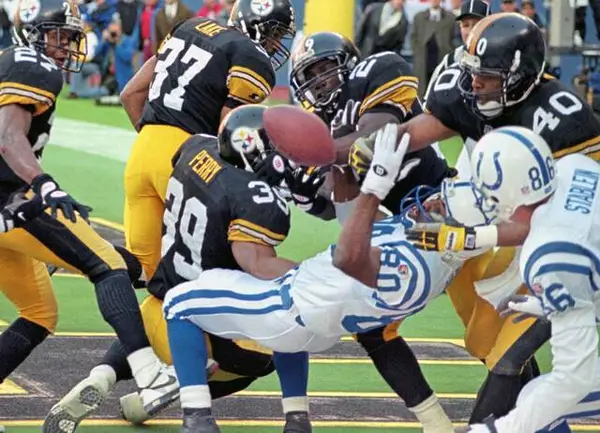
How much can happen in 6.28 seconds?
That’s about as long as it takes to get to “…dawn’s early light” in the Star Spangled Banner.
Unless you are talking really fast, you can get to “…for which it stands” in the Pledge of Allegiance, and the letter “I” in the alphabet.
Or “…blessed is the fruit of thy…” in a Hail Mary.
An actual Hail Mary.
On Jan. 14, 1996, a football floated in the winter air at Pittsburgh’s Three Rivers Stadium for about 6.28 seconds before it bounced off the cold turf of the end zone and was ruled incomplete.
In that time, legacies hung in the balance, careers were about to be defined, and residents of two different cities felt like years were rapidly coming off their lives.
Thirty years ago, the Pittsburgh Steelers beat the Indianapolis Colts, 20-16, in the AFC Championship game to advance to the franchise’s first Super Bowl in 15 years.
But not before Jim Harbaugh’s game-ending Hail Mary attempt nearly changed that outcome.
30 years ago today pic.twitter.com/XCt8bkPxN1
— Steel City Star (@steelcitystar) January 14, 2026
For the 30th anniversary of “Harbaugh’s Heave,” we hear the memories from some of those who were instrumental in scripting one of the most famous plays in Steelers history.
__________________________
Redemption quest
It had been 364 days, but the wounds were still as fresh as if they had been suffered just a week earlier.
The Pittsburgh Steelers lost the 1994-95 AFC Championship game in stunning upset fashion to the underdog San Diego Chargers on Jan. 15, 1995.
Despite three years of regular-season success under new head coach Bill Cowher, the Steelers were just 1-3 in the playoffs under him.
In 1995, the Steelers’ quest to rebound from that bitter disappointment of the ‘94 title game got off to a rocky start. They began the year 3-4, and lost Pro Bowl cornerback Rod Woodson to a knee injury in Week 1.
“Rod was the glue of the secondary,” fellow corner Willie Williams said. “Rod was on a different level. When he went down, it seemed like the morale of the team went down a little. We had to pick up the pieces and move forward.”
After stabilizing their season with a 24-7 Week 9 win over Jacksonville, the Steelers went on to win the next seven games and finished the campaign at 11-5 with an AFC Central title.
The season featured a more open and effective passing game under quarterback Neil O’Donnell. It jumped from 23rd in the league (2,964 yards) in 1994 to eighth (4,405 yards).
“We still ran the ball with Bam (Morris) and (Erric) Pegram. It was more like our two-minute offense. We got a lot of production the last 10 or 11 games from our two-minute offense,” receiver Ernie Mills said. “We tried in training camp and early season to incorporate a lot of five receivers. Then, when we found out Kordell (Stewart) could catch and do some other things in the backfield, and he became ‘Slash.’”
Cowher’s team continued that momentum through the first round of the playoffs by beating the Buffalo Bills in Pittsburgh, 40-21, with 409 yards of offense.
Meanwhile, the Indianapolis Colts qualified for the AFC playoff bracket as a wild card at 9-7 thanks to multiple big comebacks from quarterback Jim Harbaugh. They won at San Diego in Round 1, and shocked the top-seeded Chiefs (13-3) in Kansas City, 10-7, in the divisional round.
In his book “Heart and Steel,” Cowher wrote, “If (the Colts) could beat them, they could beat us.”
__________________________
‘Not again!’
The script was all too familiar for the Steelers. For the players, the coaches and the fans.
The Steelers were an 11-point favorite against a plucky underdog with a gutty, journeyman QB that seemed to be on a once-in-a-lifetime destiny ride that was flirting with the city’s first Super Bowl trip.
The Steelers were still trying to shed their close-but-no-cigar, playoff underachiever label.
“I wanted to be sure everyone in our building gave the Colts the respect — and study — that they deserved,” Cowher wrote. “I was committed to learning from the heartbreak of the ‘94 AFC Championship game.”
Unfortunately for Cowher and his players, the ‘95 game script was playing out the same way, with the Colts staying within shouting distance the same way the Chargers did. It was a 13-10 lead against San Diego after three quarters, 13-9 against the Colts.
Much like against the Chargers when Stan Humphries hit Tony Martin on a deep pass for the eventual game-winning score, the Steelers allowed a 47-yard deep shot from Harbaugh to Floyd Turner to take a 16-10 advantage with just under nine minutes to go.
“We were in a fire zone. That was a problem route. They schemed us. I remember coming over to the sideline, asking (defensive coordinator Dick) LeBeau, ‘How am I supposed to get over to the deep corner route from the center of the field?’” safety Darren Perry said. “It was something we hadn’t seen before. I was the last guy running over there. And I’m like, ‘Where is our corner at?’ That was an earned throw and catch.”
Perry said that specific play forced the Steelers to change some of their fire zone adjustments moving forward.
Indianapolis had a chance to sew up the game and send the Steelers to an ignominious defeat for a second year in a row.
“In your mind, you are thinking, ‘Not again.’ This can’t happen two years in a row,” Woodson said. “We’ve got, arguably, the best team in the National Football League, and we can’t get to the Super Bowl?”
On a third-and-1 with less than four minutes to go, running back Lamont Warren had an entire side of the field to exploit on a handoff. It looked like he could’ve run all the way out to the parking lots.
But cornerback Willie Williams made a game-saving ankle tackle to trip up Warren for no gain, forcing a punt.
“We didn’t run the defense the right way,” defensive coordinator Dick LeBeau said. “If Willie had not made that play, Warren may still be running right now.”
If it wasn’t to be a touchdown, at the very least, the Colts would’ve been able to grind more clock and try a field goal to boost the lead to six points.
“I didn’t know it was a big play until we watched the film. He could’ve ran and hit his head on the goal post,” Williams said. “There was some confusion going on. They checked the blitz to my side. Fortunately, I made the tackle. It was wide open on that backside.”
__________________________
80 Semi Go
The Steelers got the ball back and began one of the most fondly remembered drives in Three Rivers Stadium history at their own 33 with 3:03 left.
It was nearly truncated a few snaps into the possession when linebacker Quentin Coryatt dropped what may have been a pick-6, thanks to Mills (a former college cornerback at Florida) getting just enough of a hand on the ball to help knock it away.
“I just saw him jump the route and drive on the slant. I knew he was going to try to intercept it,” Mills said. “I just tried to get my hand in, and my old DB skills knocked it out.”
Again, the parallels of football irony emerged when the Steelers faced a fourth-and-3 before the two-minute warning. That’s the exact down-and-distance the Steelers failed to convert on their last offensive snap in the red zone in ‘94 to end the game in failure against the Chargers.
But this time O’Donnell found Andre Hastings for a first down.
“It was just a matter of Neil finding an open guy,” Mills said. “Great catch. Big play. And it got us right to the two-minute (warning).”
After the conversion and the two-minute warning, offensive coordinator Ron Erhardt wanted to stagger the Colts and get a chunk. So he dialed up what Mills called “80 Semi Go.”
O’Donnell threw a well-placed pass down the sideline, and Mills did a masterful job securing the ball while dragging his feet to convert the first down at Indy’s 1-yard line with 1:38 seconds left.
“We work on those catches a lot. We work on the sideline. That was part of drills with (receivers coach) Chan Gailey,” Mills said. “Running over there, I knew where the ball was taking me. I knew I was getting close to the sidelines. I had to let (my legs) die and drag them as quick as I could.”
Road to the Super Bowl: 1995 Steelers
NFL Films pic.twitter.com/PEdBjIgkEN
— Steel City Star (@steelcitystar) May 29, 2025
Two plays later, Bam Morris scored to give Pittsburgh a 20-16 edge with exactly 90 seconds to go.
__________________________
How many times do you want us to score?
The improvisational, comeback-prone Harbaugh was unfazed by the time and situation.
“We were living the dream,” Harbaugh said via an NFL Films documentary on the game. “Two minutes? How many times do you need us to score? Once? Twice? Are we down 10? Let’s make this a challenge.”
The phrase “Ball Don’t Lie” wasn’t exactly common back in 1995, but the Colts’ ensuing drive was full of those types of moments.
Just like Coryatt, Pittsburgh defensive back Chris Oldham — a player who some teammates said had the best hands in the secondary — dropped a sure interception.
“That’s when you start worrying about fate,” Cowher said.
Then, like O’Donnell, Harbaugh completed a fourth-down throw to Sean Dawkins in front of Oldham to move the chains with 28 seconds left.
After a 9-yard scramble and a spiked ball, Indianapolis’ offense found itself at Pittsburgh’s 29-yard line needing a touchdown to win on the last snap with only 5 seconds remaining.
Down by four, the next throw had to get to the end zone.
“I thought, ‘Oh my goodness. Here we go again. It was very scary,” Hall of Fame center Demontti Dawson said.
__________________________
‘Catfight’
When you think of famous Hail Mary passes, most of them aren’t snapped from inside the opponents’ 30.
Most of Aaron Rodgers’ famous attempts were snapped from 15-20 yards deeper than that, and tossed from the other side of the 50. Roger Staubach’s famous version in 1975 was gunned from his own 41-yard line.
But Harbaugh knew what he was doing. This Hail Mary had to be released fast enough to avoid Pittsburgh’s rush, but high enough so his three receivers — Turner, Aaron Bailey and Brian Stablein — could post up in the right side of the end zone.
Stablein was the tallest of the bunch at 6-foot-1. Bailey and Turner were both under 6 feet.
“Each guy has a responsibility,” Harbaugh said in the documentary. “Aaron Bailey is going to go up. He is the middle guy. He is the guy I am trying to throw the ball to.”
With linebackers Chad Brown and Kevin Greene bearing down on him, Harbaugh drifted back to the 40 and arced a moonball toward the end zone. It flew out of Harbaugh’s hand from the left hash of his own 40-yard line with 2 seconds left.
As the ball began its descent, Williams, Perry and Myron Bell converged around Bailey. Stablein and Turner set up outside of the pack of defensive backs in case a tipped ball bounded away from the hive of humanity.
Pro Bowl cornerback Carnell Lake was slightly in front of the fray and jumped in an attempt to swat the ball down, but missed it.
Perry was posted up in front of Bailey, and Bell was behind him. Bailey pulled down on Perry’s right arm.
“You’ve got a jumper, a front tip guy and a back tip guy. I’m supposed to be the jumper,” Perry said. “I said ‘Oh (expletive)!’ That was the longest play I’ve ever been associated with. You know you are supposed to be the jumper — and you’re not up there.”
Using that leverage and clear path to reach for the ball, Bailey went up to catch it. Bell went over his back and tried to bat the ball down, but ended up directing it toward Bailey’s chest as he began to fall to the turf.
__________________________
Enter Randy Fuller
A lifelong Steelers fan growing up in Georgia, defensive back Randy Fuller only joined the Steelers after Woodson injured his knee. He started on special teams but got more reps on defense as the season went along.
His job on the play was to cover the back side away from where the ball was eventually thrown. Once the ball was released, Fuller raced over from his responsibility to lend support.
“Most guys wouldn’t have gotten in that play from my position,” Fuller said. “I truly used my Georgia state long jumping skills to go and jump. I don’t know how far I leaped to get in that play, but it’s like I ran and hit the board, and I (sprang) into the air.
With full momentum from his sprint, Fuller went airborne and careened through bodies. As he did so, he jarred the ball free from Bailey as he tried to secure it following Bell’s tip.
Fuller and Bailey battled for the wobbling ball as gravity pulled them toward the NFL logo in the end zone.
“I remember feeling the ball. I’m thinking, ‘I have an interception!’ Then I feel it going away from me, and I just start raking,” Fuller said. “We just started having a catfight. Raking, doing anything I could.”
For a moment, the ball was resting on Bailey’s midsection with his arms and legs open. As he tried to close himself around the ball, Fuller fell on Bailey, preventing him from being able to wrap himself around it cleanly, resulting in Bailey trapping the ball.
“I remember having visual contact of the ball. It rolled off his body. I see it hit the turf. I see him grab it back up. I’m just hoping the ref saw what I saw,” Fuller continued.
Bailey jumped up with the ball in his hands. He and his other two receivers celebrated, thinking they were going to the Super Bowl.
“I thought, ‘Oh man…we lost….again,” Dawson sighed.
That’s when back judge Tim Millis emphatically waved it off.
“When he was in the air, and the ball was on his stomach, that took 10 seconds in my mind. It lasted a split second. But it was almost in slow motion,” Millis said to NFL Films. “When he reached for it with his right hand. When he did, it turned him. The tip of the ball hit the ground.”
OTD in 1996
An unforgettable AFC Championship
Here are the most dramatic plays of the last several minutes of the game.
Colts lead 16-13 with 6:30 left pic.twitter.com/vvRETEgxwE
— Steel City Star (@steelcitystar) January 14, 2024
Millis dropped to one knee and repeatedly smacked the turf in the end zone to indicate that the pass was incomplete. The Steelers were AFC champions for the first time in 15 years.
“If I make the wrong call, the wrong team goes to the Super Bowl,” Millis said.
__________________________
‘I wanted to pause time’
Upon review, Fuller probably broke up that pass three different times. Some of the initial broadcasts and print reports credited Bell for the breakup. It wasn’t until well after the first wave of locker room interviews that Fuller said word trickled out that he was the last guy to end up knocking it free from Bailey.
“I don’t go around telling people I played professional football a whole lot. But, when it comes up…,” Fuller paused for a slight chuckle. “I do tell the story that I am famous for one play. Once I remind them, they always remember that play. And they say, ‘That was you?’”
Harbaugh was captured on camera with a glazed expression, shaking hands with Steelers players and saying to anyone within earshot, “He caught the ball. I thought he caught it.”
Harbaugh stopped in the end zone with a crowd of reporters around him and watched the Jumbotron replays. Only by the third replay angle could Harbaugh see the ball roll off Bailey and onto the ground.
In his book, Cowher said at that moment of celebration, he wanted to “pause time” after the anguish of 1994, and after a lifetime of NFL shortcomings had prevented him from getting to a Super Bowl.
It was an ironic turn of phrase, given how time had paused with the ball in the air on what could’ve been an even more painful defeat.
Two weeks later in Arizona, there would be a few more moments that Cowher would’ve liked to pause — and erase — against the Cowboys in Super Bowl XXX.
But for one afternoon, the AFC playoff curse that had hung over the Steelers for a decade and a half had finally lifted.