

Bloomfield-Garfield Corp., a Pittsburgh-based affordable housing advocate, pays the city more than $50,000 in property and wage taxes each year.
But it was a much more modest bill from the city that sent its executive director, Rick Swartz, over the edge.
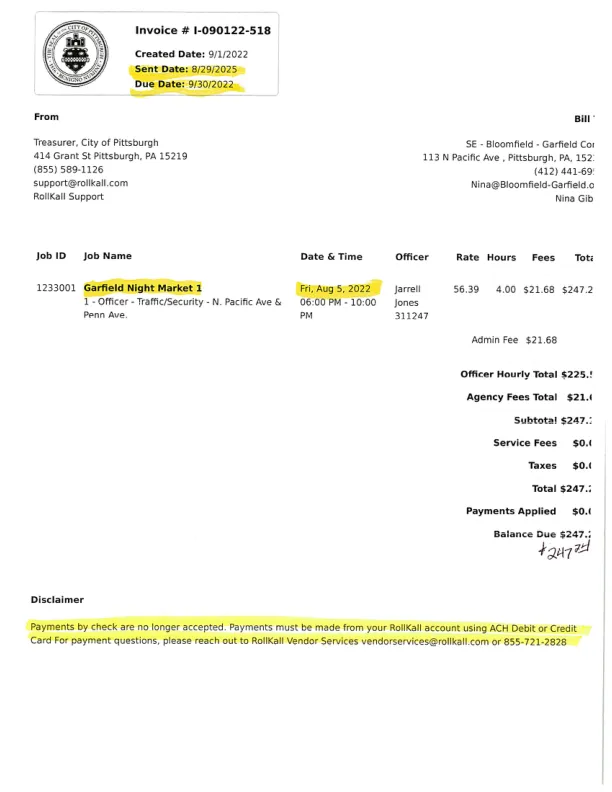
The $247.24 invoice arrived in October — three years late — for a single shift worked by a moonlighting police officer in August 2022.
For Bloomfield-Garfield Corp., the fallout was more serious than merely getting a surprise bill. Pittsburgh police said the outstanding balance prompted it to bar off-duty officers from providing security and traffic control for the group until the invoice is paid.
Swartz’s experience was hardly unique. His organization was one of 56 companies banned by the city on Jan. 1 from being able to hire off-duty city police officers because of outstanding bills.
These groups told TribLive about a range of problems with the city — including billing delays, recordkeeping glitches and poor communication — that have become the hallmark of Pittsburgh’s police moonlighting system, as detailed in a TribLive investigation last month.
“It’s really bordering on being ridiculous,” Swartz, who recently paid the bill online, told TribLive.
The banned groups ranged from major businesses and utilities such as UPMC, Whole Foods, Target and Pennsylvania American Water Co. to nonprofits like Bloomfield-Garfield and Pittsburgh Downtown Partnership.
The list included the Community College of Allegheny County’s North Side campus and the Pittsburgh Passion women’s football team.
It was unclear this week how many businesses remained on the banned list. Emily Bourne, a police spokeswoman, told TribLive she had “no update” on the program.
The TribLive investigation turned up city records showing hundreds of businesses and organizations — from a strip club to a soup kitchen, from restaurants to bars, from Duquesne Light to the Catholic Diocese of Pittsburgh — enjoyed years of police services and millions of dollars of work without paying a cent under Ed Gainey, the former mayor.
But interviews with groups on the blacklist reveal that in some, if not many, cases, the lack of payments related to invoicing problems in the police bureau’s secondary employment program rather than any failure on their part.
“Ed Gainey, I have a lot of respect for him, I do. On the whole, he’s been a great advocate for the city,” Swartz said.
“But under him these last four years,” he added, “the wheels of government have really come off.”
Businesses voice frustration
Officers eligible to work secondary employment are hired by the private sector for off-duty jobs in security and traffic control.
They are paid a premium rate. When the program works as intended, the police bureau is supposed to invoice the groups doing the hiring. The groups send the city the officers’ wages plus an administrative fee, and the wages are then routed to the police officers.
In the Bloomfield-Garfield case, for instance, the group hired an officer to staff the Garfield Night Market on Aug. 5, 2022, from 6 p.m. to 10 p.m. The officer earned $56.39 per hour.
Under the Gainey administration, the payment system faltered.
More than a half-dozen of the barred groups described receiving surprise charges, invoices that went to former employees, bills they said did not correspond to any work and other paperwork problems.
Shoddy recordkeeping by the city continues to obscure if — or how much — entities owe Pittsburgh. And that is only one of several problems vexing the broken program, according to businesses who voiced frustration to TribLive over the nitty-gritty of the program.
City officials have stepped up efforts to remedy the botched invoicing, which accounted for around $3 million in unpaid bills at its Gainey-era peak.
Among the fixes was handing collections over to RollKall, a company with proprietary software officers use for scheduling off-duty work.
The ban is “part of a continuing effort on behalf of the police bureau and public safety department to bring these accounts into a current state,” Bourne, the police spokeswoman, told TribLive.
‘We didn’t even know’
A city registry of businesses that owe money for moonlighting services lists a strip club as the top deadbeat. Cheerleaders Gentlemen’s Club on Liberty Avenue owed $105,406.79, near the end of last year, the records show.
Some of its 21 unpaid bills go back to details worked in 2022.
Management at the strip club has not responded to multiple phone calls, emails or in-person visits to their establishment seeking comment.
Far smaller debts landed others on the list.
“It was over $75 — that’s insane — and we didn’t even know about it,” said Teresa Conn, owner of the Pittsburgh Passion women’s football team.
Conn said Pittsburgh Passion paid its bill in August, though she wasn’t certain why she was billed in the first place.
The team hasn’t used moonlighting officers for years, Conn said. Though it previously played at Pittsburgh venues such as Highmark Stadium, the squad has played its home games at Slippery Rock University since 2023.
Conn said this is not the first time the Passion has experienced billing headaches with the City of Pittsburgh. Several years ago, she said she paid a $150 city invoice but wasn’t sure what work it even referenced.
“It wasn’t worth fighting about and arguing about,” Conn said.
City officials mailed Pittsburgh Water & Sewer Co., now Pittsburgh Water, bills for its off-duty police details to someone who no longer worked there, according to the utility.
The city did not send any printed invoices by mail, spokeswoman Julianne Pelusi told TribLive. Pittsburgh Water learned about the balance due only when the city published the list of banned business.
“Once we found out there was a balance, it was promptly paid. It was less than $2,500,” Pelusi added. “We were able to update our contact information with them and anticipate there will be no further issues with invoicing.”
Police also severed off-duty services for Sienna Mercato, a popular restaurant in Downtown Pittsburgh.
Susan Soto, its managing partner, still isn’t sure why.
“I don’t know that we owe them any money — if we do, I’m not aware of it,” Soto said when TribLive informed her in late December about the work ban.
City police could not say how much the restaurant owes.
Sienna Mercato previously hired off-duty officers for security, Soto said. But the Penn Avenue business now has its own security team on payroll.
“I’m totally confused — truly,” Soto added. “We’re not deadbeats.”
Confusion at the cigar club
Local businesses weren’t the only ones baffled by the city’s abrupt decision to cut off moonlighting officers.
BURN by Rocky Patel, a North Shore cigar club owned by a national chain, maintains the city is confused — and confusing — when it comes to its invoicing.
On June 7, 2022, the city billed the Naples, Fla.-based company after officers provided off-duty security there. Pittsburgh maintained BURN didn’t pay the $6,000 bill.
Top officials in the Gainey administration said they did not know when — or if — a follow-up invoice was sent. Neither the city nor BURN would provide TribLive with invoices or any related correspondence.
In the meantime, the city kept sending police officers to BURN — and churning out invoices. By the end of 2023, the club owed more than $28,000, city records show.
The cigar club has paid its tab — “all of it,” Robin Sarro, an accountant for the company, told TribLive in June.
But on Jan. 1, they, too, were cut off from hiring officers.
“Now, they’re coming back and saying, ‘Okay, you have more (money owed),’” said Mike Howe, the company’s director of operations. “It’s, like, ‘C’mon!’”
CCAC, Whole Foods, UPMC
CCAC and Whole Foods both said the city didn’t cash the paper checks they mailed for payment.
They said the city only recently told them about the need to pay online.
“We have been actively working to resolve the outstanding balance,” a Whole Foods Market spokesman told TribLive in a prepared statement. “We have now made full payment using their new electronic payment platform.”
CCAC has been using checks to pay police to provide security at athletic events since at least 2023, spokeswoman Dena Rose Buzila said.
College officials didn’t know recent payments weren’t being processed. City officials couldn’t say if they were, either.
“There was confusion regarding payments, which resulted in unpaid invoices,” Buzila said. “The total amount due and paid in full (was) $3,976.15. We are obviously no longer on that list.”
UPMC was another entity banned from hiring police for side jobs. Allison Hydzik, a spokeswoman for the health care giant, told TribLive in December that “UPMC promptly and fully paid invoices we received in 2023 and 2024.”
“We have not used those services this year (2025) and are not aware of any other invoices,” she added.
Program under discussion
Problems have plagued the secondary employment program for years.
In 2013, Nate Harper, Pittsburgh’s former police chief, pleaded guilty in federal court to charges of conspiracy and willful failure to file income tax returns.
He went to prison for diverting more than $70,000 in moonlighting fees to two slush funds he ran through a police federal credit union.
Harper used almost $32,000 for personal expenses and failed to file federal tax returns between 2008 and 2011.
Efforts to fix the system got underway in the aftermath of the Harper debacle, but issues with secondary employment persisted into the Gainey administration.
Gainey, a one-term mayor, repeatedly declined interview requests from TribLive about the arrears.
As recently as late December, the police bureau continued to turn down requests to interview the former acting police chief, Martin Devine, who has been replaced by Jason Lando.
Mayor Corey O’Connor, who took office last week, said two of his administration’s nominees — Sheldon Williams, tapped for public safety director, and Lando, nominated for police chief — “have talked about it.”
“It has been discussed,” said O’Connor, who served as a councilman from 2012 to 2022. “Because even (when I was) on council, there was an issue there, too.”