
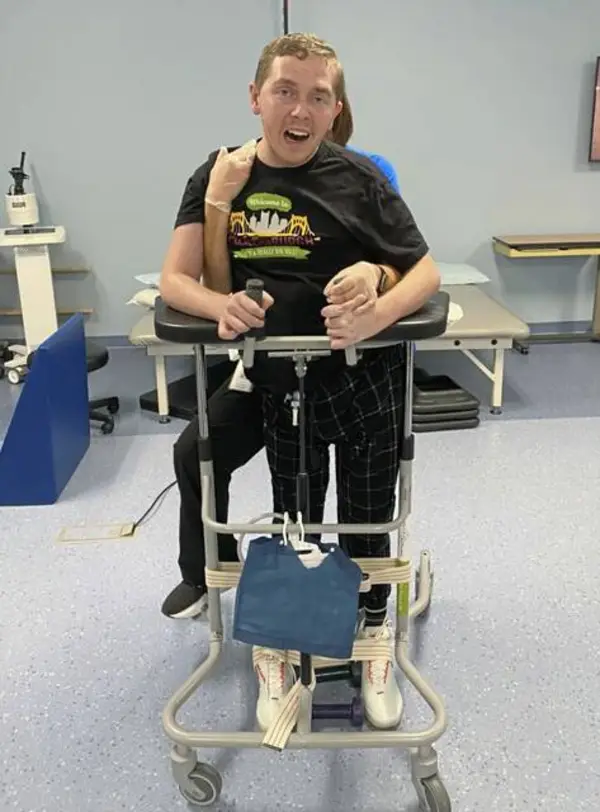
When Gabe Brown woke up from a coma last January at UPMC Mercy hospital, he could do little more than tilt his head and shift his eyes.
The 28-year-old suffered a severe traumatic brain injury nearly four months earlier while on a honeymoon in Jamaica with his wife, Lauren Esper. The slip and fall in the couple’s hotel room left him “as close to death as you can be,” she said.
Improbably, his mental acuity was intact when he regained consciousness.
A year later, his body is catching up.
Brown can stand for minutes at a time with a specialized walker and eat solid food after months of intensive therapy at a long-term care facility in Erie. A degree of independence is within reach.
“He has made so much progress,” said Esper, 26, who also lives in Erie.
Recoveries like these are not as unlikely as patients and doctors seem to believe, and should lead them to think twice before withdrawing life support, University of Pittsburgh researchers argue in a new study.
Experts from Carnegie Mellon University and the University of California, San Francisco also contributed to the paper, which was published Tuesday in the journal Neurosurgery.
They examined outcomes for more than 500 severe traumatic brain injury patients at UPMC Presbyterian Hospital between 2002 and 2018.
Those who had their life support withdrawn died, as expected.
But with continued care, about 38% who needed around-the-clock assistance three months into their recoveries achieved partial independence within two years.
Roughly 25% made the leap from no independence to partial independence between the six-month and two-year marks, and 13% did so one to two years post-injury.
“When patient after patient after patient is having a tremendous recovery from such a dire injury, I become concerned about the patients who were never given the chance to recover,” said Dr. David Okonkwo, director of neurotrauma at UPMC and a senior author of the paper.
Patients across the two groups were matched based on the seriousness of their injury and other characteristics. Because of this, the recovery statistics in the study also serve as projections of how patients who were taken off life support might have fared otherwise.
“It’s a really powerful question to go back and look at the people who underwent withdrawal of life-sustaining therapy and calculate what percentage of them would have returned to independent living,” Okonkwo said.
The findings push back on undue pessimism that can cloud clinical decision-making, according to lead author and Pitt neurosurgery researcher Shawn Eagle.
Neurotrauma patients can be a grisly sight early on, often having part of their skull temporarily removed to relieve pressure.
It’s during these uncertain first few days that decisions about life support are most often made, despite it taking weeks, months or even years to determine the full extent of the damage and possibility for recovery, the researchers say.
The Pitt paper comes less than two years after a study of traumatic brain injury recoveries by Mass General Brigham, supplemented by data from UPMC facilities, reached a similar conclusion.
Eagle sees a “growing consensus” that patients with brain trauma can recover better than once thought.
The road to recovery
Coming back from a severe blow to the head is no easy task.
Patients often need a prolonged stint in an intensive care unit, followed by rehabilitation in a specialized hospital and, finally, extensive outpatient physical, occupational and speech therapy.
The study acknowledges not all patients or families may be up for this.
“Waiting two years to see meaningful improvements in function is likely to put significant financial and psychological stressors on the survivor’s family,” researchers noted. “This amount of time may be too extensive for a family to support, especially given that recovery to at least partial independence still represents a minority of survivors.”
But Eagle warns of the “disability paradox” — where people with disabilities often report a good quality of life, contrary to the expectations of able-bodied people.
“It’s a lot different to be a healthy person and saying the minimum amount you’d tolerate,” Eagle said. “We need to do a better job of understanding how patients and their families see success long term.”
The study makes no attempt to pinpoint which factors may promote stronger recoveries, though Pitt researchers are currently examining the issue.
In Okonkwo’s experience, supporting the body’s natural processes and giving people time to bounce back is crucial.
“I have been amazed in my career such that I never underestimate the power of the human body to heal itself,” he said. “We are incredible creatures.”