
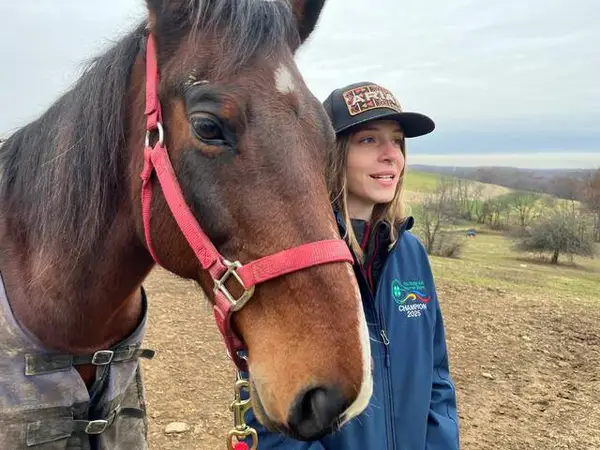
It was her last chance to win a grand champion title before she aged out of the Pennsylvania 4-H Horse Show, and Lilly Sauer had a pretty good feeling she and her horse, Woody, had won first place in the bowtie race.
Even so, hearing the announcer call her name felt “surreal.”
Sauer said even Woody himself seemed to react.
“Even he knew,” she said. “His eyes got real wide.”
From a thin, untrained saddlebred that drew no bids at auction, Woody has come a long way and defied the odds by excelling in timed events that he wasn’t bred for, thanks to his trainer, Sauer — a 19-year-old Pine-Richland graduate and freshman at La Roche University.
Sauer of Richland started horseback riding when she was 10 years old.
Soon she was competing in local barrel races with her friend’s horse and then participating in Allegheny County 4-H. She lacked a horse of her own though, and it seemed like she would never get one.
It was an expense her family couldn’t afford.
“My mom always said, ‘We’re never gonna have a horse. Stop thinking about it,’ ” Sauer said.
That was until Woody “fell into (their) hands,” Sauer said, as a gift from another horse lover, Waynesburg resident Candy Mock.
Mock got Woody in 2016 after a friend of hers rescued him from an auction. Woody was skinny and needed medical attention. Mock had him treated and gelded, but eventually she could tell Woody was bored on her farm.
“I have a beautiful 20-acre farm that he roamed on, but I just didn’t have a whole lot of time to be working with him,” Mock said. “He needed a job. He would kind of pick on other horses because he wanted to play and he needed something to do.”
Though she was sad to do it, Mock gave Woody away to a stable in Gibsonia, hoping he would find a better home there. Pulling into the barn, Mock noticed a “little blonde-haired girl riding a horse,” taking lessons in the 20-degree weather.
A couple weeks later, Mock got a call. That girl was Sauer, and she wanted Woody.
This led to what Mock described as a “two-way gift”: Sauer got a free horse, and Woody got a caring trainer and a job.
Now, Mock enjoys seeing photos and videos of Sauer and Woody and accompanies them to competitions when she can.
“She has just done so much more than I ever even imagined would have been possible,” Mock said. “Lilly really has a talent.”
Sauer knew when she got him that, as a saddlebred horse, Woody wasn’t bred for the timed events she was interested in, such as bowtie and barrel races. For these timed events, equestrians usually use thoroughbred and quarter horses, who are bred for their speed and strength.
Saddlebreds are known for their high-stepping gait, which makes them ideal for saddle seat and dressage. Sauer said this difference proved to be a challenge in training Woody.
“Getting them to manipulate their bodies, you have to get them to get their heads down. It’s how they properly carry themselves. … It’s biochemically the easiest way for them to move, and he’s just not built to do any of that,” she said. “You can especially tell when he trots. He picks his legs up real high as opposed to other horses — they just kind of stride out — and that’s because of his biology.”
Sauer didn’t let this deter her, as she believes “any horse can be a barrel horse.” But Woody’s breed wasn’t the only challenge.
Sauer got Woody in 2021 when he was about 6 or 7 years old, but he had very little training. She found him to be “ornery” and “nippy,” and he would get “worked up” easily. Sometimes he’d even kick her.
“He wouldn’t stand tied anywhere, like if you tried to tie him up, he’d pull back,” she said. “I’d come home covered in bruises. He just beat the crap out of me.”
Even transporting him in his trailer proved difficult — after a four-hour ride to their first state competition, once Woody realized it was time to go back in the trailer to go home, he panicked. It took Sauer three hours to get Woody back into the trailer.
Sauer said her eventual success with Woody came from the amount of time she put in when she first got him and her refusal to give up. When she first started, she trained with him almost every day.
“I didn’t know what I was doing, and he didn’t know what he was doing. I shouldn’t have done it, but I just threw him on the (barrel) pattern and had him figure it out, and then I went back and fixed (his movement) later,” she said.
Sauer said a lot of people start off slow, getting 2- or 3-year-old horses and teaching them special movement skills before applying those skills to the barrel pattern “so that the horse doesn’t get as confused.”
“But I just kind of said, ‘Too bad, you have to figure it out.’ But he did. He did really good with it,” she said. “He was running pretty decent times, I’d say maybe six months after I started him.”
Less than two years after they started training together, Sauer and Woody placed in the top four in a county show and then in a district show, qualifying them for their first state show. There, they placed seventh in both pole bending and cutback racing.
After three more years of hard work and three more trips to the state show, Sauer and Woody won first place in the bowtie race — in which the horse runs in a specific pattern around poles — with a time of 17.011 seconds.
“He ended up winning it by over half a second, which was just insane,” Sauer said. “There was only maybe one or two other people that were in the 17s.”
Now that she’s a freshman studying bioengineering at La Roche, Sauer faces a new challenge in balancing her schoolwork with training and competing with Woody.
“It’s a lot, especially when I have to travel and compete. I barely slept when we were at states trying to do schoolwork,” she said. “But you just got to make it work.”
Sauer said she also owes her success to her supportive family and friends, including Penn Township resident Bryan Felsing, who Sauer described as her “horse dad.”
“It does take a whole village to get to states,” Sauer said. “He’s the person that helped me with Woody’s trailering issues, and he came to states with us this year.”
Felsing said he and his wife and kids first met Sauer through the North Allegheny Horseman’s Association a few years ago and they’ve been friends ever since. Felsing said they were “so proud” to see her win at the state show this year and that “it was emotional for everybody.”
“When she won, it was an awesome feeling,” Felsing said. “She has a true passion for the animals, which is what my wife and I have. So that’s what makes us the most proud.”
Moving forward, Sauer wants to continue competing at her current level with Woody, though she hopes to someday get a quarter horse and compete at a higher level. For now, she’s hoping to take Woody to the National Little Britches Rodeo Association finals in Oklahoma City this summer.