
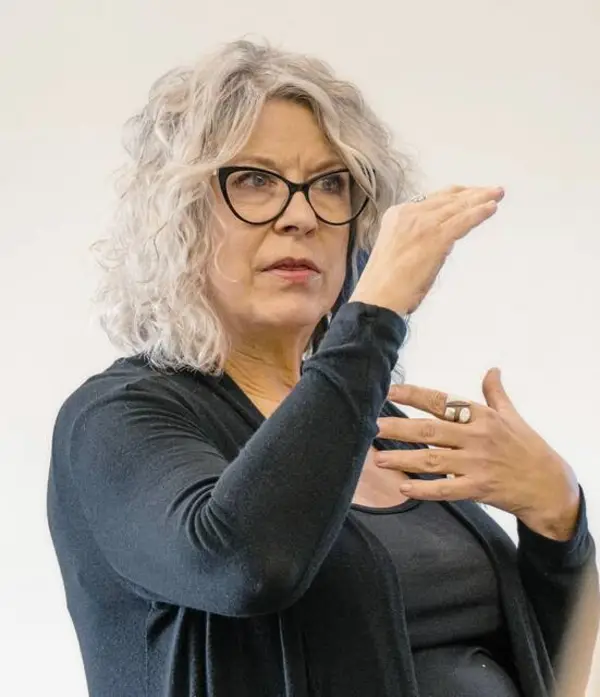
For the most part, students weren’t afraid to have difficult conversations on controversial topics when Gwen Torges started teaching at the Indiana University of Pennsylvania in 1997.
That’s no longer the case.
“There has always been, and will always be, people who say that’s not me, but there were always students who thought a good-natured debate was invigorating and they wanted to hear what other people say,” said Torges, a political science professor at IUP.
Now, “They don’t want to and because they don’t want to, they become unable to,” Torges said. “They think disagreement itself is a bad thing.”
A $2.29 million federal grant awarded to IUP is hoping to change that.
IUP will use the funding from the U.S. Department of Education to create a Center for Dialogue and Civic Life. It will be a physical space on campus staffed by a director and students, Torges said.
“The bold idea is it will change the campus culture toward having difficult conversations and difficult dialogue,” Torges said.
In addition, the University of Pittsburgh was awarded about $2.7 million to develop a university and regionwide model for civil discourse and civic leadership.
Initiatives at Pitt include bringing in visiting faculty to tackle issues, building out a social media platform to incentivize students to navigate differences, and starting a civic discourse network with student and faculty events focused on universities in the region, said Pitt professor Jennifer Brick Murtazashvili.
Across the board in higher education, civil discourse has declined, Murtazashvili said.
“The classroom really should be a sacred space where people can share with and play with ideas, and there should be an understanding that people are going to say things that may hurt people, may upset people sometimes, but it is the job of the students in conversation to one another to explain why,” Murtazashvili said. “We can’t move ideas forward if people are really afraid to engage with difference.”
At IUP, staff will work with the nonprofit and nonpartisan Constructive Dialogue Institute to implement the center, Torges said. IUP will tap into the Constructive Dialogue Institute’s evidence-based dialogue tools, facilitator training, implementation support and other resources.
Both projects are funded for four years. Officials at both universities said the funded projects will help advance work they’ve been doing the past couple of years to improve civic discourse.
By the end of the second year of the program, IUP officials expect the center to be physically established and staffed, and will host at least eight campuswide events annually.
By the end of the fourth year, IUP officials anticipate at least 40 faculty, staff and administrators will complete training in constructive dialogue, a Student Dialogue Fellows program to train at least 40 students who will facilitate at least 100 peer-led dialogue sessions, and at least 1,000 students participating in activities hosted by the center.
“At the end of the day, we want to have students who say, ‘It’s OK. You have a different opinion than I do. Let’s talk about it,’” Torges said.
Carissa Slotterback, dean of Pitt’s School of Public and International Affairs, is encouraged by a fall survey among students that indicated while discussions occur more often “among those with shared beliefs,” Pitt students exhibit “strong listening behaviors and support inclusive discourse.” Pitt plans another survey this spring.
“This kind of evaluation is going to give us a sense of whether we’re able to move the needle, and really, who our students are,” Slotterback said.
Politically, there might not be a better place than Western Pennsylvania for an emphasis on civil discourse. Murtazashvili sees people’s differing views as an asset.
“We are in the most purple part of the country, and we had presidential candidates tripping over one another during the last presidential cycle, because this region is so politically divided in many ways,” Murtazashvili said. “I think that students from the University of Pittsburgh should be able to really navigate that kind of difference.”
Murtazashvili said the goal is to transform Pitt’s culture, making the university a model for navigating intellectual and social differences.
“I think the purpose of university is to seek the truth,” Murtazashvili said. “We’re not here to tell students how to think or to promote agendas, we should be open to answers of questions, regardless of where they take us.
“This is what has made American universities really the gem of the world, is this kind of openness and pluralism. We really want to make sure that those values are enshrined in students who graduate, who participate in our programs.”