
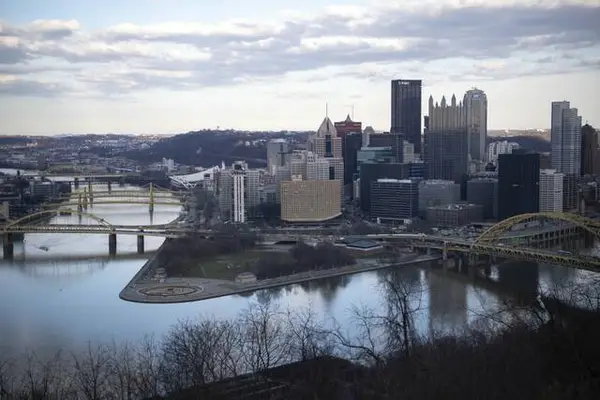
Pittsburgh Urban Redevelopment Authority officials are eyeing a tax diversion as the next step in ongoing efforts to revitalize Downtown in the wake of the covid-19 pandemic.
The authority’s board on Thursday voted to start the process of implementing a Transit Revitalization Investment District, known as a TRID.
The diversion would allow a percentage of new tax revenue from developments Downtown and in part of the North Shore and Strip District to go back into improving Downtown.
That money could help fund transit upgrades, business district projects, economic development initiatives or new housing, said Tom Link, the URA’s chief development officer.
It would not cut into the property taxes already being generated in the area.
“We are excited to present this as a continuation of our work to really revitalize our Downtown to be the most viable place it can possibly be, a bellwether of economic growth for our city and for our region,” Link said.
The city, county and school district will each have to vote on whether to allow their portion of the property tax bills to be diverted to the special district.
After a set period of time, the tax diversion would end and the city, county and school district would collect their full tax bills.
Mayor Corey O’Connor — who has highlighted cleaning up Downtown and fostering economic growth there as among his top priorities — has signaled his support.
“Downtown is the economic heart of our whole region and we need to provide it with resources to make growth happen,” O’Connor said in a statement. “We are serious about hitting the ground running and taking steps that create a strong and inclusive Downtown where there’s opportunities for small businesses, families, housing and redevelopment.”
The authority has not yet finalized details of the tax diversion, like how much money would go to the program or how long it would last.
A public process will precede final votes on the measure. Officials estimated it could take about a year to put the program in place.
Similar to Esplanade district
A $600 million Downtown revitalization effort already is underway. That includes upgrades to Point State Park and Market Square and the creation of a new outdoor civic space called Arts Landing, all of which are set to be completed before the city hosts the 2026 NFL Draft in April.
Another element is converting to affordable housing offices that were left empty after the pandemic popularized remote work.
Pennsylvania Rep. Lindsay Powell, D-Lawrenceville, said she wanted to explore whether some of the money from the proposed tax diversion could be earmarked for the Strip District, which she represents, rather than only Downtown.
“Obviously, if Downtown does well, then all of our neighborhoods, all of Pittsburgh, does well,” Powell said, adding there are “critical needs” in other communities, too. “I just don’t want all of our opportunity and value to go to one portion of this TRID outline.”
The proposed Downtown district will border a similar tax diversion district at the site of the $740 million Esplanade development in the city’s Chateau neighborhood.
Piatt Companies in December broke ground on the 15-acre development, which is set to include a massive Ferris wheel, a condominium complex, a hotel, a mixed-income apartment tower, green space, a marina and a host of other amenities.
The URA on Thursday also announced it will seek bidders to create new lighting installations throughout Downtown and to transform the storefronts under Mellon Square on Smithfield Street into a restaurant with outdoor dining in the park.
Thursday’s meeting marked the first authority board meeting under O’Connor’s administration.
The mayor appointed Director of Redevelopment Yarone Zober, who previously served as former Mayor Luke Ravenstahl’s chief of staff, as board chair. He also added Councilman Bob Charland, D-South Side, to the board.